Recently I was at a meeting organised by a community pharmacist to “remind” myself and other general practice doctors about a scheme available to patients that not only can help patients, but just also happens to be remunerated quite well by Australia’s federal health care system, Medicare. And I mean it pays general practitioners (GPs) well, and it pays pharmacists well. Suddenly another GP in the room asked just why are we being paid extra to do this when as GPs we have little to actually contribute to this patient’s particular health care encounter. The room fell silent. I couldn’t believe that finally someone had said what I had suspected for some time but didn’t have the courage to admit: that in some instances, the government does misspend money allocated for health care. I know, it seems so counterintuitive, so out of place, to suggest this at a time when the Australian government is saying that health care funding is becoming unsustainable, that the need for it has made it such a drain to government funds that it’s become unaffordable to fund alone on public money.
So where are the holes in the bucket with public health care funding? Well, in the interest of open disclosure I will admit that it’s been years since I worked in the public hospital system. I work in private practice, but as most doctors in private practice, still work under Medicare rules and (federal) funding. What I mean by this is, although we work in medical clinics that are privately owned, we receive Medicare money for part or all of the work we do. The choice to accept Medicare funding as the whole payment for services provided (i.e. “bulk-billing”) or only as part of the total fee is each practitioners choice. And the choice is not as simple as “some doctors are greedy and some aren't”.
I’m not a greedy person, but I refuse to accept the inadequately-low fees Medicare offers as payment for most general medical consultations. Let me explain this with a simple everyday example. Seeing a patient for a general medical complaint in a consulting room for 15 minutes costs the medical centre about $65-$71. That is what it’s going to cost to pay the doctor, administration staff, building running costs, etc. Now, Medicare Australia only pays $36.30 for this service. The federal government pays that not because they have calculated that that is what it actually costs for the medical centre to actually fund this consultation. No, this has been a federal budgeting decision that says that that is all the government is willing to pay for this service. It does not take into consideration the medical needs of the patient, the individual patient’s financial situation, and it certainly does not take into account the real costs of medical practice today. So, the government has essentially given the Australian public Medicare cards that you could roughly equate to “50% discount” cards (when used in private general medical practice), but they have unfortunately gone and told them that they are “100% discount” cards. And what’s more frustrating than patients not realising this, is that they expect this, politicians tell them they have a right to receive healthcare from private practitioners that are 100% subsidised (what is commonly called bulk-billing) using their 50% discount cards. What happens then is that medical centres have to charge individual patients the difference of what it actually costs to fund their healthcare and what the government is willing to pay on their behalf – or you go to a medical centre that has adjusted their practice not to suit the patient’s medical needs, but to try to make the smaller money from bulk-billing stretch (I won’t go into their practices, but there’s a reason I refuse to work in that system). But that’s not the story the governments tells the general public, honesty doesn't win votes, what they tell the public is that doctors are charging them more because they are greedy, not because governments are not funding their healthcare adequately.
Having said that, let me now discuss instances where I feel funds are not best justified. Some years ago, it was brought to the government’s attention that there is a high incidence of mental illness in the community. This affects a large proportion of people’s health, and ultimately it also becomes a drain on the social welfare system. It was identified that psychotherapy could help a lot of these patients with mental health problems. So it was then decided to allow Medicare to fund psychologist visits if it was deemed by a doctor that this was likely to benefit a person’s mental health. In order to encourage GPs to asses patient’s mental health and subsequently refer them to psychology services, Medicare offered substantial funding to GPs to provide this service. Considering the high incidence of mental illness, the cost of paying GPs and subsequently also funding psychology visits, this resulted in a massive new/extra expenditure for Medicare. So although the government wanted to encourage extra referrals to psychologists, they wanted to make sure that people weren't being unnecessarily referred who perhaps didn't require it. To ascertain this, Medicare introduced clauses that referring GPs had to obey, things like how long the consultation must last, what must be covered in the consultation, what things had to be recorded in patient’s charts and in referring letters, etc. As time has passed, these things came to lose their function: most GPs could take less than 20 minutes (one of the initial clauses) to identify that a patient likely was suffering a mental illness that may benefit from psychotherapy and write a simple referral for this. In fact, I would argue that were it not for trying to meticulously (and unnecessarily?) follow all Medicare clauses, this could all be done in the course of a single standard medical consultation. Remove the clauses, respect doctor’s clinical judgement more, and get rid of special extra incentives to GPs. I know, I know, how dare I suggest a “pay-cut”? I’m not, really, all I’m suggesting is a redistribution of public funds within healthcare.
I could raise a similar argument about other general practice activities that are all clunked up with a lot of Medicare clauses, that pay a lot money (and I say this only comparatively to other general practice activities like consultations [which are underfunded]), and that could be just as well performed by doctors without either the extra clauses or the extra money. I mean things like home medication reviews where it is acceptable that pharmacist are paid for, but it is hard to justify why doctors should also receive an extra reimbursement when we are already expected to review patient’s medications as part of a normal consultation. A lot of people also seek ‘care plans’ to be eligible for some Medicare-funded allied health services. Why not just trust that GPs can make an assessment in a general consultation that a patient has a chronic illness and would benefit from allied health assistance? And while we’re on Medicare-subsidised allied health referrals, why is Medicare funding referral for therapies whose benefit’s on people’s health is not widely accepted and tested as beneficial? Medicare offers subsidised consults with osteopaths and chiropractors for patients with chronic illnesses (on a care plan) who have been referred by a GP. Why? Even some private health funds refuse to subsidise this (due to their unproved benefits) and the Australian government thinks it is worthwhile throwing precious health care dollars at it?!
To maintain my focus on what I have more personal experience with, I haven’t commented on how public health care money can be misdirected in public hospitals. However, you can speak to many public health employees in Queensland and they’ll all be able to tell you that a lot of public health care money is directed to bureaucrats and purely bureaucratic processes. Now, I will give you a simple example of how I have noted this happening more and more – even from my end as a private practitioner in the community.
Remember how one of the “perks” of private health insurance in Australia is said to be that the patient can nominate which specialist they are to see? Well, the opposite of this is that if you attend a public hospital, there is no choice given and people are triaged on clinical need, etc. as to which practitioner they see and in what relative time frame. Well, a few years ago I could refer a patient to a public hospital outpatient clinic for review with doctors of a particular specialty and exactly that happened: the patient received a letter to attend an appointment to the outpatient clinic of a particular specialty. Do you know what happens now? That when I send a referral for a patient to see a general surgeon, for example, in a few days’ time myself and the patient receive the first of a series of letters. This first one says this clinic is heavily booked, reconsider the referral, and go back to your GP to discuss this further (I tell patients to expect this letter and to ignore it). The second letter is just for me, and it says that the patient has been given an appointment with a specialist (but they don’t state who) but because of Medicare rules, could I please tick the name of the specialist on the form, rewrite my referral, sign this new referral form, and then fax it back to them. But the patient already has an appointment booked with a particular specialist so that’s the specialist’s name I need to tick (I have to call them to ask them who this is before I can fax it back to them), and they obviously already know the clinical details I had on the original referral or the appointment would not have been booked. After I return the form to this hospital booking department, the third letter (and the only one that needed to be sent, really) arrives giving details of when the appointment is booked for. I ask myself why all this bureaucracy? And more importantly, which of my hospital colleagues in clinical roles lost their income so that this crazy bureaucracy could be funded?
Showing posts with label mental illness. Show all posts
Showing posts with label mental illness. Show all posts
Sunday, March 23, 2014


Sunday, November 25, 2012
On being a GP
A few weeks ago I wrote a mock lecture for a friend who is a nurse to “upskill” her into becoming a doctor. It was something I wrote in jest with the intention of training her to do my job (so she could see my patients while I went home to sleep). I was going through the files on my computer today when I found that “lecture” again, and I got to thinking how actually, it’s not that hard to do my job! I will show you now why I say this, incorporating part of my lecture. Think of this as something like the general practice version of the 'The House of God' rules :P


OK, now that the basics are covered – and remembering that the safest thing you can do in general practice is to do nothing, here is a more detailed (using the term ‘detailed’ in a very loose fashion) run down on the medical aspect of illness, by organ system.


Now, if you remember just a few of those things, you have very close to the medical knowledge of an Australian-trained GP. (You don’t even really have to worry about knowing how to do a physical examination. I mean, have a look at rashes and things patients like to show you, but it’s rarely going to be essential that you lay even a hand on them!)


 |
| Yes, these treatment options apply to everything. |
OK, now that the basics are covered – and remembering that the safest thing you can do in general practice is to do nothing, here is a more detailed (using the term ‘detailed’ in a very loose fashion) run down on the medical aspect of illness, by organ system.


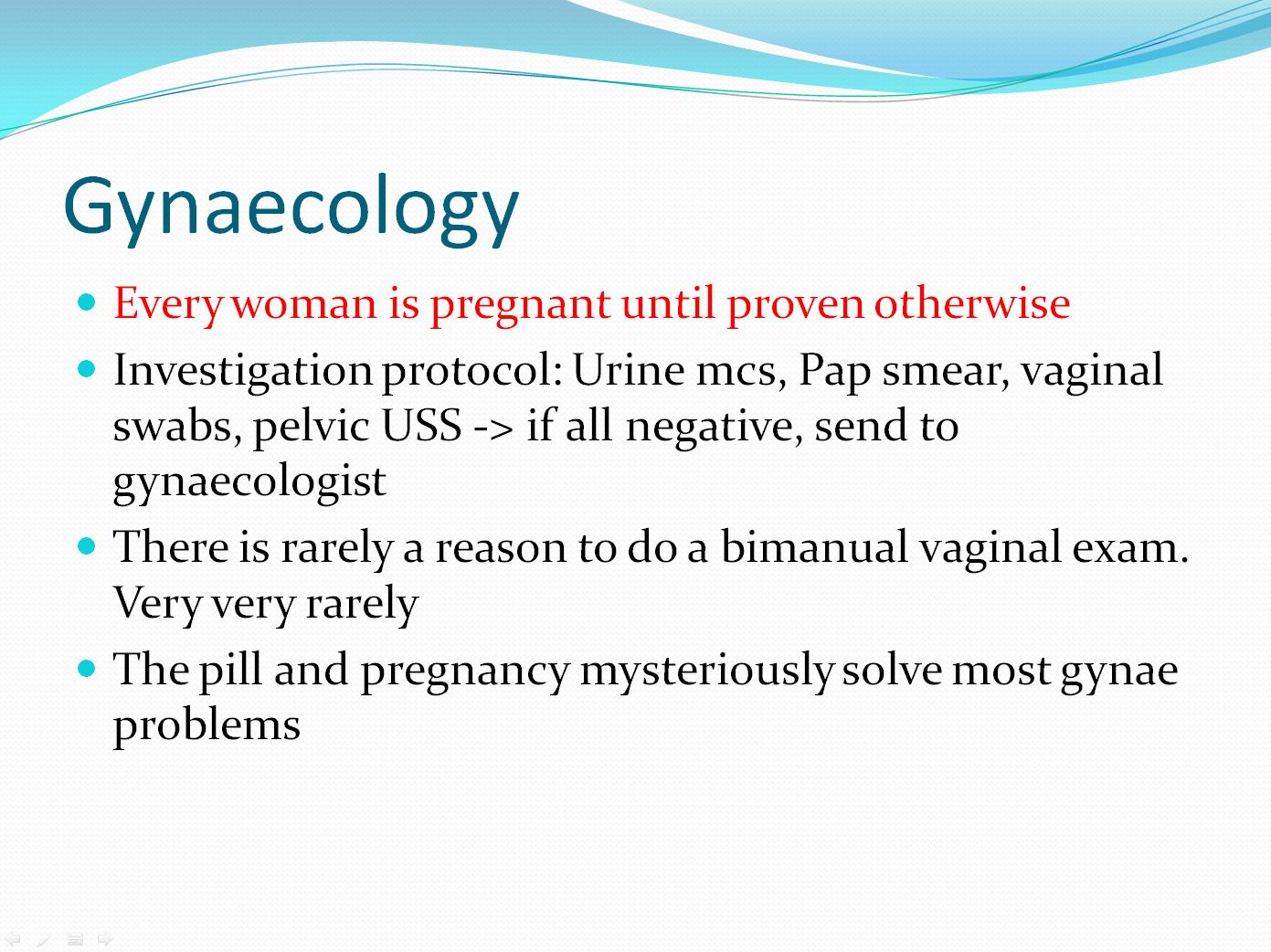


Now, if you remember just a few of those things, you have very close to the medical knowledge of an Australian-trained GP. (You don’t even really have to worry about knowing how to do a physical examination. I mean, have a look at rashes and things patients like to show you, but it’s rarely going to be essential that you lay even a hand on them!)
Sunday, April 1, 2012
On making "the unhappy" happy - Part 2/2
Of the war veterans I meet with post-traumatic stress disorder (PTSD) and depression, do you know what they value most in their lives? Not finding a “cure” for PTSD and depression, but just appreciating and being able to be with the people in their lives. They accept very courageously – not cowardly – the goals of treatment of these disorders: minimizing symptoms, moving forward from the last exacerbation, and decreasing the number of further exacerbations. They don’t seek a cure, though of course if it were feasible, they’d pay any price to have it. But why fight futile battles? So, I say again that they very courageously choose to expend their energies on the things that matter instead: love, productivity, enjoyment. But before you assume that I am making a claim such as “there is no cure for depression”, let me clarify that that is not the broad statement that I am making.
I used to think, naively, that once I fell in love, once someone loved me and I had someone to share my life with, I’d be happy. I wondered why the people I met who had the things that I thought would bring me happiness weren’t happy. How could they be depressed when they had a partner, children, a job they didn’t hate, generally good physical health, etc.? Why hadn’t the love they had in their loves not cured their depression? Because lack of love didn’t bring about the depression, nothing that was correctable did. Yes, they had love; but completely unrelatedly they also had a mental disorder. Finally I realized why people give flowers to sick relatives in hospital: the flower isn’t meant to “cure” the illness, just make it more tolerable by giving you that warm feeling inside that you’re not alone and reminding you that people care about you.
In persons who have become depressed or suffering PTSD as a result of some psychological social trauma, there is nothing in this world that can erase the memories and/or the cognitive processes that get programmed into your brain. Remarkably, though, a human being can go about their lives being perfectly functional and socially involved despite these demons we carry around in our head. When you have a chronic depression or PTSD of this kind, the best you can wish for is not being “cured”, but having people around you who understand you and stick with you on the journey. Not even “love” can erase the inner hell we experience with these mental disorders, but love can motivate the people around us to give us the all vital support and understanding. Conversely, if you find yourself in a relationship with a person who has depression or PTSD or a similar complaint, you will only hurt yourself by believing that your role is to bring about “cure”; it’s not. Your role is no different to that of anyone else who ever loved: to love, to give (including understanding), to receive, and to share life together.
Tuesday, March 27, 2012
On making "the unhappy" happy - Part 1/2
One thing that took me a while to understand when I was younger is that “love”, or having a romantic relationship, doesn’t cure everything. In fairy tales, people fall in love and love rids you of physical “ugliness”, of having an evil heart, of disease and death, of financial poverty, of social oppression, of emotional and physical abuse, of low self-esteem, of disability, and of every negative thing that can happen to a human being. And don’t get me wrong, I like those stories as much as anyone else, and I'm also aware they are often metaphors for what love can actually achieve. Essentially love, being in love, being loved, loving, discovering love, etc. has the effect of giving human beings courage to believe in their own strength and to take risks. The greatest motivator for positive change and the strength to bring about that change is love. Love can conquer all…
The second most difficult thing for a human being to do is to bring about change in this world. The single most difficult thing in this life for us to do is to bring about change in ourselves. Love is supposed to make all things possible, right? That’s what the fairy tales tell us. That is what we have learnt personally from life. I still believe this is true. But there is one scenario unique to human beings I find particularly interesting when considering all that love can do.
Depression and post-traumatic stress disorder (PTSD) result in unique states of mind where the “enemy” and the “villain” that we fight everyday lives exclusively within our hearts and minds. He may have been created by exposure to psychologically trauma or neurobiochemical imbalances or social oppression and abuse, or any of a myriad of negative human experiences. Yet the outcome of these situations are so common that someone has been able to make lists of the cognitive effects that result. They are described commonly in books and medical and scientific literature and classified into categories that receive the names of “mood disorders”. Depression, anxiety, and PTSD are very common diagnoses given to the people who suffer the effects of having these internal enemies to fight; the low mood, the lack of self-esteem, the sense of worthlessness, the compulsion to self-harm, the feelings of inability to better one’s own situation, and the inability to envision a future different to the inner world they seem trapped in.
I have seen many patients with PTSD, mainly war veterans, but all survivors of some sort of abuse or extremes of human experience. These people have lived through horrible things – and survived! If anybody can be called strong and honorable, it is them. Yet, they often are the first to believe they don’t deserve to be alive or to have good things in life. Bullets kill many soldiers in combat; depression and PTSD kills way too many survivors. People don’t choose to suffer depression, anxiety, or PTSD, the same way none of us choose to voluntarily suffer. And the worst part is that with these psychiatric complaints, you also can’t choose to “just snap out of it”. The goals of treatment in these disorders are not aimed at cure, but at managing symptoms, learning new ways to process information to help stop triggering these inner beasts, and minimizing the number of exacerbations. Of course, there are many ways we go about doing this (medication, psychotherapy, self-directed education, meditation, etc.), but generally there’s no way to completely cure these problems.
But wait, what about love? Doesn’t love “conquer ALL? Doesn’t love give you strength, courage, motivation, hope, etc. to achieve anything in life – even to change the world? The thing with depression, PTSD, and other psychiatric complaints is that the thing to conquer lies within. But love should be able to help you achieve even that, right? Isn’t love also able to change a human being? I used to believe just that.
Sunday, February 12, 2012
On the dobber's (/victim's) dilemma
I have previously mentioned the difficulty faced by victims of childhood sexual abuse as children and adolescents in telling someone of their predicament. They hesitate due to embarrassment, unwarranted guilt, fear, lack of understanding that they are victims to a terrible sin, and being unaware of the process, etc. Recently I’ve encountered a similar scenario, but in the adult victims of past sexual abuse.
Victims of childhood sexual abuse eventually grow up to become adults. Some become very capable adults, and a lot become crippled by the emotional and psychological scars of trauma. A lot of the people we encounter on a day to day basis have been past victims of this worst of crimes, most have never told a soul of their experiences. I want now to discuss a composite of this person, let’s call her Elisabeth.
An Unpleasant Story
Elizabeth was sexually abused by Josef between the ages of 10 and 14. Josef was Elisabeth’s stepfather, who joined the family just before Elisabeth’s 10th birthday. Elisabeth told Rosemarie, her mother, of Josef’s behaviour towards her, the fondling, etc. She did this when she was 14 and then the abuse stopped. Rosemarie had some “stern” words with Josef, but eventually she was a woman in love and they decided to put this “episode” behind them and move forward with family life. The “episode” was never discussed with police or counsellors or anyone else who may have cared. Rosemarie and Josef remain together to this day. Elisabeth, somehow, finally managed to escape the rape dungeon she called a home.
Elisabeth became a woman of her own, independent, self-sufficient, struggled with some things but succeeded in others; she was just a normal woman with a past most of us would never wish on our worst enemies. But the past was in the past and the past can’t hurt you, right? I don’t know that that is right. Elisabeth had managed to move ahead with her life, leaving the past behind, until one day the past came back to find her. Sounds clichéd, right? Yes, but it also sounds horrible and unfair.
One day Elisabeth found out that Josef was accused of doing some things she knew he was capable of, things she had witnessed at one time when she had been the victim of such things. But this was a separate incident, separate incidentS, things not related to her at all, but it brought to her consciousness something that she had suspected all along: that she was not Josef’s only ever victim. There had been others, there probably would be more… And whenever we read this scenario the answer seems so simple: tell. Elisabeth should tell her story, right? Elisabeth should do the right thing for the greater good, right?
Imagine yourself in Elisabeth’s shoes. In the movies and episodes of Law & Order: SVU what happens is that the Elisabeth-character tells her story, feels good about herself, saves the day, the baddie goes to prison forever, and everyone has a perfect life thereafter. Reality is not like the movies. Elisabeth knows this.
Elisabeth asks some people for advice; should she “assist” the potential case against Josef? This isn’t about her life or the things that happened to her, this is about doing the allegedly right thing. Everyone tells her, ‘yes, of course, you HAVE to tell your story’, it’s her duty. The thing is Elisabeth has a life now. She has left that past behind and she owes no-one anything for getting where she is. Who does she owe? Josef’s other victims? The “general public”? Why? She suffered too, but how does that make her anything other than a victim? And will she really feel better to tell her story, to become the hero that saves the fate of children she’s never met and owes nothing to? Doing good things makes everyone feel good, we’re told… And yet I feel that no one should feel coerced to re-live any pain except for their own self.
How do we convince Elisabeth to do the “right” thing? What is the right thing to do? This is the dilemma of knowing something that incriminates someone, but that also inadvertedly incriminates you too. I know you’re thinking ‘but how does that incriminate her if she tells her story?’ Josef maybe or maybe doesn’t get prison time. Elisabeth is punished by having to re-live pain of her story, the humiliation and embarrassment of discussing the very personal and degrading things done to her, she is faced by the well-meaning but hurtful murmurs that if she had told earlier none of those other victims should have had to suffer what they did. Is it worth it? Is the sacrifice worth it for Elisabeth? Forget for a second the “general public”, the “greater good”, is all this worth it to Elisabeth? What will she gain by telling her story?... It’s easy to answer that, but not if you’re truly only thinking of Elisabeth. The only person thinking of Elisabeth – and for a long time – has only being Elisabeth.
And if Elisabeth doesn’t tell her story and Josef goes on to abuse other children, is it Elisabeth’s fault or is it Josef’s? Elisabeth was a victim. Before we judge her, we have to understand her dilemma. Sometimes it’s enough to be a survivor without being a hero.
Tuesday, January 24, 2012
On the Eminem thing
People think I’m trying to be purposely funny when I describe myself in the “About Me” section as being like Eminem. I’ll be the first to admit I’ve never met Marshall Mathers III, and I’ve never even had the good fortune of being to an Eminem concert. I identify a lot with most of the lyrics of Eminem’s songs, though. A lot of people must; he sells records in the millions of copies. Personally I believe he is a great expressionist, and not only that, he has a very common human story.
There is an Eminem song (Same song & dance) where he is considering different ways to tell his crush how he feels about her (he’s a shy, socially-awkward person like so many of us) and he postulates: "Should I cut off one of my ears and mail it to her? Send her pictures of my collections of skeletons? Or footage of me impaling myself on an elephant's tusk?" This kind of strategy may not occur to everyone, but it does to Eminem because he is he and he thinks the way he does… I keep a small collection of animal skeletons and to me Eminem’s proposition of sharing something dear to him does not seem strange.
I won’t go try to analyse Eminem’s lyrics for anyone, but I would like to share some of them which are the reason I identify with him so much. I guess, the way Jorge Luis Borge’s words always come to mind: ‘each man is every man’ and each man’s story is shared by every man. I have been the “dark phase” Eminem, as much as I have been the Eminem who rejoices in his blessings. We all have to different degrees, I think J
I'm not afraid /To take a stand
Everybody /Come take my hand
We'll walk this road together, through the storm
Whatever weather, cold or warm
Just lettin’ you know that you're not alone
Holla if you feel like you've been down the same road…
****
I got some skeletons in my closet /and I don't know if no one knows it /So before they thrown me inside my coffin and close it /I'm-a expose it... (Cleaning Out my Closet)
Well since age twelve, I've felt like I'm someone else /’Cause I hung my original self from the top bunk with a belt...
And by the way, when you see my dad, /Tell him that I slit his throat in this dream I had. (My Name is)
All I know is I don't want to follow in the footsteps of my dad /’cause I hate him so bad /The worst fear that I had /was growing up to be like his f*ckin’ ass /Man if you could understand /why I am the way that I am... I never dreamt I'd get to the level that I'm at /This is whack! This is more than I ever could have asked... (Saying Goodbye to Hollywood)
Yo, never was a thug, just infatuated with guns...
/I'm a soldier, these shoulders hold up so much /They won't budge, I'll never fall or fold up... (Soldier)
My thoughts are sporadic /I act like I'm an addict /I rap like I'm addicted to smack... (‘Til I Collapse)
Sometimes I feel so alone /I just don't know /feels like I been down this road before /So lonely and cold /it's like something takes over me /Soon as I go home and close the door. (Deja Vu)
I'm just so f*ckin' depressed /I just can seem to get out this slump... I think I'm starting to lose my sense of humour /Everything is so tense and gloom... (Beautiful)
Sometimes I even cut myself to see how much it bleeds /It's like adrenaline, the pain is such a sudden rush for me...
But what's this sh*t you said about you like to cut your wrists too? /I say that sh*t just clownin’, dog /C'mon, how f*cked up is you? /You got some issues, Stan. I think you need some counselling... (Stan)
If I, were to die murdered in cold blood tomorrow /Would you feel sorrow or show love, or would it matter?...
But there's way too much at stake for me to be fake /There's too much on my plate, I’ve come way /too far in this game to turn and walk away...
The only way I'm leavin’ this bitch is suicide... I'm not what ya think /I appear to be f*cked up, mentally endangered /I can't stay away from a razor...
It hurts when you see your friends turn their back on you, dog /And you ain't got nothing’ left but your word and your balls /And you're stressed from the calls of your new friends /Begging with their hands out...
Death itself can hurt me /Just the thought of dyin’ alone that really irks me (When the Music Stops)
Sometimes I think, there's nothing to live for /I almost break down and cry /Sometimes I think I'm crazy; I'm crazy, oh so crazy! /Why am I here? Am I just wastin’ my time?..
People make jokes, cos they don't understand me /They just don't see my real side /I act like shit don't phase me /Inside it drives me crazy /My insecurities could eat me alive... Sometimes it feels like the world's on my shoulders /Everyone's leanin’ on me /Sometimes it feels like the world's almost over... (Hailie’s Song)
I never would have dreamed in a million years I'd see /so many motherf*ckin’ people, who feel like me /Who share the same views and the same exact beliefs /It's like a f*ckin ARMY marching in back of me (White America)
Yet everybody just feels like they can relate /I guess words are a motherf*cker, they can be great /or they can degrade. Or even worse, they can teach hate /It's like these kids hang on every single statement we make /like they worship us... They say music can alter moods and talk to you /Well can it load a gun up for you and cock it too?... That's why we sing for these kids who don't have a thing /except for a dream and a f*ckin’ rap magazine /Who post pin-up pictures on they walls all day long /Idolize they favourite rappers and know all they songs /Or for anyone who's ever been through sh*t in they lives /'Til they sit and they cry at night wishin’ they'd die /'Til they throw on a rap record and they sit and they vibe /We're nothin to you - but we're the f*ckin’ sh*t in they eyes /That's why we seize the moment, try to freeze it and own it /Squeeze it and hold it, cause we consider these minutes golden /And maybe they'll admit it when we're gone, just let our spirits live on /through our lyrics that you hear in our songs... (Sing For the Moment)
(If it looks like you’ve seen this before, I have posted most of it on my facebook notes before.)
Sunday, January 8, 2012
On logical suicide
I was at an internal medicine grand rounds talk one day when a colleague started speaking about “logical suicide”; as in suicide that does not seem like the irrational choice we all have come to believe it is. Experience, philosophy, or science, have taught us that a human being’s overriding desire in life is to live. If we deviate from this, if a person wants not to live, then that human being must be ill or evil. But are there ever situations when suicide can actually be thought of as logical? It takes a little bit of tearing down of our usual norms to even contemplate this, but I was curious to explore this further.
A life worth living
In medical ethics circles you’ll often hear the terms “a life worth living” and “quality of life” banded around. What is a life worth living? Most of our lives. We have our basic physiological needs met; we have freedom to think, decide, and act accordingly; and we have (most of us, I mean) the physical capabilities to transform our desires into acts. But, then, just what is a life not worth living? You could say that it is a life that lacks those things we spoke about before, but that’s not true. You may lack any, a few, a lot, most, or all of your physical abilities and yet still consider your life worth living. The important thing is that decision on the ‘worthiness’ of your life is made by you, the owner of that life and body.
A life not worth living
The medical profession and some societal groups, though, have decided on certain broad aspects of a human being’s existence which, if lacking, deem that person’s life a “life not worth living”. Things like if a person’s brain lacks measurable electrophysiological activity, or if the person requires constant support in their nutrition, hydration, breathing, etc. Of course, the problem with a third party deciding which life is worthy and which not worthy of living is a very fearful one. The Nazis, for example, conceived a concept of “a lifeunworthy of life”. Initially, they considered it a socially useful tact to destroy peoples who were brain dead, brain impaired, mentally retarded, or psychiatrically ill to the extent that they could not survive without the assistance of others. It was considered that these people weren’t worthy of life and in fact were unaware of what life meant, therefore, eliminating them from society (by purposely killing them) was totally acceptable. We are now all very aware that the Nazis’ category of “life unworthy of life” eventually extended to some very broad groups of people and resulted in mass killings without a logical rationale. I, am, however, now digressing…
Suicide
Why do people suicide? That is a question psychologists, scientists, doctors, religious people, and a lot of us ask every day! What do people who suicide tell us (in their last writings or after a “near miss”)? That they did it to end to the pain, that they could see no other options in their life, that they no longer wanted the mundanity of life, that they had failed beyond what they considered remediable, that they had succeeded enough that anything further would be a downhill decline which they didn’t want to face, that they had nothing left to live for, that they had more to gain in death and the afterlife, that they didn’t want to be a burden on others around them that supported them in their existence, etc., etc. People’s reasons for dying are as complex as those we live for. And yet, for most of us, living just seems like the right thing to do. Most of us don’t even question it. And when we become ill or our life is threatened in any other way, our instinct is to try to preserve it. Then what is wrong with people who want to die? People will often quote you that up to 95% of people who commit suicide have a mental illness, for example, depression. But I’ve always wondered about the other 5%. OK, OK, 4% didn’t have a diagnosed mental illness but were intoxicated with drugs or alcohol, acted impulsively after a sudden change in life circumstance, or suicided “accidentally”. But what about the remaining 1%?
Logical Suicide
I’ll start by acknowledging that I’m playing devil’s advocate here just to explore this question further. My colleague who spoke of logical suicide was in fact speaking of one of our patients. It’s not that he disliked this patient and wanted him to die, he was just saying that if this patient decided to suicide, it wouldn’t be considered a totally irrational thing to do. Of course, there were a gasps of disbelief in the room and a few chuckles thinking he was purposely trying to bring up a taboo for a few laughs. How could he speak such preposterous ideas? Because he knew the patient was very aware of his own conditions. The patient did not suffer an intellectual impairment and he knew what he had been through with his condition and that it was only going to get much worse for him. He was in constant pain and discomfort. He was still physically able to act so as to procure his own death and he was not depressed or suffering any other mental illness. Would he want to face further suffering and physical deterioration? If he didn’t, would his opinion be irrational? If he suicided, could you consider his decision illogical? What happened in that room with our colleague having raised this, is that the conversation quickly changed topic. It is still taboo to speak of these things, apparently.
Now, consider a person who, like most of us, has set an agenda for his life, something he would like to achieve and this is what motivates him day to day to keep living. For some of us this is doing a particular job, helping others, marrying the person you love, competing in a sporting race, raising your children, making music, self-expression, visiting a particular place on earth, caring for your parents, etc. These are things worth living for, for you, at least. Now, let’s consider, for example, a person whose sole motivating thing in life is to get married and have children. He wants that more than anything else in life, and that would make his life happy and complete. He is not unhappy without it, however, but he is just existing with the purpose of achieving his dream. What if he was born with a physical impairment that meant he was completely dependent on someone else to care for him and as a result wasn’t able to meet any women to have potentially fall in love with him, marry him, or have his children? He reaches 20 and hasn’t met anyone yet, online or in person. He reaches 30 and he is still in the same predicament. He reaches 40 and his parents, who are his only source of real meaningful love (but not of romantic love, which he desires), are becoming elderly and still his predicament hasn’t changed or improved. He isn’t any more likely now to a) become free of his illness, b) prevent his own physical deterioration, c) find a new overwhelming desire/purpose for his life, or d) fulfil his own self-designated mission in life. What is he living for? How does he answer that question to himself if he isn’t a religious man? Is he living to wait for his death one day?... Well, if this man suicides thinking he has nothing of value to him to live for, could you honestly say his suicide was not logical?
Living
When someone speaks of suicide, of contemplating it, we often see ourselves come up in defence of “life”. We tell the person that they should seek treatment for a mental illness, or we “remind” them how wonderful life is, or we tell them how missed they will be and how many people love and care for them, or we say that perhaps soon medical science will come up with a solution to what discourages them from life, or we tell them to think of how much they will hurt others if they go through with what they’re contemplating… We’re actually pretty good advocates for life! However, perhaps what we should be doing instead of telling others how to feel or what to think, is ask some questions of how they’ve reached their conclusions. The person most likely to convince you of something, even living, is yourself. And hearing back your own arguments for life vs. death is perhaps the only way to have a person change their minds on suicide.
Until recently we still spoke a lot on suicide prevention, but that lead to a lot of people (family, friends, religious ministers, health professionals, etc.) feeling guilty. They were feeling guilty because suicide was being discussed as purely “preventable”, which mainly implied that it could and should be prevented, and if a person succeeded in suiciding then it meant that someone (or everyone) had failed this person. The emphasis is now shifting to raising ‘suicide awareness’, to be able to recognise those at risk of suicide. Most of these people can be helped. The others we may not be able to prevent from suiciding, but we can equally help while they’re living. You don’t need to be anyone special or especially-trained to do this, all you have to do is be a human being and engage the attention of another human being. Who knows, they may just help you too.
Sunday, September 25, 2011
On hierarchy
One of the things that really bothered me when I was working in the public hospital system is the pronounced (and revered) hierarchy of the medical industry. In short, it is what people call “top heavy”. If you’ve ever read ‘The House of God’ by Samuel Shem, even if you know nothing about it from personal experience, you’ll realise that this is a universal system of our industry. There’s an almighty, infallible boss at the top of the pyramid who ‘makes the big bucks’ and has his name attached to the patients “in his care” – even though he may not even be aware of these patient’s existence. Then there’s the half-bosses, charged with making all the hard decisions and often physically doing some of the too-hard things. He makes reasonable money, and you see him once or twice a day, but he also rarely sleeps. Then there’s the minions, working for scraps of money, working for almost every minute of every workday, being dealt all sorts of unpredictable tasks, and who is for the majority of the time a secretary with a medical degree.
If a scenario came up where the minion has just walked across a desert fighting off bullets and helping out injured civilians; he is met at the difficult battles by the half-boss who takes an armoured vehicle from one hard battle to the next (but driving by the lesser battles); and they are met at base camp in an air-conditioned shelter by their godly boss who has been driven in by chauffeured limousine from his 5-star hotel only seconds ago – who do you think will be offered a chair and a cold glass of water? Not the dehydrated, wounded minion with blisters on his feet. No. The boss will take the chair and the glass of water and not even thank anyone for it – he is the boss, apparently he deserves it more than the others. And that’s life. That is not just the medical industry or the military, it is probably most industries! And that is why I had to get out of the public hospital system.
There’s also another story I don’t often tell about my experiences in the hospital system, and it is related to the above concept, but also about a certain type of discrimination. See, another thing about working in a hierarchy is that you have to respect and worship the hierarchy. You have to! Otherwise how are you ever going to make it to the top if you don’t play by the hierarchy’s rules, worshipping the people above you for their pity, grace, and reward? This is where I went wrong. My mistake was choosing to be honest, and choosing to be true to my own convictions. My mistake was also to be born flawed – but I’ll get to that later.
I was working in a team that was just like any other hierarchy I just described. I was a minion, of course. One day, through no fault of my own, I got sick and couldn’t come in to work. Oh my mistake! I received a reprimand from a (half) boss for staying home sick – how dare I?! But my mistake went even further than that. My mistake was that I refused to kiss ass, or to apologize for being human, to give an excuse or apology for being unwell that day. And I told the boss quite clearly that I would not apologize for being sick. So began my downfall. The next day when I arrived at work I was “kindly invited” to a surprise evaluation of my performance, a discussion led by my boss before a panel of hospital “Gods”. Oh, what a terrible worker I was! Late in the mornings, slow, lazy, absent on so MANY occasions, time-waster, friendly with too many other staff members, too well-like by administration and ward staff, etc. etc. I guess you can’t really say “she’s an insolent b*tch who won’t kiss my ass like she should” so you have to phrase it differently, even if slanderously.
I was then politely asked my opinion to his allegations. Needless to say, I was speechless. One day I am away sick at home, and the next - without warning – I am asked in a panel if I dare to contradict the guy who grades my assessment and who can end my career right then and there if he chooses to. Yep, seven years of university training, a $70,000 student debt, and a lifetime of passionate pursuit of this career on the balance. I kept quite. Even if I could speak, I’d had no time to prepare my defence (aka, stating the truth correctly). In my silence, the man hearing the case, summarised my case based on what was said about me. Clearly I was ALWAYS late to work. Clearly I had TOO MANY days off sick. Clearly I LACKED ENTHUSIASM for my job and my team. Clearly I was SLOW. Clearly I was LAZY. Clearly it meant I was WASTING TIME becoming friends with the people I worked with every day. Clearly I was guilty, because the boss who is higher up in the hierarchy than me said so. I then made only one comment; I said “it sounds like you’ve already made up your mind”. Yes, yes, the panel had. Never mind the fact that I had been working on this team for over 3-4 months with no complaint made about me, that no complaint had ever been made of my performance ever, and that these statements were great generalisations of that one time I was away sick. Was it a coincidence that all these allegations came to light from the man I had apparently disobeyed by being human and being sick, and that they came to light the day after I had refused to kiss his ass? Apparently so.
But before the panel “discussion” was over, one final point was raised. Was it not true that I suffered what is commonly called depression? After all, this can lead to increased work absenteeism, to tardiness, to lack of enthusiasm, to general slowing down… Oh, this is when I lost it! Talk about discrimination – and coming from the same profession that should be advocating against this type of prejudice. It didn’t matter that the things that I was accused of in an act of spite, of revenge, to put me in my place, to hurt me, were false; what mattered was that I had a condition which obviously must apparently make the allegations true. And I lost it because you can’t wash these things off. Did I not suffer depression? Yes. ‘Well, then that must mean that you are slow and lazy and unenthusiastic and take a lot of days off work…’ The only thing getting in the way of that theory was that these allegations weren’t true in the first place. And I was completely symptom-free at the time this all happened. But I couldn’t say no; that would be a lie. It was to me like being asked “isn’t is true that your skin is brown?” or “isn’t it true that you’re Latin?” or “isn’t it true that your native language is Spanish?” But I won’t be ashamed of my skin or my culture or my language, I wouldn’t deny them. It seemed to me at that point that in this world it is politically incorrect to be racist, but not so to discriminate against those with a history of mental illness.
I must admit I have had times where I wish my defect was in my skin or in a spot I could just have surgically repaired and then be on my way. It’s not that easy. If you have a mole on your face that everyone stares at when they look at you, it makes you uneasy. But at least you can have that removed and be more appeasing to those that are superficial and judgemental. What so many people wouldn’t give for a solution that easy.
Monday, August 15, 2011
On a curious incident
A few weeks ago I received a phone call at work from Centrelink, our blessed government welfare agency. Usually when they call doctors it’s to verify that their clients haven’t been falsifying medical certificates to exempt them from job-seeking activities or to ask further details about a patient’s medical condition on one of their thousand forms (which they so commonly misplace). This time when they called me, it was to ask another request of me: to diagnose a medical condition that would label my patient as permanently disabled. Wait, what?! To make my patient sick? To label my patient as sick? But, more intriguingly, why? And here was the Centrelink officer’s reason: because it was getting to be too much hard work to try to find this patient work!
I get it; sometimes the patients want us to give them a medical certificate to excuse them from work for a few days, almost always for very legitimate reasons. Then those who would cheat the system regardless of whatever system was in place want us also at times to write similar certificates to secure government disability pensions, have their airfares or gym memberships refunded, to postpone academic assessments, to get those much-coveted disabled parking permits, etc. etc. But this “please diagnose disability” did not seem to me as a simple request (even though you could very rightly refer to it as a request to be a co-participant in federal fraud); it was at least to me about something much more than about money. It also was not something the patient himself has asked of me.
I’ve previously discussed about the dangers of labels. And surely also some labels have their advantages, for example, in forming self-identity and bringing likeminded people together. However, my concern at this particular request was (aside from the fact it is at least unethical if not illegal to lie about a patient’s medical condition) about the effect labelling my patient as disabled, as ‘writing him off’, would have on him. The patient had seen me previously and not asked that I fill out any Centrelink form and surely did not mention about considering himself unfit for work due to physical and/or mental limitation. As almost every other patient that walks into a consulting room, their focus was on getting better and that was what we discussed – and one reason he wanted to get better was that he was keen to re-enter the workforce and get on with other socially-enriching activities of life! This reason especially is why the Centrelink officer’s request so surprised me. Of course I asked her to not just send me forms but rather to send me the patient back because I wanted to ensure we were all on the same page.
In short, the Centrelink officer’s agenda was an act of desperation because she was struggling with her own job: helping my patient find paid employment. It is very much easier in this, as in many other “people jobs”, to just give people what they want despite the company policy or government rules or laws or our own position on a matter. It’s the easy way, right. But the easy way is so rarely the right way. What I’m trying to say is I don’t blame this poor public servant for wanting to make perhaps two people’s lives easier. What I do, however, have a problem with is to allow this person (the patient) to opt out of life.
I say opt out of life rather than opt out of the workforce or even opt out of ‘effort’ not to be dramatic, but because a simple fact of human life is that in the majority of situations we define ourselves by our work. Think for example how when you first meet a person one of the first few questions you ask them is what they do ‘for a living’. Knowing this tells us a lot about a person, yes based on stereotypes, but in education stereotypes are one of these essential things for learning. Knowing what a person does for work tells us about their education, their finances, their likely social circles, etc. But, of course, none of these things are of primary importance and the stereotypes fade once you get to know the individual. Have you ever been unemployed or met someone who is unemployed and they referred to what they previously did for a job or what they’re looking into getting? It’s a bit of a matter of healthy pride, to let you know that they are still a part of human society.
I have previously touched on the concept of maintaining societal involvement in order to preserve our mental health. The DSM defines mental illness by a variety of particular symptoms, and furthermore that they cause significant “distress or impairment in social, occupational, or other important areas of functioning”. For example, we all have felt sad but not as many of us have been so sad that it interfered with our ability to shower or eat, etc. for weeks or months and so being able to be rightly diagnosed with depression. OK, but here I am discussing not mental illness but rather societal involvement. Mental illness leads to decreased involvement, but it also worthwhile to consider that the decreased involvement can also exacerbate negative mental states. As I have mentioned in a previous post, one of the methods used as punishment in our society is imprisonment. The punishment isn’t just about keeping you separate from your family, friends, and other people, but also of depriving you of all other types of social environments such as work.
So, let me summarise why this whole incident caused me such a dilemma 1) it was not a request by my patient but a third party, and 2) I didn’t feel right about labelling my patient as disabled, and 3) I didn’t want my patient to be excluded from societal involvement and be exposed to the negative effects that come with it.
Sunday, August 7, 2011
On the government 'doing something about it'
One of my favourite quotes ever is by Lily Tomlin about a realisation she once made that changed her world: “I said ‘Somebody should do something about that.’ Then I realized I am somebody."
The reason I was thinking of this quote recently (besides the fact I have pinned a copy of it in my room for years) is I was reading a comment in a medical magazine addressing the high rate of mental illness in our society. The writer rightly identified that it is the way our society has been shaped, leaving people with few others able to be called friends, people to talk to, less faith in the spiritual and religious clerics, less time to meditate and accommodate our inner thoughts, that have contributed to greater psychological distress levels than before. Our jobs demand increasingly greater time and mental efforts, our motives have been adjusted to the pursuit of material things rather than personal growth and realization, etc., etc. But it’s not that that I want to discuss today, rather it is the next part of this commentator’s contribution. She suggested that ‘the government should do something about it’. “It” referring to having less friends, spending more time at work, etc….
The government should do something about it. Really? “The government”? The government is expected to tell us and mandate how we spend our time on this Earth, who to trust and who to believe, what to prioritise? I couldn’t believe such a suggestion should be made by someone who is in our society regarded as “intelligent” just by virtue of having earned a medical degree. But the issue isn’t one of how intelligent a person is but rather of feeling so drained of power. Remember Seligman and Maier’s dog experiments where they described “learned helplessness”? That is exactly the situation so many of us can find ourselves in when we forget that we are human – and powerful! Even a very academically learned person can learn helplessness, believing that an only an external, greater body can bring about change. It is such a shame that we have forgotten that we as individuals are in the driver’s seat, that we are deciders of our fate not merely victims of it, that we can be the somebody that brings about the change you long to see. And I don’t mean to imply that we are one individual to change the world (though that is also a choice if you’re brave enough to believe it), but ‘the world’ radiates out from ourselves and it does start with us.
The other thing I find disturbing about the government ‘doing something about it’, being expected to bring about change not just in operational standards of running a society but also in that society’s consciousness is that the past has shown us that it’s not a very wise choice. Some of the things democratic societies pride themselves on are things like freedom of speech and religious choice, etc. But handing these rights over for the sake of uniformity is a very dangerous thing! By definition the way governments “do something about it” is by enacting legislation, by outlining specific rules and specific exceptions to these rules. Human psychology is not very amenable to these sorts of rigid concepts! Consider, for example, countries with laws governing certain types of “morality” where governments can make it a crime to have sexual intercourse between consenting adults who are not legally married to each other or who are of the same sex. That is a government with a right to govern over private matters, with a right to “do something about” the things you do in your own bedroom and a right to mandate who you can express your feelings for.
What am I trying to say? I am just hoping to remind us that we aren’t powerless, helpless, completely reliant on external constructs to bring about any change. If we identify a condition we are dissatisfied with, it IS within our power to start a change.
Sunday, July 31, 2011
On depression and V-Tech
You're going to have to forgive me for reposting from my facebook notes, but I just really want this story shared:
Remembering V-Tech
On April 16, 2007 a guy called Seung-Hui Cho killed 32 people at Virginia Polytechnic Institute and State University. None of this is news, the media called it “the V-Tech massacre” and compared it to the “Columbine shootings”. Why does this interest me? Because Seung-Hui Cho interests me. Many people hate him; others tag him with as many psychiatric diagnoses as possible in order to fathom him as a human being. I think it’s also important to have a listen to how he thought of himself, or what he thought, in general. Here are some non-contiguous excerpts of things he said prior to the massacre/suicide:
Now everyone points out the obvious things about these words: 1) He resented those that were wealthier or better off than him, 2) He had something like a grandiose delusion comparing himself to Jesus Christ, 3) He denies responsibility to his actions by saying he “had to” do what he did. And those things may be true, but there’s something else about him that interests me. What if he really was just a normal human being reacting like how any other human being would react in the same situation? There’s this segment in the Bible where someone asks why all the “bad” people seem to get everything that they want and he who tried to live a noble and decent life, didn’t seem to get the same benefits, the same riches. What I’m saying is that the feeling of injustice or unfairness is not a new thing, the Bible is thousands of years old. But beyond a common feeling of experiencing frustration, disappointment, resentment, sadness, or anger at injustice, is something else that then enables or empowers you to act. Could this be mental illness? Could these be the immature coping mechanisms they talk about? Maybe. I’m not an expert. I know about something, though, and some people call it depression.
What I know about depression is that it’s not the same thing as sadness. Sadness is what you feel when you experience loss or disappointment. Everyone has known sadness. Depression is like when there is nothing left to be sad about. There’s just nothing. No companions, no love, no words that could bring comfort. It’s like having this dark being by your side—always—that follows you around and fills your space. It’s what gives you the courage to fear nothing because nothing outside of it exists. Sadness is almost beauty, a romantic ideal you wish you could at least aspire to. In depression there is no love, no beauty—no sadness, even. It’s a void; a dark space with nothing inside and no walls you could even break through. Therein lies the frustration, and when you have no battles left to fight, you cry. Everyone cries, and most people cry at the moment they realize their defeat.
You know when you have those dreams that you’re falling into a black hole, but then you wake up and you’re still in your bed? Imagine this, but you keep falling for hours, days, months – and you can’t get used to it. There’s no sense of direction or orientation; nothing you can grasp at and no sensible motion, so although you’re moving and falling, you can’t even feel it. You don’t feel a thing. Nothing. Pretty soon you realize you can’t leave, you can’t scream, you can’t see or experience anything other than complete overwhelment at the nothingness that is your life. You can’t feel and so you stop wanting to. That’s the worst part: when desire finally leaves your soul. Nothing hurts and nothing feels pleasurable; nothing you could care about exists. There is you and outside of you there is only darkness and the void. You can’t touch or be touched. You can’t feel or want to feel. There is nothing to be sad about and you’re not. You’re not sad—you’re dead already. You’re not content or satisfied; those things describe nothing known to you—but you’re not sad, either. To be sad one has to be alive, to long for something. When you’re depressed, you’re no longer alive or wanting. Depressed people don’t commit suicide; they commit euthanasia by physiologically killing what on the inside is already dead.
That’s one side of the story of why someone could react the way Seung-Hui Cho did (and I am using him only as an example). That argument could explain suicide, but what could possibly explain homicide on such a large scale? I believe it’s not such a large leap. When nothing matters, when you realize you have nothing to lose because the future has already being decided and there are no consequences to fear because you won’t be living with them, then you are the most powerful being around. In this line of thought, it’s quite easy to believe you are a God, with the ability to do as you want, to decide who lives and who dies, to act with ultimate freedom. The knowledge of your power is what allows you to explore all your options, things you may never have even considered before, things like actually hurting random strangers “just because you can”.
I’m not trying to justify Seung-Hui Cho’s behaviour at the end of his life. But I do believe it’s important to remember “the V-Tech massacre” if only for the reason of trying to understand. George Santayana said “those who cannot remember the past are condemned to repeat it”. So lest we forget.
—11/04/2009
Remembering V-Tech
On April 16, 2007 a guy called Seung-Hui Cho killed 32 people at Virginia Polytechnic Institute and State University. None of this is news, the media called it “the V-Tech massacre” and compared it to the “Columbine shootings”. Why does this interest me? Because Seung-Hui Cho interests me. Many people hate him; others tag him with as many psychiatric diagnoses as possible in order to fathom him as a human being. I think it’s also important to have a listen to how he thought of himself, or what he thought, in general. Here are some non-contiguous excerpts of things he said prior to the massacre/suicide:
“You had everything you wanted. Your Mercedes wasn't enough, you brats? Your golden necklaces weren't enough, you snobs? Your trust funds wasn't enough? Your vodka and cognac weren’t enough? All your debaucheries weren't enough? Those weren't enough to fulfil your hedonistic needs? You had everything.”
“Do you know what it feels to be spit on your face and to have trash shoved down your throat? Do you know what it feels like to dig your own grave? Do you know what it feels like to have your throat slashed from ear to ear? Do you know what it feels like to be torched alive? Do you know what it feels like to be humiliated and be impaled on a cross and left to bleed to death for your amusement?
You have never felt a single ounce of pain your whole life. Did you want to inject as much misery in our lives as you can just because you can?”
“You have vandalized my heart, raped my soul and torched my conscience. You thought it was one pathetic boy's life you were extinguishing. Thanks to you, I die like Jesus Christ, to inspire generations of the weak and the defenceless people.”
“I didn't have to do this. I could have left. I could have fled. But no, I will no longer run. If not for me, for my children; for my brothers and sisters that you fucked. I did it for them.”
“When the time came I did it. I had to. “
Now everyone points out the obvious things about these words: 1) He resented those that were wealthier or better off than him, 2) He had something like a grandiose delusion comparing himself to Jesus Christ, 3) He denies responsibility to his actions by saying he “had to” do what he did. And those things may be true, but there’s something else about him that interests me. What if he really was just a normal human being reacting like how any other human being would react in the same situation? There’s this segment in the Bible where someone asks why all the “bad” people seem to get everything that they want and he who tried to live a noble and decent life, didn’t seem to get the same benefits, the same riches. What I’m saying is that the feeling of injustice or unfairness is not a new thing, the Bible is thousands of years old. But beyond a common feeling of experiencing frustration, disappointment, resentment, sadness, or anger at injustice, is something else that then enables or empowers you to act. Could this be mental illness? Could these be the immature coping mechanisms they talk about? Maybe. I’m not an expert. I know about something, though, and some people call it depression.
What I know about depression is that it’s not the same thing as sadness. Sadness is what you feel when you experience loss or disappointment. Everyone has known sadness. Depression is like when there is nothing left to be sad about. There’s just nothing. No companions, no love, no words that could bring comfort. It’s like having this dark being by your side—always—that follows you around and fills your space. It’s what gives you the courage to fear nothing because nothing outside of it exists. Sadness is almost beauty, a romantic ideal you wish you could at least aspire to. In depression there is no love, no beauty—no sadness, even. It’s a void; a dark space with nothing inside and no walls you could even break through. Therein lies the frustration, and when you have no battles left to fight, you cry. Everyone cries, and most people cry at the moment they realize their defeat.
You know when you have those dreams that you’re falling into a black hole, but then you wake up and you’re still in your bed? Imagine this, but you keep falling for hours, days, months – and you can’t get used to it. There’s no sense of direction or orientation; nothing you can grasp at and no sensible motion, so although you’re moving and falling, you can’t even feel it. You don’t feel a thing. Nothing. Pretty soon you realize you can’t leave, you can’t scream, you can’t see or experience anything other than complete overwhelment at the nothingness that is your life. You can’t feel and so you stop wanting to. That’s the worst part: when desire finally leaves your soul. Nothing hurts and nothing feels pleasurable; nothing you could care about exists. There is you and outside of you there is only darkness and the void. You can’t touch or be touched. You can’t feel or want to feel. There is nothing to be sad about and you’re not. You’re not sad—you’re dead already. You’re not content or satisfied; those things describe nothing known to you—but you’re not sad, either. To be sad one has to be alive, to long for something. When you’re depressed, you’re no longer alive or wanting. Depressed people don’t commit suicide; they commit euthanasia by physiologically killing what on the inside is already dead.
That’s one side of the story of why someone could react the way Seung-Hui Cho did (and I am using him only as an example). That argument could explain suicide, but what could possibly explain homicide on such a large scale? I believe it’s not such a large leap. When nothing matters, when you realize you have nothing to lose because the future has already being decided and there are no consequences to fear because you won’t be living with them, then you are the most powerful being around. In this line of thought, it’s quite easy to believe you are a God, with the ability to do as you want, to decide who lives and who dies, to act with ultimate freedom. The knowledge of your power is what allows you to explore all your options, things you may never have even considered before, things like actually hurting random strangers “just because you can”.
I’m not trying to justify Seung-Hui Cho’s behaviour at the end of his life. But I do believe it’s important to remember “the V-Tech massacre” if only for the reason of trying to understand. George Santayana said “those who cannot remember the past are condemned to repeat it”. So lest we forget.
—11/04/2009
Sunday, July 10, 2011
On prescribing choice... and the hypocrite's spiel

There are many people who will tell you that pharmaceutical companies are the devil. I say the devil is the devil, but I also say the pharmaceutical companies are no angels. Let me first disclose something to you: I eat the lunches brought in by the pharmaceutical sales representatives (almost everyday at my work!), I give my patient’s their drug samples, I enjoy their “educational” dinners at expensive restaurants, I am grateful at their supply of products ‘directly related to my clinical practice’, and I miss the days of the free drug-stamped stationery and random gifts. I do not claim to be immune to their marketing tactics simply because I am aware of them; both they and I know that I am human and the tactics exist because they do work. There are those who directly embrace the drug companies with the attitude of ‘hey, if they want to give money away, they may as well give it to me and I will do what they want me to do’. And there are those that completely shun them, who demonize them, who accuse them of being a… a business. Aren’t we all in business? Those who claim they aren’t, aren't in business very long.
Just this past week I recognized a tactic by the sales reps I hadn’t noticed before: bullying. Now, what I mean to say is not that they wanted to humiliate or hurt me, but they sure as hell wanted to make me feel guilt. Now if I remember correctly from my industrial psychology and marketing readings, creating negative emotions in targets is one of the least effective methods to inspire change of behaviour (in this case, prescribing more of the drug they’re promoting); however, least effective doesn’t mean ineffective. The rep was telling me of some new medication; was I using it, she wanted to know? I said no, I studied a little pharmacology too and I felt more comfortable with another medication. She was horrified! Did I not know that it was the most popularly prescribed medication in its class, prescribed by the greater majority of my peers?! My mind was thinking ‘yes, and?’, but I said, ‘Oh, ok. I’ll keep that in mind. Anyways, thanks for the lunch.’ I went away thinking, wow, really, everyone but me uses it, was she implying that I am doing the wrong thing by prescribing something other than “the most popular”? Is it the most popular because it’s the most effective, because it the newest (and newest we are told is better), because they are better doctors than me and if I want to be good then I must be like them. As I walked towards my consulting room from the lunch room where I had the food brought in by the friendly drug rep, I realised it had worked. I was here second-guessing my clinical management not based on clinical data or evidence, but based on simple human emotion: everyone likes to be liked and to be like the rest. I then laughed at myself.
A few weeks ago another drug sales rep was speaking of a medication for erectile dysfunction. Of course it was about the drug, but they alway tells everyone “it’s about the patient”, thinking of what’s best for them. There’s no news or controversy in saying this; no matter what industry you work in, at the end of the day everyone must eat (and you need money to buy food, right?). Every drug rep walks in to that lunch room and comes with 1) our daily bread (or gourmet lunch), and 2) the “educational material” to impart to us that just so happens to show that the drug their company sells is better for our patients for some or another important reason. But this drug rep wanted not to tell me about why their erectile dysfunction drug was better than the other two, but wanted to know what I based my choice on. I’ll tell you what I answered but first I just want to consider another point on prescribing choice.
Now, you could have five different drug reps talk to you about five different drugs from the same class, both targeting the same “disease” (I’ll explain later why a disease is worthy of my quotation marks here), and they can all show you with ‘real clinical evidence’ and ‘scientific studies’ that their company’s drug is the best. The first rep will say their antihypertensive is the best because it, say, doesn’t have this bad side effect. The second one says theirs is better because it reduces blood pressure quicker than the others. The third one says theirs is better because the effects on reducing blood pressure last longer. The fourth one says it their drug tastes better and is in a smaller pill and that this is very important to patient compliance, therefore in fact being the best drug because patients will actually take it. The fifth one will say theirs is the newest and is so many times better than a placebo. Who wants to be associated with the old and outdated, right? Ah, the stories…
What I answered my friendly drug rep is actually not anything new to them. Why do I prescribe a certain erectile dysfunction drug versus another? Honestly, I confessed, my choice was based on whatever sample pack was in stock in our drug samples cupboard. They know this, that’s why they like to stock our cupboard, not because they like to give away “free samples”, but because it works at securing consumers. I have to clarify a little, though, I use this rather non-clinical method to guide my prescription choice only in certain conditions that in my experience the medications are only slight variations on each other with similar clinical effects, for example as in erectile dysfunction. The second reason to why I do this is because these medications are very expensive and I want my patient to try it first before he goes and spends his hard-earned money on something that may or may not be right for him. Most doctors do this, too. You give the patient the sample pack and a script to purchase the medication if they are satisfied with the effect or tolerant of its side-effects. In cases like this, I prescribe what is in the drug cupboard because I know the brand name will make little difference to the clinical effect I am trying to achieve in a patient. For some reason my honesty seemed to surprise the rep and I think it is because there must be some secret pact that we, both the pharmaceutical companies and doctors, must deny that our interactions are in fact business transactions and we should pretend they are purely “educational” and clinical.
As a medical student I did a placement at a clinic that strictly forbade pharmaceutical reps from visiting to promote their products (or should I say, educate us). It was a clinic were most of the clinicians also held academic posts at the university and they were thoroughly involved in evidence-based medicine. I remember one doctor specifically telling me about how he always prescribed the generic version of a particular drug because it was the cheapest and therefore it meant less money spent on government subsidies paid to the drug companies, and subsequently more money left in the health budget for other essential matters. It made sense to me. Some years later I worked at another clinic where another very noble and more senior doctor advised me that I should prescribed the brand-specific version of a medication for depression that was now off patent. The reasoning was that the company that made this brand of antidepressant was highly involved in drug research and development and also at producing patient education and support materials, but they obviously can’t afford to do that unless they are making money also. It made sense. Yes, besides I also knew that once you allow for the generic version of a medication to be dispensed by the pharmacist, he incidentally happens to supply the patient by the generic version of a medication which is made by his pharmacy chain. Oh, everybody is a businessman. So my choice is then, who do I feed? The pharmaceutical company making the brand-label stuff or the pharmacy chain making the exact same but generic-labelled stuff (which in most cases cost no different to the brand-label medication). Ah, such decisions… Oh yeah, that’s right, this was mean to be about the patient!
Another thing that the pharmaceutical companies are accused of is not only of making healthcare a business (which I don’t believe they are solely responsible for), but of also creating disease. What do I mean ‘creating’? This is mostly in reference to the medicalization, the labelling, of certain human existential states as disease. Some years ago I read a story about how bad it apparently is that we have made things like pregnancy and ageing disease-states. In a similar vein, drug companies have been accused of doing either a good or bad thing, depending on your point of view. One could say that thanks to the educational and public awareness campaigns directed by our blessed pharmaceutical industry, so many people can be diagnosed and directed towards the treatment of many ails such as depression, anxiety, mood swings, hyperactivity, etc. etc. Another group of people report that the drug companies directed these campaigns as a diversion to their real campaign: increase uptake of certain medications (mostly psychotropic medications). They convinced people that their sadness, that their agitation and worry, that their child’s childish behaviour, are abnormal and required treatment – by using the drug that their company so happened to manufacture. Oh, so many coincidences…
And what have I achieved in telling you of these few tales? That I am a hypocrite? Maybe. But hopefully I have also reminded us all that we live in a capitalist society and that denying that there is a devil at our table won’t make that devil any more of a saint. Worse than being the devil’s pawn is not knowing that you are. As doctors, as human beings entrusted with the care of others weakened by disease, we must ensure that that truly is the worst thing: that we sell our own souls, and not that we trade in those of our patients for a piece of the devil’s share.
Monday, July 4, 2011
On pride and prejudice... (not the book)

In my job I meet a lot of people, people who we as medical professional often create. Almost every health professional can tell you a story about “some junkie”, a person with a substance addiction that they met along the way. But there’s a particular sort of person that we at times encounter and we don’t immediately think of as “a junkie” but we know that they’re addicted to prescription medication. In my experience, it’s usually the benzodiazepines class of drugs, the Valium-type medications. There’s a few main reasons why benzos are particularly good to get yourself hooked on: 1) they work, 2) gives you immediate ‘results’, and 3) doctors have fewer qualms about prescribing it than other dependence-forming drugs.
A scenario I see very often, and which I admit frustrates me to my core every time, is the young man coming in to see me for his repeat valium (diazepam) prescription. I ask why he’s on it. He says anxiety. I ask how long he’s been on it. He says years. I ask why. He says for anxiety; it’s really “good” at “treating” it. I ask how much he takes. He takes it “only” 2-3 times a day. I do the sums – he is taking huge amounts of it! I ask why he never had his “anxiety” treated, why he didn’t get proper treatment, why he never had counselling, why he isn’t on more appropriate medication. He says it’s because he doesn’t get “anxiety” that often or that it is not very severe; he only uses the tablets every 5 or 6 of the 7 days in a week, 2-3 times a day.
Usually at this stage my heart sinks because the next part of the conversation is also very predictable. I ask does he know it is very addictive. Yes, he knows, but he only takes it when he needs it, those 2-3 times a day on those 5-6 days a week. Again I ask why he takes it (yes, I always pray the patient will have an epiphany – and no, they never do). He takes it for anxiety, of course. I tell him that it must be pretty devastating to be feeling anxious to the point of needing external relief 2-3 times a day almost everyday; surely that would be very uncomfortable. Yes, he tells me, it is pretty unfortunate – but luckily the drugs are so good at “treating” it that as soon as he takes one, within minutes he feels better. I offer a friendly suggestion: wouldn’t it be better to be able to function without having to feel so anxious almost all the time, wouldn’t it be great to be free of the anxiety? Yes, he concedes. Good, I am relieved he agrees! I say ‘ok, let’s get rid of the anxiety then’ (usually I’ll have figured out by this stage that this guy has no time or patience for psychotherapy, he prefers a pill, even a bandaid if that would do it). I suggest this tablet, you take it only once a day, it’s safe, not addictive, and it has a longer time of action so you need only take it once and you won’t have those flare ups of anxiety at random times during the day or week. He doesn’t believe that’s possible. I assure him, it is; in fact if he takes it everyday he won’t even need the valium for those random daily attacks of anxiety because he just won’t be having them anymore!
He has a question for me now: is the medication I am talking about also called an antidepressant? I say, well, it is an SSRI medication which are classed as such, but has a mode of action that will relieve him of his symptoms. At this point he says No!.. But, but, why? He tells me the story again about his anxiety not being that bad, he doesn’t get the symptoms that often (only 3 times a day, 6 days a week), he’s not depressed, he doesn’t need an antidepressant tablet, he’s not crazy, why change what is working, etc., etc. I explain in vain that what he is taking currently, the valium, isn’t working because if it was he wouldn’t need it everyday, multiple times a day. He assures me it does work, because he takes it and he feels better… and eventually I realize that no-one has ever made a person addicted to a substance rationalise about their dependency. It’s the very nature of addiction, there are no great epiphanies – at least not about why ‘feeling good’ is bad. And it breaks my heart that this person would rather take a tablet with much less stigma amongst prescription pills, almost with the status that alcohol has compared to illegal substances, than take the one he really needs. And he makes his choice because of the association this other medication has to “bad things”: a mental illness such as depression. Apparently it’s a matter of shame to have ANY association to mental illness.
Let me now tell you of another class of patient. He also doesn’t want to be thought of as mentally ill. Luckily for him, he isn’t! He has this condition, a complex pain syndrome, a condition that is very difficult to treat. I met a man once who had been diagnosed as having fibromyalgia. The poor guy, was such a shame to see him; he was in discomfort and pain all the time. He had seen a lot of GPs, a few specialists, spent hundreds on natural remedies and iridologists, spoke to anyone that might be interested and asked for help. Eventually one medical specialist got him started on a medication he hadn’t tried before. He didn’t get his hopes up because he had tried many many medications with no relief. But, amazingly, this one worked! He was free from pain; it’d been months, maybe years since he felt so ‘normal’. And then one day he picked up his tablets from the pharmacy and started to read the consumer information page in the pack. And then he read in there that this drug was a TCA – and that the A in that means antidepressant! He was furious, disgusted, so angry at the doctor that told him to take it. It didn’t matter that the tablet alleviated his symptoms; what was intolerable about it was its name, its association. He stopped taking it immediately and attended his doctor to express his disgust.
I spoke to him a few months afterwards, his face was all cringed and he seemed in a lot of pain. He told me the story of what had happened and about how disgusted he was that the doctor had offended him by giving him an antidepressant for his fibromyalgia. He imagined that the doctor thought he was “crazy”, that he was only pretending to be in pain, etc. I let him speak and then I asked it the medication had worked, though. Yes, he said it had – but that was not the point. My heart again sank a little and I explained to him (gently, not trying to tell him what to do), that the TCA type of drugs are commonly used for some types of pain, and that they are very effective. I said they are called tricyclic antidepressants because their original purpose was to be used as an antidepressant but this new use for them had been found and it was great for pain of that particular sort. Yep, good story, Vanessa; he believed me because he knew I have a medical degree, but pride isn’t always about having rational or accurate information. Poor guy, I still see him in so much pain.
Now I’m going to deflect a little to tell you about something I initially thought about when I was at university. There was a ‘gay rights’ rally and in response to someone’s judgement that homosexuality is a disease and a social evil etc., someone had made a banner saying “homophobia is a disease”. It was like the perfect comeback. Only I’m a nerd who probably overthinks things and I was at the time studying medical microbiology and infectious diseases, so I immediately thought: cancer is a disease too. The point is no-one chooses to suddenly grow a cancer because they want to endanger their life or a limb or organ, or because they like to suffer. Most of us can at least empathize on seeing a person sick with cancer, ravaged either by disease or chemotherapy. I have never met anyone who would discriminate negatively against someone with cancer, someone with a disease they did not ask for, a disease that is beyond their control. Mental illnesses are a disease also, something no-one asks for or can internally control. Why should we accept that it is OK to discriminate against those suffering an illness? It’s sad that almost any reference to mental illness, whether people, disease processes, and even the medications used to treat it, still attract such great discrimination. Maybe the time for a new human rights movement is arriving.
Subscribe to:
Posts (Atom)