Showing posts with label medical school. Show all posts

Sunday, November 25, 2012

On being a GP

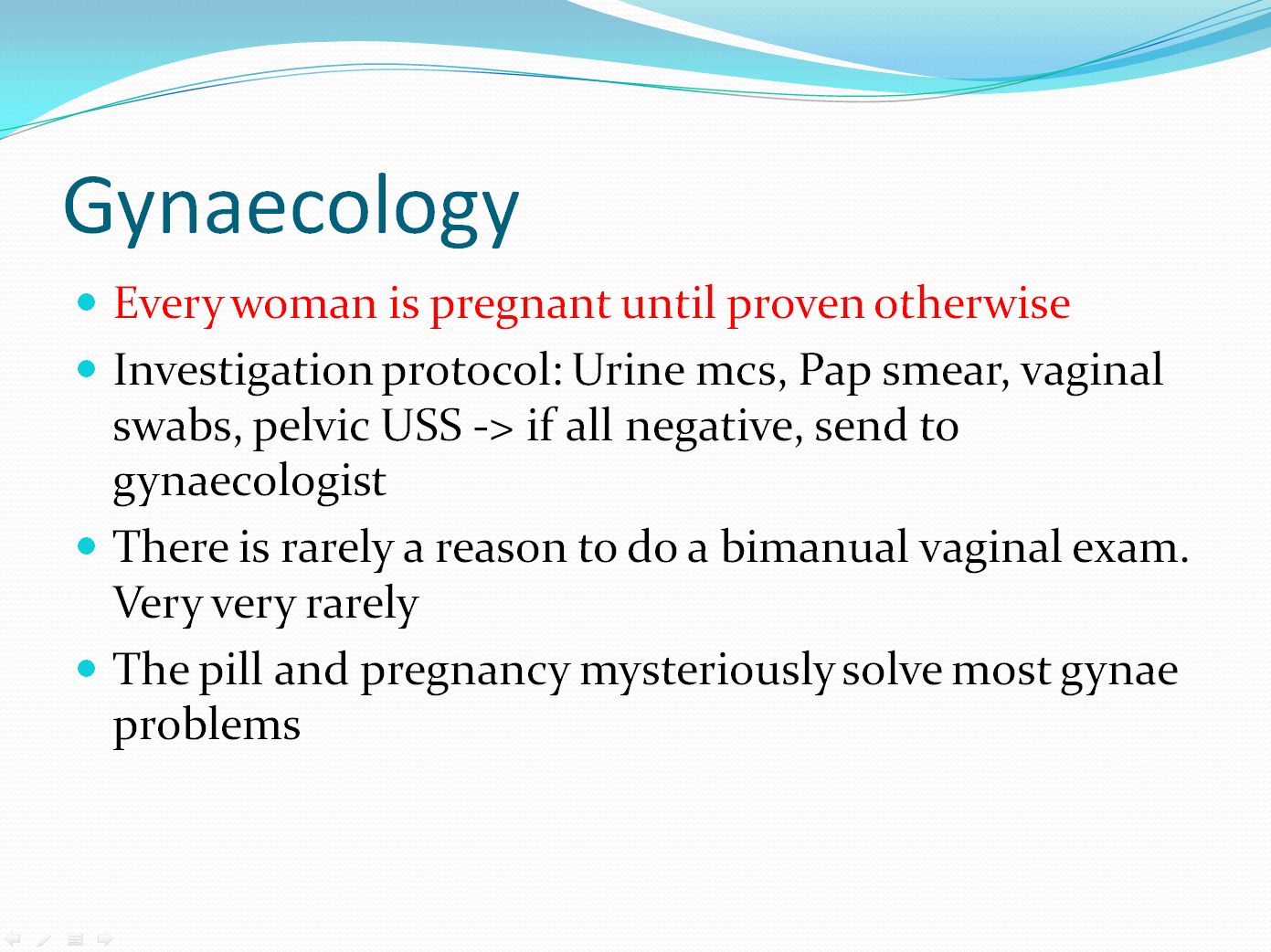
A few weeks ago I wrote a mock lecture for a friend who is a nurse to “upskill” her into becoming a doctor. It was something I wrote in jest with the intention of training her to do my job (so she could see my patients while I went home to sleep). I was going through the files on my computer today when I found that “lecture” again, and I got to thinking how actually, it’s not that hard to do my job! I will show you now why I say this, incorporating part of my lecture. Think of this as something like the general practice version of the 'The House of God' rules :P


Yes, these treatment options apply to everything.

OK, now that the basics are covered – and remembering that the safest thing you can do in general practice is to do nothing, here is a more detailed (using the term ‘detailed’ in a very loose fashion) run down on the medical aspect of illness, by organ system.


Now, if you remember just a few of those things, you have very close to the medical knowledge of an Australian-trained GP. (You don’t even really have to worry about knowing how to do a physical examination. I mean, have a look at rashes and things patients like to show you, but it’s rarely going to be essential that you lay even a hand on them!)

Tuesday, July 10, 2012

On memory


I came across an email I wrote a few years ago and it was about something that happened to me in 2007. In 2006 I took some time out of medical school for reasons I’ve discussed many times in this blog. The thing is that in 2007 I returned to finish off my medical degree and I kept running into people I’d known previously from medical school – and they were all surprised that I had returned! The only person, it seems, who wasn’t surprised that I returned to my studies was myself. And yet I struggled to understand why people were surprised given that I never once considered it a possibility of not returning.

Here’s part of the email I wrote to my friend (and, yes, I do write very long emails):
Being back at the hospital I am often running into guys who knew me from a few years ago, and its so weird. Some of them (I guess the ones who knew me a little) tell me that they’re glad to see I came back into it, back to med. This girl even gave me a hug the other day and said exactly that! Now, in my mind I can’t remember ever being as unsure as these people seem to be that I would return. When I decided to take leave, I knew it was just a break, that’s what I wanted, and I don’t remember doubting that I would return, only doubting that if it was to be one rotation off or the rest of the year (that’s all the options the school offered me). But maybe I was projecting something different. I don’t know now, I’m confused. Maybe other people were projecting onto me and doubting my commitment or abilities more than I was. It’s so strange; I don’t recall being that unsure.
I remember feeling empty and alone and overwhelmed - and the insomnia- but it wasn’t even the lowest I have ever been. By comparison that period wasn’t even that bad or even that long-lasting. And I remember a few months after I stopped doing med in 2006, a friend of mine (and I mean a friend not an acquaintance) said to me “you’re not going back, right?” I thought that comment came out of nowhere and I was a little offended, because even at the time of that question I was very convinced that I would – and actually looking forward to returning to med the following year. 
My family also had countless talks to me telling me that I should return to med. I felt it was so pointless because they spoke to me as if trying to convince me of something that was against my will, whereas I felt ‘of course I won’t counter-argue because we both are thinking the same thing’. It was absurd. But of course, I knew that some of them were telling other members of my family that I was a loser who was incapable of finishing a real uni degree. 
And then there was my therapist, who probably knows me better than most of the people in my life and is familiar with most fragments of who I am. She also asked me before I started back, if I actually wanted to go back. Returning to med was never an issue as far as I was concerned; when I would was the only issue present at the time I decided to take time off. And she had known me since before I started to feel all the negative stuff that made me want to take the time off. 
So, my question is: why did everyone doubt that I would return to med; what have I forgotten from that time? Why do I forget? And what else am I forgetting? It’s scary, you know.
The only explanation I can think of for my old acquaintances saying they’re ‘relieved’ to see I came back into med is based on another theory of mine. After I’d already been on leave a few months 
I told two acquaintances of mine from medical school that I was on medical leave. So, my theory is that these two boys must have told a pretty drastic story of how I was and why I’d had the time off. I figured this after I ran into some people and to catch them up on my story I’d tell them that I was a year below them because I’d had some time off – and yet most people already knew that even though I’d only told two people in my course.  They all added that they were glad I had decided to come back. What decision to come back?! I had never doubted whether I would or not. Unless I am forgetting something. Am I forgetting something? 
It’s pretty confusing. I am scared of becoming convinced of something like 2+2=5 if you tell a person enough times, like in that book 1984. Maybe the whole world is really like that, and the world trade centre really just fell accidentally and there were weapons of mass destruction in Iraq and you can convince a person that the world has always been the way it is and nothing of the past atrocities brought us to this “progress”. But then what do memories serve us for? To confuse us? To make us suffer because of the incongruences?...
What I’ve come to realize since the time I wrote that email is that in this world it is dangerous to believe what others tell you about yourself. Hitler, for example, surrounded himself with yes-men, people who agreed with his every word and told him his every idea was genius. Isn’t the same equally true if others are constantly beating us down and telling us what a failure we are and how unlikely we are to succeed? We need not surround ourselves with only our worshippers and we don’t have to believe our oppressors, but the truest stories are sometimes those we write ourselves. The story of Vanessa is best written by Vanessa; and if I want to describe a positive person, then I have to build my story to allow myself to become that positive person. It’s taken me a while to figure that out, but my story is a work in progress.

Sunday, June 10, 2012

On prescription drug abusers


Every now and again all doctors will come across a person who wants to access prescription medications for the wrong reasons. Some people will want them to feed their own personal addictions, and others will resell them for a profit on the streets. Personally, I am never one to judge people for their weakness or for their lifestyle choices, yet this scenario bothers most doctors for a variety of reasons. It bothers me because the false stories these people tell will make me second guess and misjudge the person who tells the same story but it is true and they have a real need for these medications. And, yes, it is also frustrating to have to deal with patients who are lying to you or who abuse your trust or become aggressive/threatening when you challenge them or deny them what they want when all you’re trying to do is get on with your daily job.

There are some government systems in place to help doctors identify people who abuse prescription drugs, but unfortunately they have big limitations. The biggest reason they probably don’t work is that a doctor has to first decide to enquire with them about a specific patient. Now, the patient who is a prescription drug abuser usually knows how not to arouse suspicion from doctors – therefore the doctor never decides to check their background! In medical school they taught us some basic things that should arouse our suspicion that a patient may be a drug abuser, but most drug abusers have figured these out and found ways to deal with us to make us believe they aren’t one of those people we learnt about all those years ago. For example, some of the things we were taught are that drug abusers tend to:
  •          book the last appointment of the day (no, not anymore. If anything, they tend to be morning people)
  •          ask for specific medication (they know how to calculate equivalent doses of whatever you give them if it’s from the same drug class. They also know to ask for an NSAID and paracetamol along with their opiates and benzos)
  •          can’t back up their stories with clinical data (they have scars to prove the “surgery”, the medical report from the hospital, the clinical signs on examination, the old packets of the medication they have been prescribed, the imaging report, the name of the interstate specialist who looks after their condition but is unfortunately unavailable right now, etc.)
  •          they become angry if you question them about drug abuse (“Oh no, doctor, not me. You can even call my specialist – oh wait, he’s not there today”…)
  •          refuse referral or liason with other clinicians (you have to admire these guys’ confidence in their lies. I once was  informed by a hospital oncology department that I was the 15th GP that week that had referred a patient for urgent review– a patient who did not actually have the metastatic cancer the CT report he provided from his interstate doctor, a doctor who knew nothing of the patient either)
Most doctors agree that a solution to the problem of prescribing to patients who abuse prescription medications is to have a real-time system of prescribing where the doctor is alerted to how many times a drug of abuse has already been prescribed to a patient. Would it work? Maybe, or maybe not. I hope it does if it's ever introduced.

To be honest, what bothers me most about the issue of prescription drug abusers is not that I was once duped by an amputee who claimed to be a war veteran but who had in fact lost a limb from intravenous drug use related disease (and not a war injury as he claimed) and I gave a script for opiates to. But that that experience made me doubt the next amputee war veteran I saw who had lost his limb through war injury and had severe phantom limb pain for which his pain specialist had prescribed a whole concoction of drugs, including opiates. Had his specialist not been available and his story backed up, I may well have let him go without receiving the proper medical care he deserved. That is my greatest fear regarding this: not that I feed a junkie’s addiction, but that I commit an injustice to a real and deserving patient.

Tuesday, December 27, 2011

On alternative medicine

The most “open-minded” thing I’ve done this year is to try this so-called natural medicine thing from a consumer point of view. Whenever I tell this story people almost gasp in disbelief: Yes, me, an Australian-trained doctor trying this thing we have been taught since medical school is mostly witchcraft. And yes, I admit, that is (or at least was) my own view on this. The common medical literature tells us “natural medicine” is not scientifically-evaluated, poorly understood because for the most part it’s not in line with the common biopsychosocial model of medicine, and that it’s potentially very dangerous.

Sometimes patients ask me what my views on natural medicine are, and essentially they mean to ask my medical opinion on whether certain natural medicine treatments will help their condition or not. My response is almost always the same: “If you believe it’ll work, it probably will. If you don’t, it won’t”. I don’t know if that’s true, but I’m pretty close to certain that it is true when we are talking about homeopathy. My response is also an acknowledgement to the God-blessed and irrefutable placebo effect. And that is about the extent of my knowledge on non-Western (or alternative) Medicine.

My experience with alternative medicine until a few weeks ago did not leave me with the best of impressions, and they were mostly experiences I had had through my patients. However, before starting to share some of these experiences, I would like to say that I don’t intend to vilify or defame something which I have just admitted to understanding so little, in telling these few stories.

The most recent gimmick I fear for my patients sake are the “full-body scans” that promote themselves as being ‘scientifically-proven’ for the diagnosis of a multitude of vague complaints. They spit out beautiful 3D images and buzz words like “inflammation” or “congestion” and the name of a body organ. Patients pay hundreds of their dollars for the beautiful colour printout they get after having their temperature, blood pressure, pulse, and maybe even respiratory rate measured. But the point is they get what they want because some manufacturer has figured out how to give the patient what he wants (to be taken seriously, to feel cared for, education about his condition, etc.) in exchange for what he wants (money). Oh and how it breaks my heart to have my patient come back to tell me he has stopped taking all his heart medication because the printout said nothing about anything being wrong with his heart only about his spleen being ‘congested’. Or sometimes they’ll come back with a list of obscure tests the naturopath or someone has asked he have checked though you think they are not clinically indicated. So you explain to the patient that those tests may be performed privately, with the cost to the patient, and suddenly they think you are the devil because you are the one who told them about the cost even though it’s not a price you’re setting or something you even think they need… There are many frustrating stories out there from clinicians whose patients have sought the services of an alternative medicine practitioner and some have happy endings and some drastically worse, but what I really wanted to share this week was about my personal experience.

Now, a few weeks ago I allowed my mother to talk me into trialling some “alternative medicine” through a Chinese medicine practitioner one of her friends had recommended. This is the common referral method in this field; word of mouth. So I went along to see this gentleman about a vague diagnosis of “depression” which mum had noted I had increasingly being struggling with (since a recent change in my life circumstances, so probably not even real clinical depression but a temporary low mood). But, hey, I thought I had little to lose so I went. The nice Chinese man with only basic English began by taking a routine medical history and a brief clinical examination (checking some aspect of my pulse and looking at my tongue). He asked about medication I was taking, and after looking at my tongue told me I had a problem with indigestion and ‘loose stools’. He also said I don’t like change and that is why I had “depression”, it was so easy, he said, to see that in me (I call that being human, but whatever).  And he said he could help me if I followed him. Then he took me to another room for acupuncture.

As I lay down on the bed, knowing how “well-educated” people consider me to be, I felt I truly had no idea what was going on and what was going to happen or the mechanism by which it was meant to help my very vague collection of symptoms (including the ‘loose stools’ or ‘indigestion’ which I had not noticed or even bothered me before, and the reactive low mood in response to some changes in my life). I remembered what I told my patients, and I decided to trust the guy about to stick needles in me. I wondered if he could sense my ambivalence and distrust, but truth is it doesn’t take any kind of professional to recognise that in another human being. I wondered just why I was going along with this: To “cure” myself of ailments I probably didn’t even have? To please my mother? To see what all this ”quackery” was about? I think it was a combination of all the above, but despite my reasons, I knew there was nothing imaginary about the needles about to pierce my skin.

He came back in the little cubicle with (to my relief) sterilely-packed acupuncture needles and ethanol wipes. He inserted 11 needles in me, on both sides of my body: 2 near the fibular head, one posterior to the medial malleolus, one on the palmar aspect of my wrist, one just behind each mastoid process, and a final one on the very top of my head into my scalp. What I’ve always being told about acupuncture is that they use tiny tiny needles; what I didn’t realise until the day of my first session was that these tiny needles still hurt! After I had the needles inserted, I was left in the cubicle for 30 minutes and a soft harp music was played over the speakers.

I didn’t know what I was supposed to think about for those 30 minutes, so I started thinking all sorts of things. I couldn’t move because every time I moved, sharp stabbing pains would shoot through the spots where the needles were in me. First I thought I was meant to focus on the music and just relax, however I was in the middle of an Asian-dense shopping centre and people were talking and shouting and that kept distracting me. Then I thought I might focus at the point tenderness the needles were causing me, but that got old pretty quick too. So I started to try to decipher how the whole acupuncture thing works. The guy who put the needles in me hadn’t explained it to me, but actually I remembered that one session in medical school where we briefly discussed about alternative medicine. It was something about Chi channels, which don’t correlate to lymphatic or nervous or vascular channels and have possibly no anatomically corresponding structures to account for them. Then something about the balance of the Ying and Yang, which are some metaphysical constructs related to health and life in general… Oh Gosh, I was half making it up and I was still no closer to understanding what I was at that moment meant to be going through.

Finally the 30 minutes were over and the Chinese medicine practitioner told me to get up and follow him. He asked how I felt. Um, I felt like I had just had being laying down for 30 minutes listening to relaxing music while having needles pierced in my skin. What was I meant to feel? Spiritual enlightment? Physical invigoration? Relaxed? I felt relieved, honestly, because my neck was sore and I needed to change my posture. So that’s what I felt, relief; but I didn’t think that that was what the nice Chinese man wanted to hear so I said I felt “better”. I remembered how I sometimes treat patients for things they don’t fully understand (though I try to explain) like hypertension. I tell them the medication won’t make them “feel” any different, let alone any better, it’s not meant to. They may not feel sick, but untreated high blood pressure increases you risk of things no-one wants to have like heart attacks and strokes. So they take the medicines I give them though they don’t notice any change, except maybe some side-effects, and they trust the 2 minute explanation I have given them as to why it’s good for them. I felt a bit like that with my Chinese medicine practitioner, though he asks me how I feel. I like this guy, he’s a nice man, he is trying to achieve something with me here, so though I don’t know what the right answer is, I don’t want to call either him or myself a failure... Better, I must feel better.

He charges me more than I would charge a patient for a consultation of equal duration and he picks out some pill boxes from his shop, all in Asian writing I can’t understand. He says take 40 of these tablets twice a day. What?! No, no, it’s fine, he says. He tells me he can “guarantee” they aren’t going to cause any side-effects; that they are free of these evil “chemicals” the medicines I prescribe have. Of course, they are “all-natural”. I ask what they are. They are “natural remedies” with “natural” ingredients to treat my loose stools and indigestion. Oh yeah, those things that weren’t even causing me any discomfort. He books me in for a further 4 acupuncture sessions which will make me feel even “better”. My heart sinks because my mother has heard this whole exchange and she’s ecstatic!

I went along to the other 4 sessions, my mother kindly driving me in and even offering to pay my fees. My mood is still a bit low and my self-esteem a bit shattered from the personal difficulties I had faced a few weeks earlier, so I don’t have the courage to say no. I even take the 80+ tablets twice a day for a few days until I get constipated… At my second acupuncture session he asks whether I have stopped taking my other “non-natural” medicines yet. I didn’t know I had to, but no, I haven’t. I understand the potential side-effects from stopping my medication abruptly. A cold chill goes through me thinking that this is exactly what my patients face, and no wonder they do stop their medications and suffer the consequences. It seems so cruel to me. He asks if I feel better. Well, time is helping heal my emotional wounds that had being inflicted some weeks ago, and I’m pretty sure that would have happened despite the “natural remedies” and acupuncture; but yes, nice man, I am better. Is the “indigestion” better? Am I free of the ‘loose stools’ yet? Yes, nice man, I am free of those things I didn’t even know were problems... Eventually, I’ve spent so much money, I have got so much “better” (judging by what I am telling the nice man), and my self-esteem and normal affect have returned that I just can’t continue this whole thing.

And am I better because of the intricate placebo I have just trialled? Or am I better because I never was ill? I don’t know, but I have at the least realised the effect of faith has on healing. When my patients seek alternative medicine methods, they are usually at their most vulnerable and desperate to be well again. I would be better to see them more frequently, to engage them, to ask (maybe demand?) improvement from them. Maybe if I keep asking them if they are better, maybe if I keep seeing them once or twice a week, maybe if I make them believe the challenge is not just his but his and mine, maybe if I keep asking him to take his medication time and time again, maybe if I pay him personal human to human attention, he will get better. And I think that is the lesson in this for me: that is the kind of practitioner we need to become a bit closer to being, rather than leaving all these tasks to the alternative medicine practitioner, who may or may not also give the best medical advice.

Sunday, November 20, 2011

On telling

I remember as a medical student being told by a psychiatrist who was teaching us about clinical communication skills to always ask yourself “is this for the patient or for me?” A little bit of self-disclosure in clinical scenarios is helpful; it helps establish rapport, trust, and confidence that the person we have entrusted with our psychological care knows exactly what it’s like to be human. That’s the purpose of self-disclosure in medicine, that’s how we can justify telling patients our sins, our glories, and just our everyday occurrences. Besides that, all we are being paid to do is provide a clinical service of diagnosis and treatment. Needless to say, it’s not appropriate to start telling our patients intimate details about our personal lives and thus introduce potentially biasing information that will impact on the patient themselves or their views on us as their clinician or the clinical advise/treatment we provide. But this rule about what we tell and don’t tell got me to thinking to how it applies to life in general, not just as it applies to health professionals.

Two key features of a successful and happy relationship are honesty and trust. You want to be able to trust that your spouse/partner/friend/business associate/etc. is an honest person that does not lie or betray you, right? But at the same time you need to be able to trust that they won’t, otherwise the relationship will be ruined by the constant questioning of their (or your) honesty. Consider, for example, an ideal romantic partnership where the two people involved love and care for each other and have romantic interactions exclusively with each other (including sex, but also other forms of physical or psychological intimacy). That would be a good relationship, right? But what if a similar scenario arose where the two people involved in a romantic partnership love and care for each other and have romantic interactions exclusively with each other BUT the partners were repeatedly asking of the other: “have you slept with anyone else today?”, “have you told any lies to me today?”, “do you love me still today?”, etc. etc. Now, the other partner could repeatedly be honest and say “No”, but isn’t it likely that this good and honest relationship will be destroyed by the lack of trust?

Now consider a scenario where you have the trust but not so much the honesty. You could, for example, have two people who love and care for each other but their romantic interactions are not exclusive to each other. They may every once in a while have sex with other people. They don’t, however, ask of each questions of fidelity, it is only assumed – they assume the other person is honest or sexually monogamous or that they have romantic feelings only for them. You could say that these are either happy human beings or you could say that this is not a good relationship, even if the two parties seem outwardly happy with themselves and each other. You may say that even if everyone it is happy then that happiness is invalid because it is predicated on dishonesty – or better said: lack of honesty.

This ‘happy couple’ to me poses a very interesting human dynamic, because as happy as the members of this couple are and as happy as the whole scenario is, it often fails. And it doesn’t fail because of dishonesty or mistrust. No, it fails, because of misplaced and selfish honesty. Again, let me repeat the scenario. There are two people who love and care for each other and are not unhappy in their relationship, but one (or both) of them engages in an act of intimacy (however you wish to define it) with another person (or persons). They’re not unhappy with each other, their relationship works and is otherwise normal. The relationship can function this way for months, years, decades, or until death parts them. What’s wrong with that? What’s wrong with having a happy life and a happy relationship, right? Well, probably nothing, except that it rarely happens. And I’ll tell you why.

After one of the members of a partnership has committed an indiscretion to whatever gravity, something happens but not to the partner who may be blissfully unaware or to the relationship which still has as much potential as it did before, but something happens to the offending partner. You know what it is? Guilt. Guilt creeps in, escalates by the minute, and this thing we call a conscience tell us that we should tell our partner what we did. It goes over and over in your mind, you convince yourself you are a bad person, you are convinced what you did was wrong, but overwhelming the feeling is guilt. Tony Robbins once said that guilt is really a trigger to correct your behavior, it means you have a standard which you haven’t met and as a result of this failure you feel guilt. That’s the point of it, to correct behavior back to what your standard is.

The truth is most of us do sign up to relationships to be an exclusive intimate partnership between only two people; that’s our standard. That’s what we expect to receive and that is what we expect to give in the partnership. So when we fail, when we don’t reach our own standard, we feel guilty. But what a lot of people do is mistake the trigger to change our behavior for one of simply anxiety or an unpleasant sensation. Therefore instead of thinking that what we need to do is change the behavior, we become convinced all we need to is just to relieve the guilt. So maybe we’ve stopped doing what we once did that caused us to feel guilty initially but we continue to experience the guilt because we can’t forgive ourselves. And we’ll keep feeling guilty until the day we decide to do two things: 1) meet our own standards, and 2) forgive ourselves. The second part is actually a lot more difficult than the first one is, so we often – mistakenly – substitute it. You know what we do when we can’t forgive ourselves? We ask others to forgive us.

When you can’t forgive yourself for cheating in a relationship, even if it was a once-off, we often make the mistake of asking our partners to forgive us. And we ask not because we care about them or because we love them and think they deserve to know the truth. No, I don’t believe that at all (although that is what we tell ourselves and our partner)! We tell of our indiscretions purely as a selfish way to ease our anxiety and guilt. This is what I mean by selfish honesty. There is nothing honorable about wiping your filthy hands on someone else just because you want to have clean hands again. That is selfish, self-indulgent, and spiteful. Don’t get me wrong, though, there are cases when we must confess to our indiscretions, such as, if we have placed another person’s health at risk or there are legal ramifications to our acts, etc. And here is where we need to ask ourselves: “is this for the other person or for me?” What exactly do you expect to gain?

If we tell our stories purely to ease your guilt, then don’t expect a reward for your honesty. I think that is so banal. Yet that is often what a lot of people do, confess their “sins” to their partner, tell them that they are confessing because they didn’t want to lie to them anymore (even though they had caused the other person no harm at all), and then expect to be forgiven because that is exactly what they need to ease their guilt. That is an even greater violation to the relationship. We shouldn’t use our partners to wipe our conscience. If the anxiety of holding a secret is really tearing us apart, if the guilt of what we’ve done is eating us away, there are more responsible ways to deal with it. As I said, what you really need to do is change your behavior. And if you must tell, tell a friend or pastor or psychotherapist, etc. The only reason we should tell our partners - hurt our partners, their self-esteem, their self-worth, their trust, their sense of identity, their faith in you – is to benefit them, not selfishly ease our conscience. And then we must expect not forgiveness but consequence. 

Sunday, November 6, 2011

On euthanasia

Jack Kevorkian served 8 years in prison for second-degree murder, that is murder that is not “premeditated”, or what you may also describe as murder that is not ill-intentioned. Essentially, he was a doctor that assisted many ill patients to die; what we commonly call euthanasia. He argued that he was imprisoned for being merciful, and that his merciful acts were to procure or hasten the death of other human beings. They were merciful because he aimed through his actions to liberate the person from suffering due to illness – when this person had indicated that they wanted or needed his assistance to do just this. The law said that regardless of the intent, procuring or hastening someone’s the death equates to murder and this is illegal even if the other party consents and requests it.

Now, a lot of the issues surrounding euthanasia and death legislation are about semantics, and to a lesser degree also intent. I remember first learning about euthanasia in a bioethics class, and I will describe it briefly now as I was taught it. There were four categories of “euthanasia” described:
1) voluntary active euthanasia (where the patient voluntarily requested help in dying and another person actively helped him achieve this) – E.g. a person asking someone else to inject a fatal substance into them.
2) voluntary inactive euthanasia (where the patient voluntarily requests help in dying and another person acts by withdrawing or ceasing an action that is helping the patient stay alive),  - E.g. a person asking someone else to pull out all tubes providing life-saving support like oxygen or fluids, etc.
3) non-voluntary active euthanasia (where the patient does not actually request or oppose help in dying and he is acted upon so as to hasten his death), - E.g. a non-communicative or possibly brain-dead patient who has made no prior indication of his wishes in this situation being given a fatal substance to hasten their death.
and  4) non-voluntary inactive euthanasia (where the patient does not request or oppose help in dying but another person acts by withdrawing or ceasing an action that is helping the patient stay alive). - E.g. a non-communicative or possibly brain-dead patient who has made no prior indication of his wishes in this situation having all life-supporting measures like oxygen or fluids withdrawn.
“Non-voluntary” is used as opposed to “involuntary” because involuntary implies that it is against the person’s wishes whereas non-voluntary simply that it is not opposed nor is it specifically desired. For example, involuntary active euthanasia could be thought of as common first-degree murder where a person does not want to die but he is purposely killed. Involuntary inactive euthanasia could be akin to a person actively asking for my help to avoid death (which I can presumably prevent by some action) but I withhold from providing this life-saving thing. This is a crime similar to murder in many countries too.

In most countries in the world what the law forbids are active forms of euthanasia, and in fact inactive forms of euthanasia are quite readily accepted – and legal. Every day in intensive care units patients are non-voluntarily actively euthanized, when their treatment is deemed futile by someone other than the patient themselves. And our right to “voluntary inactive euthanasia” is hailed one of the great achievements in medical ethics when doctors were disrobed of the expectation of paternalism to have that same power handed back to the alert, competent patient, in the form of autonomy. Any patient in the world can refuse any treatment in the world even if that treatment is considered life-saving. You can even write down your wishes when you’re still able to communicate them for future reference, for those times when you are non-communicative or no longer medically-competent. But I am digressing here, I could go on for hours on medical ethics, but what I really wanted to discuss is active forms of euthanasia.

Take religion and law away from the argument for a moment and try to discuss why euthanasia is “wrong”. Well, they tell us, it’s inherently bad because it has the potential for abuse and you run the risk of evil people wanting to just kill whoever for whatever trivial reason. Reasons such as, maybe, “he’s no good to society anyway”, “I don’t like him”, “he is of this race or culture”, “he’s poor”, or “he has no family”, or “he will cost more than I am willing to spend to keep alive”, etc. etc. There are many things in medicine with potential for abuse. We often hospitalize and treat the mentally ill; we force-feed those with eating disorders; we prescribe medications with known side-effects; we terminate the lives of foetuses for whom we can’t prove either way whether they are “persons” with an independent right to life or not, etc. I even heard it once said that one of the biggest mistakes in medicine was the idea to try to keep premature babies alive at all costs. Many of these babies will have chronic health problems, and the expenditure on neonatal intensive care units is massive. Some would say we have abused the technology in life-sustaining measures by trying to apply it to each and every patient, even these tiny babies which we are potentially setting up for terrible lives. My point isn’t to argue if these tiny babies are worth it or not worth it; my point is that we do entrust health professionals with many life and death situations all the time. And we do this because we have assumed they won’t abuse their powers just to see a new technology or treatment work without thinking of the consequences.

So then, why else is euthanasia “wrong”? They say because we could make a mistake – and the consequences of that mistake is not reversible. Again, doctors face this potential every day! I think that if you were to filter it down, the real controversies with euthanasia are 1) religion, 2) law, and 3) an expectation (or perhaps misconception?) that the overriding aim of medicine is to prolong an individual’s lifespan (as opposed to other aims like preserving their dignity, ensuring quality of life, and having a social responsibility to the rest of our fellow humans). Unfortunately, like many things in life, when you use one rule to apply to everyone in every situation, you will often get it wrong. Many people do not like to think that their doctor could have the knowledge or ability to perform euthanasia, because they assume doctors are special and, like I mentioned, should only want to prolong a person’s life. However, I believe that keeping euthanasia from the scope of medicine isn’t keeping us from any evil we aren’t already at risk of committing. I also don’t support allowing the scope of euthanasia to evolve without the input of medical professionals. If you’re going to do something, do it right. This is called harm minimization, and is not a new concept to medicine at all.

But why do I personally believe that euthanasia isn’t bad (if it were able to delivered effectively and without inflicting further harm or pain)? Because I believe that every person is free and free to choose to live their life how they choose. I also think it is cruel to deny someone something, especially their freedom of choice, simply because they need someone else’s assistance to achieve their goal. Imagine being denied access to the top floor of a building because you are a paraplegic in a wheelchair and the building isn’t equipped with elevators or ramps. Now, imagine that the reason you want to get to the top floor is because on the ground level where you are there is a fire that keeps intensifying. Don’t you wish someone could help you? But no-one can because then they will be arrested and they would rather not go to prison, even if they’re your friend or relative and they love you. So you’re left to fend for yourself. No-one bans you from going to the top floor, it’s simply a shame you can’t get yourself up there – and that is your only option! Oh well, better just wait for the fire to intensify, your skin to burn, and to watch yourself helplessly, and probably painfully, die. You knew all along that upon going to the top floor you’d only fall asleep and die up there, but hey, wouldn’t it have been nicer? Apparently not. Apparently it is nicer to allow our much-esteemed friends and family members to die in pain and helplessness.

And yet, having said all this, I have to clarify one thing for fear of being called out on my inconsistencies. Fortunately or unfortunately, I am Christian first and foremost, so no, I personally would not help a patient in this way. But I have tremendous respect for people like Jack Kevorkian who were/are courageous enough to serve their patients at all stages of life. Death is simply another stage of life.

Sunday, September 11, 2011

On skin

I was sitting in with a dermatologist one day learning about skin conditions of the type that are severe enough to make it into hospital. Before I went in to sit with him (as an observer) I had to wait out in the waiting room with his patients. I noticed a red man there with lots of fine scale on his blue work shirt and around his chair. There was also an older lady who I could not discern anything of note from where I was sitting. Then I went in to the dermatologist’s room to sit in the corner as any good medical student.

The man I had seen in the waiting room came in. He was quite animated and greeted both me and the specialist with a handshake and a big smile on his face. He was having another flare up of his psoriasis because he had been working out on a roof (he was a painter, I believe) and didn’t wear his usual long-sleeve shirt that in the Brisbane summer is only best described as torture. He was bright red (beyond what I had learnt the word erythema meant) and was shedding layers of skin everywhere, even as he talked and sat. He had come in his work clothes and he offered to remove it so that I, the medical student, could see and learn just how bad psoriasis can get. He was not a bit embarrassed, and he thought he owed to show me at least the worst spots of the disease, which extended literally from his feet to his face. After his treatment was sorted out and different work strategies were discussed to prevent such frequent exacerbations, he left with a smile even bigger than the one he came in with. The dermatologist explained to me afterwards that he was an extreme example, that he was the worst even he had seen, and that the man was remarkable to continue on with his employment and in such great spirits. I must admit, until that day, I had never even seen any psoriasis at all except in books – and that was not ‘typical’.

The second patient we saw was the other lady I had seen out in the waiting room. She came in, sat down, pulled her skirt up above her knees, and started crying. There were two small psoriatic plaques on her knees, about 4cm long by 1cm wide. The plaques were raised and had some scaly skin on top. There was no redness. This was devastating to her because this was the second or so time this had happened to her in the last four years. One knee, two small spots, and not inflamed. She apologized for having to show us such “disgusting” things that were on her knees; she was clearly embarrassed. The dermatologist treated her as if he had not just seen actually bad psoriasis and tried to dissipate her concerns and offer medical therapy for her skin. I was stunned to see how incredibly emotional she was and how humiliated she seemed to be!

One day I was out walking with a friend and she was telling me how she had always struggled to feel comfortable in her skin because she had a skin condition since she was very young. I had of course noted her skin appearance, but it had never occurred to me that she felt self-conscious about it. She told me how she imagined people thought of her because of her skin. They might think she is unhygienic and her skin is disgusting, that she is ugly and possibly ‘retarded’ or suffering some greater disorder. She said she imagined people would speak of her and comment on how ugly and disgusting she looked, and they would laugh and make fun of her. Just then a group of adolescents with skateboards went past us and were laughing amongst themselves. She said episodes like that made her think it was her they were laughing at. I felt at that moment not pity for her for having a skin condition, but rather offended as a human being not of what she thought people said of her, but what she thought of us, us people other than her.

I had one question to ask her: what did she think when she saw a person with a skin condition like hers? Did she think they were ugly and disgusting? Would she laugh and mock them? She responded no, of course not! I asked her then if she was special, was there something about her that meant she was a good person and the rest of humanity were judgemental, spiteful human beings? She said no, she wasn’t special. Of course she would never think she was special, her problem was one of low self-esteem not a heightened arrogant one! Well, I said, if she is not special and she would never think that way of anyone, what made her think anyone else would think that of her? Here she was accusing strangers, others, of being spiteful, judgmental, arrogant people with vicious mocking thoughts in their minds. Freud called it projecting, the act of ascribing to other attitudes and feelings you personally have. I believe no medical condition, handicap, special ability, money, or other advantage or disadvantage entitles you to cast judgement on other human beings!

There’s an early movie by Pedro Almodóvar called ‘Dark Habits’ in which a group of nuns take on the names such as Sister Manure, Sister Rat, Sister Damned, and Sister Snake. The aim is to humiliate themselves and remind people how even the “good” ones of us are despicable; they believe that “man will not be saved until he realizes he is the most despicable being ever created”. By the end of the film all the nuns have become either prostitutes, drug addicts, drug dealers, and other such “sinners” befitting of their adopted names. At the end, a higher-order cleric visits them to shut their order down and reminds them that sometimes “humility” can be the worst kind of arrogance when you wear it for a badge. Nothing that attracts pity entitles you to act carelessly or exonerates you from being responsible for what you say or do.

Sunday, July 10, 2011

On prescribing choice... and the hypocrite's spiel

There are many people who will tell you that pharmaceutical companies are the devil. I say the devil is the devil, but I also say the pharmaceutical companies are no angels. Let me first disclose something to you: I eat the lunches brought in by the pharmaceutical sales representatives (almost everyday at my work!), I give my patient’s their drug samples, I enjoy their “educational” dinners at expensive restaurants, I am grateful at their supply of products ‘directly related to my clinical practice’, and I miss the days of the free drug-stamped stationery and random gifts. I do not claim to be immune to their marketing tactics simply because I am aware of them; both they and I know that I am human and the tactics exist because they do work. There are those who directly embrace the drug companies with the attitude of ‘hey, if they want to give money away, they may as well give it to me and I will do what they want me to do’. And there are those that completely shun them, who demonize them, who accuse them of being a… a business. Aren’t we all in business? Those who claim they aren’t, aren't in business very long.

Just this past week I recognized a tactic by the sales reps I hadn’t noticed before: bullying. Now, what I mean to say is not that they wanted to humiliate or hurt me, but they sure as hell wanted to make me feel guilt. Now if I remember correctly from my industrial psychology and marketing readings, creating negative emotions in targets is one of the least effective methods to inspire change of behaviour (in this case, prescribing more of the drug they’re promoting); however, least effective doesn’t mean ineffective. The rep was telling me of some new medication; was I using it, she wanted to know? I said no, I studied a little pharmacology too and I felt more comfortable with another medication. She was horrified! Did I not know that it was the most popularly prescribed medication in its class, prescribed by the greater majority of my peers?! My mind was thinking ‘yes, and?’, but I said, ‘Oh, ok. I’ll keep that in mind. Anyways, thanks for the lunch.’ I went away thinking, wow, really, everyone but me uses it, was she implying that I am doing the wrong thing by prescribing something other than “the most popular”? Is it the most popular because it’s the most effective, because it the newest (and newest we are told is better), because they are better doctors than me and if I want to be good then I must be like them. As I walked towards my consulting room from the lunch room where I had the food brought in by the friendly drug rep, I realised it had worked. I was here second-guessing my clinical management not based on clinical data or evidence, but based on simple human emotion: everyone likes to be liked and to be like the rest. I then laughed at myself.

A few weeks ago another drug sales rep was speaking of a medication for erectile dysfunction. Of course it was about the drug, but they alway tells everyone “it’s about the patient”, thinking of what’s best for them. There’s no news or controversy in saying this; no matter what industry you work in, at the end of the day everyone must eat (and you need money to buy food, right?). Every drug rep walks in to that lunch room and comes with 1) our daily bread (or gourmet lunch), and 2) the “educational material” to impart to us that just so happens to show that the drug their company sells is better for our patients for some or another important reason. But this drug rep wanted not to tell me about why their erectile dysfunction drug was better than the other two, but wanted to know what I based my choice on. I’ll tell you what I answered but first I just want to consider another point on prescribing choice.

Now, you could have five different drug reps talk to you about five different drugs from the same class, both targeting the same “disease” (I’ll explain later why a disease is worthy of my quotation marks here), and they can all show you with ‘real clinical evidence’ and ‘scientific studies’ that their company’s drug is the best. The first rep will say their antihypertensive is the best because it, say, doesn’t have this bad side effect. The second one says theirs is better because it reduces blood pressure quicker than the others. The third one says theirs is better because the effects on reducing blood pressure last longer. The fourth one says it their drug tastes better and is in a smaller pill and that this is very important to patient compliance, therefore in fact being the best drug because patients will actually take it. The fifth one will say theirs is the newest and is so many times better than a placebo. Who wants to be associated with the old and outdated, right? Ah, the stories…

What I answered my friendly drug rep is actually not anything new to them. Why do I prescribe a certain erectile dysfunction drug versus another? Honestly, I confessed, my choice was based on whatever sample pack was in stock in our drug samples cupboard. They know this, that’s why they like to stock our cupboard, not because they like to give away “free samples”, but because it works at securing consumers. I have to clarify a little, though, I use this rather non-clinical method to guide my prescription choice only in certain conditions that in my experience the medications are only slight variations on each other with similar clinical effects, for example as in erectile dysfunction. The second reason to why I do this is because these medications are very expensive and I want my patient to try it first before he goes and spends his hard-earned money on something that may or may not be right for him. Most doctors do this, too. You give the patient the sample pack and a script to purchase the medication if they are satisfied with the effect or tolerant of its side-effects. In cases like this, I prescribe what is in the drug cupboard because I know the brand name will make little difference to the clinical effect I am trying to achieve in a patient. For some reason my honesty seemed to surprise the rep and I think it is because there must be some secret pact that we, both the pharmaceutical companies and doctors, must deny that our interactions are in fact business transactions and we should pretend they are purely “educational” and clinical.

As a medical student I did a placement at a clinic that strictly forbade pharmaceutical reps from visiting to promote their products (or should I say, educate us). It was a clinic were most of the clinicians also held academic posts at the university and they were thoroughly involved in evidence-based medicine. I remember one doctor specifically telling me about how he always prescribed the generic version of a particular drug because it was the cheapest and therefore it meant less money spent on government subsidies paid to the drug companies, and subsequently more money left in the health budget for other essential matters. It made sense to me.  Some years later I worked at another clinic where another very noble and more senior doctor advised me that I should prescribed the brand-specific version of a medication for depression that was now off patent. The reasoning was that the company that made this brand of antidepressant was highly involved in drug research and development and also at producing patient education and support materials, but they obviously can’t afford to do that unless they are making money also. It made sense. Yes, besides I also knew that once you allow for the generic version of a medication to be dispensed by the pharmacist, he incidentally happens to supply the patient by the generic version of a medication which is made by his pharmacy chain. Oh, everybody is a businessman. So my choice is then, who do I feed? The pharmaceutical company making the brand-label stuff or the pharmacy chain making the exact same but generic-labelled stuff (which in most cases cost no different to the brand-label medication). Ah, such decisions… Oh yeah, that’s right, this was mean to be about the patient!

Another thing that the pharmaceutical companies are accused of is not only of making healthcare a business (which I don’t believe they are solely responsible for), but of also creating disease. What do I mean ‘creating’? This is mostly in reference to the medicalization, the labelling, of certain human existential states as disease. Some years ago I read a story about how bad it apparently is that we have made things like pregnancy and ageing disease-states. In a similar vein, drug companies have been accused of doing either a good or bad thing, depending on your point of view. One could say that thanks to the educational and public awareness campaigns directed by our blessed pharmaceutical industry, so many people can be diagnosed and directed towards the treatment of many ails such as depression, anxiety, mood swings, hyperactivity, etc. etc. Another group of people report that the drug companies directed these campaigns as a diversion to their real campaign: increase uptake of certain medications (mostly psychotropic medications). They convinced people that their sadness, that their agitation and worry, that their child’s childish behaviour, are abnormal and required treatment – by using the drug that their company so happened to manufacture. Oh, so many coincidences…

And what have I achieved in telling you of these few tales? That I am a hypocrite? Maybe. But hopefully I have also reminded us all that we live in a capitalist society and that denying that there is a devil at our table won’t make that devil any more of a saint. Worse than being the devil’s pawn is not knowing that you are. As doctors, as human beings entrusted with the care of others weakened by disease, we must ensure that that truly is the worst thing: that we sell our own souls, and not that we trade in those of our patients for a piece of the devil’s share.

Sunday, June 19, 2011

On "that" year

Kingaroy, QLD

2006. I was 24 still. I was a child still. But before I tell you about that year, I’ll give you a speedy run-down on my life until then. Age -9 months: my mummy meets my daddy. Age -6 months: my mummy finds out the father of her daughter is also father to 14 other children before her. Ages 0-9 years: growing up in El Salvador, a country with low literacy amongst those of my social class, and in a single-parent family where no-one has ever finished high school even. Age 6: I “decide” to become a doctor like the “cool” guy my mum works for as a cleaner/nurse. Ages 6-22: still stubborn about wanting to be like that cool guy. Age 23: finally start medical school. Ages 23-24: study, study, study. And then 2006 came along…

Things got tough for me in 2006 and my second so-called “depressive” episode happened. I lost the joy in everything, study was a hassle, I became morbidly preoccupied with my own mortality, a great solitude and loneliness came over me, and I wanted nothing because simply wanting anything required effort. The social withdrawal and pathological shyness again set inside me. Then I got into a situation where a false accusation was made against me. I was feeling pressure from my religious peers and my internalized God concept. In essence, I felt deficient. I felt lacking. And I felt dead inside – and then the feeling to externalize what I felt inside came over me. I lacked the motivation, the energy and willpower to do even that. Fearing my own internal monsters, I chose instead to go again in search of Vanessa.

Once I left everything, I felt both a great freedom and a complete hatred and fear of that freedom. There were no friends, no company on my journey, I had some advice but which felt more like orders. I had no allies – and I didn’t want anything or anyone even if there had been such people there. At first the numbness overwhelmed me and I was as a ghost walking around (which I recognized because this was not the first time in my life I have had these “episodes”). Gradually, over the next few weeks, reality and the mundane started to creep in. I needed to eat, pay bills, move, reply to the questions that were being asked of me. I started then to formulate my own questions. Who is Vanessa? And yet, not so much who is she but who does she want to be? Why does she want to be that? Does she really want to be that? What does being that entail, the practicality of it? And what of everything else? What is important? Who is important? Who, if anyone, is my friend? And what do I do with these things I love but won’t make me any income? And what should I do about these things that keep pestering me, these things others call conscience? You’ll often hear me diss and complain about the ‘white man’s stupid concept of “finding themselves”’, but you could say that that is what I set out to do.

Specifically I had some questions to answer and that was my quest in this time without commitment to study to answer. Formulating the questions was the easy part. Even finding the answers while on the quest wasn’t that hard. Finding what you’re looking for is easier when you know what it is you’re looking for. The hardest part was making the decision to take a break from my study, my big commitment at that time, to go on my quest. I risked a lot. I risked losing my friends, my family’s belief in me, jeopardising potentially years and years of prior education (and money), and losing my credibility. But I made the choice and I then had to go exploring my questions, myself, trying out different scenarios and risk finding out that my whole life had been a sham. But sometimes not knowing is as deleterious as finding out an unpleasant truth.

The second part of my task, after walking away from it all, was easy: I had the question that needed to be answered. Did I really want to do medicine as a career or was it a childhood dream of mine that I expressed and no-one ever had the courage to shut me down about it despite all the odds being stacked against me? I was a poor kid in a third world country where tertiary education costs more than entire families need to survive. It was a nice fantasy that they let me believe for a long time – until fate and relocation made my dream a possibility. But I was always a stubborn person, did I want to go into medicine purely as a whim? To prove people wrong and that I could do it? They were questions, and I answered them fairly quickly, actually. I think that giving yourself the space to not feel judged is very empowering. People may still be judging you, and I remember a lot of “friends” and even family members discounting me as a drop-out, as someone with no stamina, as a loser. But me, I gave myself the space I needed, I didn’t need anyone’s permission to explore my own life and motivations.

Like I said, the process of answering my questions took a remarkably quick time after I let go of the restraints I allowed to be placed on me by society, by other people’s expectations, by my own pride, and by my pessimism and distorted view of ‘reality’. And in the process, I learnt not only who I in fact was, but also to no longer despise myself for not being what was ‘expected’ of me. The answer to my questions were:  yes, medicine is what I, Vanessa, want to work in; and this will be a job like any other. I came to this conclusion by considering the things I enjoy (writing, visual arts, and film and theatre) and the things that I could bear to do for income. I could not bear to do anything other than medicine as income, and I’d perhaps do it even without income if something else where somehow feeding me. At the same time I was able to explore many aspects of the medical profession, and I had no grand illusions about it like a lot of people do, illusions of ‘saving’ people or of ‘making a difference’. I came to understand a lot of the industrial and organisational psychology of the business. And I became comfortable with what I learnt.

The rest came easy. The friends elected themselves by being the only ones standing when everyone else had gone. I bit the bullet and made a religious commitment. I got a “money” job because I was already planning for my future and my dream to see the wild condors in the Andes in South America. I in fact spent the remaining months of that year killing time by working and entertaining myself until my return to uni and getting on with my task of achieving the next task on the journey. So guess what I do now for work? Medicine. And guess what I do for passion? Write. And I can now unashamedly say that my name is Vanessa and I know exactly who Vanessa is.

Condor! Colca Canyon - Arequipa, Peru

Sunday, April 24, 2011

On 'what's going on' with me

'The Thinker', on top of 'The Gates of Hell'. Auguste Rodin.
O.J. Simpson once said, "They say people don't change, but I say they're wrong. People change, but it's usually for the worst". He may be a man that doesn't always speak the truth, but he wasn't too wrong in saying that. Or maybe he was. I've always believed that in life change is inevitable, but qualitatively neither good or bad, just inevitable.

Recently I've had some well-meaning people ask me "what's wrong", "what's going on with you". Now, to the majority of the non-family, non-religiously-affiliated of my friends this question may seem a little odd so allow me to provide a little background. Who is Vanessa? Some people that know me may answer this differently to other people who know me. Which is the right version? Both! All angles, probably. I'm no different to anyone in this respect. But a lot of people who know me from either being family or a religious peer will describe me as shy, non-engaging, quiet, and abiding. They see me that way because I was that way for such a long time. I am not the perfect Christian or the perfect relative, but I am presumed to be pretty close to it. Worse than being presumed to be perfect is to buy into the belief that you have to be. Even worse than that is knowing you are being evaluated at every encounter to ensure you still meet the same criteria. What can I tell you about me? I can tell you I am human.... And let's consider humans for a little while.

A human is born a small dependent child that needs the basic things we need thoughout our lives: nutrition, hydration, protection, sensory stimulation, social contact, and what we broadly call love. The difference between a child and a grown adult is that the child is initially dependent on others for all these basic needs. As he enters adolescence the social contact he needs becomes more than that of his parents and immediate family members; he seeks and needs the interaction with other peers. Later, maybe into puberty, he comes to crave a sexual relationship (whether that be physically or emotionally intimate or both). As adults we don't stop developing; our physical, social, and psychological needs change and the tasks we have to achieve to meet these needs change too. We are a constantly growing being.

Have I changed? I hope to God I have! I'd hate to still be thought of that defenceless child lying in a cot with only a cry to communicate my needs, and then waiting and needing someone to come help me meet them. Everyone changes. It's human to. It's inevitable in this skin and body to stop being human without killing yourself and hoping that those things we believe in about the afterlife are true, whatever they may be.

What's going on with me? The same thing that is going on with every other human being: living, experience, change. I can narrow one thing down, though. I was always an insecure, shy, quiet girl when I was younger. Gradually, and very very slowly I must add, I became a bit more and more confident. And by confidence in my sense I mean more at ease at accepting that I am also human, and at the same time that it is okay to be and feel different to others. I became confident to form my own identity. A long time ago Erikson, a psychologist, described a series of psychosocial stages of development that a human being transgresses as he grows chronologically older. Everyone ages; everyone equally and inevitably must grow psychologically. I guess where I am different from a lot of other people is that because of my pathological shyness, the formation of my own identity didn't happen when it does in most people: puberty / adolescence. Me, as I've mentioned in a previous post, I couldn't even look at my own body comfortably until I was 26 years old. 26! I couldn't believe or accept that that body I had to look at only because I couldn't get away from it, belonged to and was me. And that was the external aspect; I can't even begin to explain what the psychological experience I struggled with, these feelings of depersonilization and unreality, were like. I reached 26 years without yet fully defining and deciding who Vanessa was. And I'm 29 now... There are those that are intellectually retarded, I guess I prove that you can also be psychosocially retarded :)

Sunday, April 17, 2011

On doctors... Part 2

Just as I thought I’d finished this post, I remembered what exactly I set out to do: provide a dual view of people’s experience of health care. Now, it may seem that above I was just taking a defensive stance to explain what is experienced by the doctor himself compared to what the non-medical population, our patients, expect. But it must be acknowledged that a lot of patients do have these, perhaps out of date, perception of doctors – and doctors would be callous for overlooking this!

It’s already established that a doctor has a very specialized knowledge, access to which you can ‘buy’ for the cost of a consultation fee. However, this knowledge is of value to every human being because it deals with something that affects you directly and in the flesh. Access to this knowledge, the service the doctor provides, could potentially save your very life – there are very few services this could be said of! Patients know this and that is why they seek them. Doctors have to equally acknowledge this, so as to fulfil our duties (for which we are being paid for). Generally, people do not present to a doctor just to hand over some money for the consult fee and waste some time. Generally, they pay their fees in order that the doctor provides advice and or treatment for a sub-optimal machine fragment. That is an important thing for an ethical doctor to realise. Now, I say ethical speaking of work ethic more so than moral or philosophical ethic. If you paid a mechanic to fix the gearbox in your car and he dismissed your concern about it because he doesn’t feel motivated to work currently, and he did nothing to repair or investigate the problem in your gearbox, then charged you his mechanic’s fee, what would you think? You would think he has a poor work ethic, not necessarily that he’s an immoral person or that he’s not a good mechanic; quite simply he has not done what he was paid to do.

Patients don’t go to see their doctors when they are happy and healthy and life is grand. They seek the doctors when they are in need. And that to me is one of the biggest realisations a lot of doctors fail to make. Even the patients that abuse us, that blame us, that threaten and disrespect us, did not come to us without a need. Perhaps it may even be that they need treatment for their abusive behaviours and just haven’t realised it. But patients don’t present to us to waste our time. They perhaps have expectations of us that are above reality, but they do have basic needs that are not being met – and sometimes the cheapest treatment we can offer them is to acknowledge and validate their concerns.

Having said that, I can only emphasize that medicine as an industry does not always obey your standard commercial industry rule to give the client exactly what he asks for. You may ask someone to sell you a plank of wood of a particular length and he will gladly comply and bill you accordingly, but from a doctor you buy a service, not a product on its own. For example, if a patient attends a new doctor demanding a script for a drug of dependence, that doctor is not obliged to hand over a script at the end of the consultation. He is required to perform a consultation and apply his special skills to determine what the treatment indicated is, which may or may not be to provide a script for a drug. And in that, the medical profession differs because we do have a duty to both aim to improve the patient’s health and also to prevent negative health effects. A doctor does not sell prescriptions, investigation requests, or referrals to other health professionals in exchange for your consult fee. No, he sells his time and specialized knowledge, which may require referral, investigation, or medicinal or surgical treatment.

I suppose if I have to summarize this whole two-part rant I’d say I was trying to make two points: 1) Doctors are normal people doing special jobs, and 2) Doctors would be silly not to acknowledge that the non-medical public does attribute some beyond-human qualities to them. People do the jobs they do for different reasons. Medicine is also a job, but a special one in the personal and direct nature of it. As human beings engaging in human-human relations, both doctor and patient in the relationship need to acknowledge the fact that we are all deserving of the same respect and care owed to each human being aside from our duty in the transaction.

Sunday, April 10, 2011

On doctors... Part 1

I particularly hate labels because of the stereotypes, often negative, associated with them. But today I will discuss doctors, as a label, just like the non-medical world sees/believes it. Now, I am during the hours of 8am-6pm, Monday to Friday, also one of these doctors so I will aim to give you some insight into what this is actually about.

Traditionally medicine as a field of study (science or art, as you choose to see it) was something that was practiced by a select, if not elite group of people. Guys from the times of Hippocrates were taught by apprenticeship. They had a code of practice, and they were taught by and from the knowledge others before them had acquired. Those chosen to partake in the training to practice medicine were children of the wealthy, of other doctors, and other persons who excelled academically or otherwise, etc. It was an elite group acquiring a very specialized knowledge. Their superior knowledge and skills on which others from the village depended on placed them in greater standing in their communities. They were people to be respected, protected, renumerated, and admired for their service to the community. Such behaviour was totally understandable when it’s considered how many people in a village one physician was entrusted with caring for (often for a fee because these were rarely men of religion or charity).

Fast track to modern times and a lot of people still have the belief that doctors are special people. They believe they are smart, inherently “good”, of high moral standing, wealthy, caring, and just somehow different to other human beings. Now let me consider a few of these points. Actually, first let me consider what it means in modern times to be a functional human being. A man or woman living in modern times needs nutrition, shelter, psychosocial support (usually family and friends), industry, recreation, self-efficacy and satisfaction, and the money to be able to afford a lot of these things. Doctors are human beings too. Doctors also need these things. Doctors are human beings who are practitioners of a particular profession – but they are first and foremost human beings born of other human beings and of the same substance of every other human being on this planet.

I will start by discussing first the most banal of subjects, because it is a subject neither doctors or non-doctors like to associate to the profession: money. A doctor is a person whose job it is to deal with other human beings in order to improve their health or wellbeing. Note first that he is a human being doing a job. Jobs are done for money. A doctor needs money the same way everyone else needs money. You can’t walk into a supermarket and grab your groceries and tell the checkout personnel that you won’t be handing over money for your items because you are a doctor. No! It’s absurd. Money is demanded of doctors the same way and for the same things it is demanded of any other human being. What makes people uneasy about this discussion is no-one likes to think that a monetary value can be placed on preserving or improving the wellbeing of another person – but try doing it without it! How without money can you buy the equipment you need to exercise your profession, to feed and clothe yourself, and to enjoy the recreation all human beings are entitled to? A doctor provides a service, a product if you will, a specialized service; in return a fee is charged for this service. There is nothing abnormal about this. Teachers, engineers, shop assistants (not shop owners), prostitutes, psychologists, and even a lot of clerics, do it. Are they bad people for practising a human profession? No. They are workers employed to render a service for compensation. To deny that doctors don’t think about money and how to make it is like to deny that they eat and breathe and defecate just like any other person on this planet. Interestingly enough, unlike the nursing profession, medicine was never so inherently related to charity and religious servitude. A medical man was always separate to the concept of providing charity; he always provided a service for which material reward was often gifted/charged/expected.

The other common misconception is that doctors are somehow different, or better people, than others. Well, what kind of people go into the medical field these days? All kinds of persons. People of wealthy families, people of poorer families, people who are religious, people who are atheist, people who are accepting and welcoming, people who have prejudices, people with high academic scores, and people of not so high academic scores. At the end of your medical school training all these people are awarded (or earn) medical degrees. The prejudiced guy’s degree and that of the religious girl are both equal – and they both are now doctors. The medical schools teach you medicine, not how to be a “good” human being. Therefore, post-graduation the only thing in common of the graduands is their medical degree not their moral standing or wealth or religious views or any other societal variable. A person with a medical degree is still just that, a person. To say “doctors are special” is like saying “children like birds”. Some children like them, others hate them, some of them don’t even notice them, some wouldn’t even know a bird if one stood on its head. What am I trying to say? There are as many “good” doctors proportionately as there are “good” people in this Earth.

Lastly, I want to consider the concept of the ‘caring’ professions. One complaint patients sometimes make of doctors is that they don’t care. Now, remembering what I just discussed about how different sorts of people enter the medical profession, we have to consider that the reasons that people do go into medicine are also varied. For example, a person may go into medicine for some perceived social higher standing, because it is a profession in which continual education is inescapable, because they find biology and science fascinating, because they want to be of assistance to other human beings, because they enjoy certain technical aspects of surgery or procedural medicine, because they enjoy interacting with other human beings, because science and biology was something they were good at academically at school so they may as well use it in their work… the list is endless. Of course, most members of the non-medical community assume all doctors have gone into work in the medical field because they ‘want to help others’ or because they care about human beings to the devout (and also sacrificial) extent a religious minister might. These patients are often disappointed by the doctor who treats them as a client receiving a service (which they are) and not as a saint tending to his disciples’ every need. Medicine is a health care profession, not a ‘caring’ one that implies caring for things other than the person’s health. Your fees pay for a doctor to render a health care service, his specialized knowledge.

Of course, I am not saying all doctors are uncaring, money-hungry, immoral people who care only about themselves. No. Neither am I encouraging the general belief that doctors are superior, all-knowing, all-caring angels of God sent here to heal people of all their woes, health-related or otherwise. What I am saying is doctors are human beings. Human beings doing special jobs, but they are just human beings no more special than any of their patients.

Sunday, March 6, 2011

On fate

If you know me, you'll know how I credit Napoleon Hill for the great change in my life that came about in 2006. Napoleon Hill wrote "motivational" material of the kind we commonly associate with self-help books. Throughout the years since, I've read a lot of material from Napoleon Hill and other similar writers, including Tony Robbins.

Back in 2006 I was in a bit of a dark hole, emotionally and spiritually. I took a year off medical school to sort myself out. To re-evaluate not only if I wanted to finish my course, but also if my total existence was worthy of effort. I didn't feel hard-done by the world; I just had allowed myself to exist without a known cause to justify my existence. Now, not many people will go through these "existential crises" because we are either in good environments with supportive people, or we have external passions, or quite simply questioning your reason for existence is just not something that would capture our attention at all given all the other tasks of life. I, however, like to question everything. So I started questioning and I just couldn't identify many reasons why I should continue to be alive. I at that stage wasn't suicidal, no, that's not what I mean. I did however "wish" for an alternative to my current life. I wished for disease, for sudden death, for a road accident, for natural disasters, etc. But it wasn't all negative, I also wished for "love", for money even, for artistic success, for a child, for anything that would take me out of my then empty life to elsewhere. I wanted anything, good or bad - as long as it came to me and I didn't have to do anything to get it. I believed that fate had brought me to this slump, but that it would equally bail me out. It was then I started reading Napoleon Hill's work and realized that all these things, these "good" things that happened to some “lucky” people (unlike myself) didn't just happen due to fate.

Napoleon Hill tells a story at the start of the book 'Success Through a Positive Mental Attitude' about a poor family in which the child asks his mother why his family is poor. The child is pondering his own “fate” to grow up and become a poor man himself like every other member of his family. Now, the obvious response seems at first to be 'we're poor because our parents were poor like their parents before them, etc.' Or ‘we’re poor because we can’t afford the type of education others can’. Or ‘we’re poor because we are of this race, or culture, or religion, etc’. However, is it an unchangeable fate that some families or some people are born either poor or successful? The mother explains "We are poor, not because of God. We are poor because... no-one in our family has ever developed a desire to be anything else”. Now that seems like a simple statement, but if you consider that the family in question was an African-American family, not too many generations removed from slavery and oppression, and that the child that asked the question became a very wealthy businessman, you can begin to understand the paralysing effect our belief in fate can bring.

In relationships many of us believe that fate will bring us the “right” man or woman. And not only that, we also believe that fate will determine the length or strength of that relationship. Fate will decide if we have children or not. Fate will decide if we have a “good” or a “bad” partner and whether we ourselves are good or bad. So no longer are we in control of the relationship, or of our role in it, but this external entity we call fate is. Why try, then, if it is all up to fate? The other comfortable position we can adopt is to say we are simply bad at relationships. And we may well have reasons to be bad at relationships; maybe we didn’t have the best role models, maybe we have low self-esteem due to any number of things, maybe we had a prejudicial childhood or subject to trauma somewhere in our past. All these things shape us, of course, but insight is often the first key to unlock us from this uncontrollable thing called fate. However, you can unlock a person from slavery, from trauma, and then it is up to the person to walk out of his/her cell. As a result of all the abuse and trauma maybe the person is initially too weak to walk through the door alone, but how long should we keep using that excuse? After a week? A month? A year? Ten years? The rest of our lives? It’s really up to the individual person, isn’t it? We may not have been responsible for our pasts but we are in control to shape our futures. Things don’t always just happen to us, some things we can make happen too. Acknowledging that is isn’t accepting blame for our pasts; it is accepting the challenge to steer our own future.

Similarly in our careers or vocational aspirations. Too often I hear people tell me that they wish they could do that job but they’re doing this other one because not many people get to do that job. But somebody will get those jobs, right? Why can’t that somebody be you? People will then proceed to tell you excuses (aka “reasons”) why they believe it can’t be them. They need more education, those jobs are for people who know other people, you need money to get into that field, you would need to relocate elsewhere, etc. So? The great thing about these “reasons” are that perhaps you in fact need to see them as steps rather than excuses. So if you have to know someone, why not get yourself known to someone? If you need more education, why not apply for a further education course? See, yet it is so easy to say that fate would have it that you don’t (yet) know the right people, you don’t (yet) have the money, etc. We become victims of our fate and also of our past – and that is how we remain stagnant. We may in time come to blame fate for the job we don’t have, the money we don’t earn, the associates we can’t exactly call friends. It is easy to blame an external entity – but we don’t have to be victims of any past or future if we take responsibility for our role in our own lives.

The last thing I want to consider is our great fear of control, or what is more commonly called accountability. I know, I know, we think we all want control, right? Everyone wants control, but no-one wants to be held accountable for their actions. So we hesitate to dream, to aspire to anything, to want or demand change. We would rather place our faith in this mystical thing called fate. ‘If fate will have it, I will have a good marriage. If fate will have it, I will enjoy this new job. If fate will have it, I will be financially successful in my career...’ People look to horoscopes to fuel their faith. If a thing I want is suggested by my horoscope, then it is okay to want it. If my horoscope says I am not to have something, then I am bound to have this fate happen to me. Now, you may have heard of this thing called self-fulfilling prophecies. I speak of it in terms of horoscopes because it is the most obvious example. Often a horoscope will tell you a general bit of information that describes you – ok, you agree with it (e.g. “oh yes, I am calm like other virgos). Then it tells you something vague but positive about what will happen to you – and you can always identify at least one instance of this happening. For example, ‘you will meet a handsome stranger’ can mean that guy that looked at you on the bus. You were alert to this and so you see your destiny being fulfilled. Had you not been alerted to the fact you may not even have noticed anyone on the bus even if he was very overtly trying to capture your attention. Similarly, it may be with career success, financial wealth, etc. It is like we are free to allow good things to happen to us – or god forbid and we actually act in order to have good things happen to us – only if we are devoid of the accountability for our futures. Accountability becomes a thing to shun not only in regard to negative consequences, but also in potentially positive ones. No one wants to say they tried and did not succeed at this instance. It is so much easier to say that it was our fate to fail.