I went through a phase several years ago where I was almost hooked on self-help, positive thinking, and motivational books. There’s nothing wrong with that. But I sought them out so much because as my default mood, I have for the majority of my life been quite the opposite of all that. It was very helpful and I honestly learnt a lot because, as I said, I am not someone who is instinctively looking for the positives in things. But of late, my life has been – gratefully– very stable, and with it also my mood. I hadn’t thought about the “positive thinking” concepts I learnt about in a long time. I didn't need to. Then a few weeks ago I played a video game that reminded me of some important things I was forgetting.
You may have heard of Mortal Kombat, a fighting game known for its over-the-top cartoon-style violence and gore. This is one of my favourite games. The violence in these games is so cartoonish, I can’t help but find it comedic. These video games also suit other aspects of my personality, like my short attention span and direct-goal focus. You press some buttons, it has an immediate effect, you see immediate results. I don’t have the attention span for games that require you to do missions and tasks to achieve one main objective of the game’s storyline hours or days or weeks after you started the game. Anyhow, so let me tell you now about two instances where Mortal Kombat, of all things, reminded me of the important effect that perspective and determination/focus has on success.
In the first scenario, I was fighting against an opponent and the particular challenge of this match was to try to defeat him without being able to see my progress. You see, neither players’ health bars were visible. So, essentially, you have to try to defeat the opponent without knowing how well or how badly you’re fairing. The opponent was very very skilled and had powerful attacks. He defeated me twice and so easily. I thought to myself, ‘This is impossible. He's too good and I can’t even tell whether I’m winning or losing’. Then I remembered at this moment one of those positive thinking concepts: it doesn’t matter. It doesn’t matter whether I’m winning or “losing”, as long as I am giving it my best. If I do my best and I succeed, then that’s good. My current progress doesn’t matter; as long as I’m aiming to win, then I have a chance to actually do it. Because as long as I am aiming to win, then I am winning. I’ve said it many times before, no soldier in war dies a loser; everyone of them is a hero even if they die.
In the second instance I was fighting an even more powerful opponent. One little attack from this opponent and a big part of my character’s health bar got drained. And yet I could bash him with a series of attacks and it would barely touch his health. After he defeated me several times, I got very frustrated. And I got whingey too, and I did the thing we all do but that has absolutely no consequence on anything: I started to make excuses. ‘This is not fair! The opponent is too big and too powerful for any character to oppose him.’ I was so frustrated that I nearly quit the game. But I felt it wasn’t right for me to quit so close to defeating this series of competitors. So I gave myself a little self-talk that was more useful than the previous one I was giving myself. I said “He’s not beating you because he’s bigger or more powerful than you. He’s beating you because you’re focused on his strength and size, and not on your own skill.”
And that, friends, is how I play video games. And that is also why it was never a waste of time to learn about how changing our mental perspective can change our outcome in so so many areas of our lives, no matter how trivial (like playing video games) or real (it helped me one day overcome those depths of depression).
Saturday, April 30, 2016


Monday, February 29, 2016
On how to make a coffee table
For a month now I’ve been feeling quite flat. On February, 2nd I finished work on a coffee table I’ve been working on since at least December 2015. I remember the date I finished because I was so very happy and relieved! Since then, though, I have been feeling quite flat – and I’ve only recently realised that my feeling of emptiness is entwined to that exact same feeling of accomplishment. I think for me it’s like the two slopes of a mountain where the summit is only a few steps wide: when I’m engaged and striving to finish something, my world is full of positivity and enthusiasm. When I reach my destination, I am absolutely ecstatic. But as soon as I’m done and the elation wears off, I feel completely void of any enthusiasm towards anything, and even the memory of any recent success won’t cheer me up.
When I realised this about myself, I wanted to do something positive with this knowledge. I asked someone else if they had noticed how flat I had been, and if it seemed to them like it happened after I finished the coffee table. The answer was a dishearteningly enthusiastic ‘Yes!’. Of course I had changed since I wasn’t running off to work on the next step of the project. So knowledge is power, right? (At least my Mortal Kombat video game had said it was). Motivated by wanting to change my feeling of apathy, I sought to find out if other people felt the same way I did. I sent a message to a woodworker I follow on YouTube and Facebook, The Wood Whisperer. He had just completed an absolutely beautiful bed and his feed was filled with photos of it and a very palpable sense of accomplishment. This is what I said, and his reply to me:
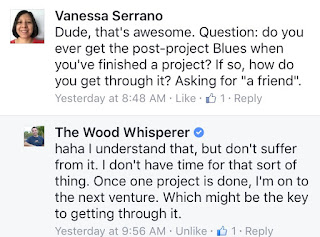
Keep busy. He wasn’t saying he had felt the same post-project (or post-completion) blues, but he was suggesting that perhaps he hadn’t because he always had another project lined up. And it makes sense, of course, he makes a living off woodworking too so there’s also the motivation to feed yourself and your family. With me and my blues, it was permeating everything. Woodworking makes me happy. Lego makes me happy too. A lot of things make me happy. Most days I don’t even mind my job either. But these post-woodworking project blues were eroding from so much of my life. I’ve been going to work half-enthusiastically. I haven't even finished building a Lego set I had been waiting to get for ages. I hadn’t even played the video game my coffee table was going to hold the parts for (Lego Dimensions – meaning that with the coffee table I brought 3 of my great loves together: Lego, woodworking, and video games). I’d been so flat and unenthusiastic generally.
More knowledge. How do I use this power now? I have to keep busy, it seems. But also I really want that buzz again, that motivation in my life, not just in woodworking. So the question to me was how do I get motivated again? Find a new project? I have lists and plans for many things I want to build but I’ve too flat to start on. Do I need more time or more money to do the projects I want? Well, yes, but that’s not the limiting factor if I’m honest with myself. The woodworking highlights it for me, but it’s not all its about. I’ve been ambivalent for some time, wondering: should I work more or should I work less?
Both paths have their advantages and disadvantages. If I work more I could theoretically make more money (I say in theory because the tax department doesn't like/allow such logic to be quite true). If I work less, then I can dedicate more time to woodworking or walking on the the beach or doing other things that make me happy...
Just a few days ago, an acquaintance who I felt had always tried to tell me that I should work more, made me really stop and realise that I have to decide quickly which way I will have it. She informed me that there’s an opportunity for me to work more, and that I should be happy about this because it meant I could make more money. However, in the strange twists that life has, she in turn made me remember something I have learnt from my patients. Life doesn’t wait on anyone; illness or misfortune doesn't come only when you're ready. Any day it could all end, regardless on whether you're just starting on any of life’s projects, or midway through, at the peak, or in the calm just after. It could all end, and what of your accomplishments will you be proud of? I know I wouldn't be satisfied if all I can list is I came to work on time, I worked hard, and I made money which is now in a bank and others will inherit when I’m gone. No, that wouldn't satisfy me. The memory of February 2nd, 2016 when I said to mum “it’s finished!” and proceeded to hug her because I was so happy that I built something myself from start to finish is so much more satisfying. I want more of those moments. I crave for more of that feeling.

For those who are interested, the coffee table was actually quite simple:
-Laminated radiata pine for all but the lid (non-laminated pine boards for the lid).
-Minwax oil-based walnut stain, then Minwax clear satin polyurethane to external sides.
-Inside drawer: Dulux oil-based primer; then Dulux semi-gloss vivid white enamel.
-Recycled tempered glass for the lid (came off a small glass side table).
-Recycled mirrored glass for the base of the drawer component (came off a discarded display cabinet).
When I realised this about myself, I wanted to do something positive with this knowledge. I asked someone else if they had noticed how flat I had been, and if it seemed to them like it happened after I finished the coffee table. The answer was a dishearteningly enthusiastic ‘Yes!’. Of course I had changed since I wasn’t running off to work on the next step of the project. So knowledge is power, right? (At least my Mortal Kombat video game had said it was). Motivated by wanting to change my feeling of apathy, I sought to find out if other people felt the same way I did. I sent a message to a woodworker I follow on YouTube and Facebook, The Wood Whisperer. He had just completed an absolutely beautiful bed and his feed was filled with photos of it and a very palpable sense of accomplishment. This is what I said, and his reply to me:

Keep busy. He wasn’t saying he had felt the same post-project (or post-completion) blues, but he was suggesting that perhaps he hadn’t because he always had another project lined up. And it makes sense, of course, he makes a living off woodworking too so there’s also the motivation to feed yourself and your family. With me and my blues, it was permeating everything. Woodworking makes me happy. Lego makes me happy too. A lot of things make me happy. Most days I don’t even mind my job either. But these post-woodworking project blues were eroding from so much of my life. I’ve been going to work half-enthusiastically. I haven't even finished building a Lego set I had been waiting to get for ages. I hadn’t even played the video game my coffee table was going to hold the parts for (Lego Dimensions – meaning that with the coffee table I brought 3 of my great loves together: Lego, woodworking, and video games). I’d been so flat and unenthusiastic generally.
More knowledge. How do I use this power now? I have to keep busy, it seems. But also I really want that buzz again, that motivation in my life, not just in woodworking. So the question to me was how do I get motivated again? Find a new project? I have lists and plans for many things I want to build but I’ve too flat to start on. Do I need more time or more money to do the projects I want? Well, yes, but that’s not the limiting factor if I’m honest with myself. The woodworking highlights it for me, but it’s not all its about. I’ve been ambivalent for some time, wondering: should I work more or should I work less?
Both paths have their advantages and disadvantages. If I work more I could theoretically make more money (I say in theory because the tax department doesn't like/allow such logic to be quite true). If I work less, then I can dedicate more time to woodworking or walking on the the beach or doing other things that make me happy...
Just a few days ago, an acquaintance who I felt had always tried to tell me that I should work more, made me really stop and realise that I have to decide quickly which way I will have it. She informed me that there’s an opportunity for me to work more, and that I should be happy about this because it meant I could make more money. However, in the strange twists that life has, she in turn made me remember something I have learnt from my patients. Life doesn’t wait on anyone; illness or misfortune doesn't come only when you're ready. Any day it could all end, regardless on whether you're just starting on any of life’s projects, or midway through, at the peak, or in the calm just after. It could all end, and what of your accomplishments will you be proud of? I know I wouldn't be satisfied if all I can list is I came to work on time, I worked hard, and I made money which is now in a bank and others will inherit when I’m gone. No, that wouldn't satisfy me. The memory of February 2nd, 2016 when I said to mum “it’s finished!” and proceeded to hug her because I was so happy that I built something myself from start to finish is so much more satisfying. I want more of those moments. I crave for more of that feeling.

For those who are interested, the coffee table was actually quite simple:
-Laminated radiata pine for all but the lid (non-laminated pine boards for the lid).
-Minwax oil-based walnut stain, then Minwax clear satin polyurethane to external sides.
-Inside drawer: Dulux oil-based primer; then Dulux semi-gloss vivid white enamel.
-Recycled tempered glass for the lid (came off a small glass side table).
-Recycled mirrored glass for the base of the drawer component (came off a discarded display cabinet).
 |
Sunday, August 23, 2015
On passion vs. possession
 |
| My original Lego pirate (with a replacement hat) |
There was a story that a friend told me once that I never
managed to quite grasp the significance of until earlier this year. Lego helped
me to understand it, as strange as that sounds. I’ll explain the Lego side of
things before I tell you what it helped me understand. And yes I am well aware
of how ridiculous and abstract this story will sound because I’m an adult going
on about how a very specific niche like Lego affects my feelings.
See, what happened to me was that because I grew up poor,
I didn’t have any Lego until I was about 10 and we moved to Australia. The Lego
I did have then were the smallest sets then available, the only “luxury” toys mum
could afford. I loved Lego as a concept, I loved the minifigures (that’s the
little Lego people), I loved the stories I could make with them, the adventures
the minifigures could go on, etc. I even held onto one of my original pirate
minifigures until now, about 25 years on. As a kid I played with him and as an
adult I carried this little guy around on a keyring for a long time – until I
lost his hat, then I decided it was safer to put him on a shelf and get more
Lego. But then as an adult I became hesitant to spend money on “toys”.
In about 2011, after I left my hospital job, I started to
earn more reasonable money. Now, when you’ve been poor growing up you can then become
a very frugal person. That’s what happened to me. One day I was in a store with
a good friend and I was eyeing off some Lego. She said to me “why do you keep
looking at it? If you can afford it, get it”. But I couldn’t bring myself to do
it. I was hesitant to "waste" money. Geez, there’s people even poorer
than my family was and they can’t afford basic things, so how can I bring
myself to splurge on something so non-essential to life, a luxury? But my
friend supported me, she could see how badly I wanted the Lego (and yes I was
at this stage nearly 30 years old) and yet how much it troubled me to spend
money on myself for non-essential things. She convinced me that it’s OK to enjoy
life and the things I like. And so I allowed myself permission to spend on Lego.
And I developed a true love and passion for it! I mean greater enthusiasm than
I had as a child; greater than I think children are actually capable of (if you
meet any true adult Lego fan your first thought will be ‘what a weirdo, this is
a kid’s toys’, but your second thought will be ‘wow, this guy really really
LOVES Lego’). It's crazy but I felt so passionate for all things Lego, and I wanted
to learn everything about them and just enjoy them as much as I could. If you
know me, you probably have at some point received from me photos of a Lego set
and saying something like "the guys who designed these sets are absolute
geniuses!" Needless to say, I soon came to own a fair amount of Lego,
though I only get the sets I feel something for.
Recently I met someone else who claimed to like Lego
though didn’t own any as an adult. I did as my friend had done with me and
normalized it for her, told her it’s OK to have Lego as an adult – just like I
had. Well, what happened was that suddenly she started buying Lego, copious
amounts of Lego. Making decisions to buy entire series of Lego without first
even knowing what individual sets came within that series, what the cost was, without
any care for individual sets or figures, just a determination that all must be
owned. That’s when I started to become uneasy with her. Because to me Lego (at
an adult fan level) is about passion, and she was treating it purely as a
possession. The crux of my thought was that she was treating my passion without respect. And yet I
remained fully aware of how petty my unease sounded if I ever voiced it to
anyone, except maybe another adult fan of Lego.
My unease peaked when this woman started buying a Lego
series known as Modular buildings, a series designed by the Lego group
specifically in response to adult fans of Lego. See, the thing is that to me as
an amateur adult fan of Lego owning any of the sets in the Modular series is
the ultimate prize, the big reward. And she bought them the same as one buys a
$2 piece of junk you just want to have in your house. And as pathetic as this
sound, that kind of hurt me. It's weird, but it was like stepping on my toes!
It hurt me that someone who’s new to this, who doesn't share the lifelong
passion for Lego, just goes and basically buys my dreams! And with full
awareness that this will make me sound even more pathetic, I mourned. I felt
like I had to mourn my dreams. I can't own the modulars now. How can I
"treat" myself to or call a prize something that to this woman was
seen like just a simple "thing"? I had to mourn that I will now never
own a modular set. I don't want to share with her something that to her means
nothing.
Anyhow, so recently (actually not that recent, I have
been sitting on this story a few months because I didn’t want to hurt anybody’s
feelings), I told this story to the friend who originally convinced me to get
into Lego again as an adult. She’s often my confidante and knows me more than
most people. And I said to her, “I am being ridiculous, right? Tell me I am
being silly feeling so hurt because this other woman didn’t respect my passion;
tell me this isn’t as big as I’m making out to be”. And, yes, at first she
laughed, but mostly because she said to me ‘so you now get why the story I told you about what happened to me and my
job affected me so much?’ And, yes, I remembered; yes, I finally understood
something about her I hadn’t fully understood until then. And, yes, it also
eclipsed what I felt because her story actually involved people’s careers and
overall life journey. I feel I have to tell you this story so you also
understand why my Lego story affected me so (in case you still can’t get over
the fact that I am talking about Lego, and, yes, Lego is marketed as a stupid
children’s toy).
My friend worked 10 years towards becoming an ambulance
officer. It was her dream job. Every job she had before that was in preparation
for it. In fact, by the time she started working this job she was possibly
overqualified. Her partner knew very well that this ambulance job was the dream
she had been working towards all along. Then one day, her partner realised that
he was miserable in his own job, and came home and told my friend that he was
going to join the ambulance service. Just like that. He never had a real
interest in it. Then suddenly, my friend who is more giving than she is capable
of self-preservation, realised that her partner had taken her goal and made it
his. But not in the way couples do when a goal becomes a shared goal like
keeping the relationship together or caring for children or growing a joint
financial investment, etc. It was more like my friend’s dream was cast aside –
and it quickly became, not her partner’s dream, but his “must-have”.
So, when I told my friend the Lego story between me and
this other friend she said to me “I see how you feel like you were stepped on.
I know what it feels like to have someone almost steal your passion from you.
But not for the right reasons. Not because you actually share that passion.
That's different. But when it's more of a 'Yeah, I can do that!’ Or ‘I can get
that too!.. And I can do even better and go the whole way’” My friend
eventually realised how her partner’s thought pattern and behaviour didn’t just
apply to the jobs they did, but more generally. How other aspects of his
personality and his willingness to “step on her toes”, his must-have nature,
didn’t just extend to just work. And my friend became resentful of him without
even realising it. She realised though that her partner did not understand her
at all, and that this whole incident had caused her to lose part of herself
when her partner became an ambulance officer. They’re not together anymore. So, she
said, she gets how deeply hurtful my experience with my friend is because it is
somewhat similar to what she went through. And they thing is she had told me
her story before, but only now did I get
it. Because I had now felt perhaps only a small proportion of what she felt for
a long time.
There's passion. And then there's possession. And it’s hard
to respect someone who will step over your passions to claim a possession for
themselves.
Sunday, February 8, 2015
On when it's enough
This year’s Australian of the Year award recipient was Rosie Batty, a woman who has helped raise the attention we give to domestic violence
in our society. This got me thinking a lot about the issue, and in fact it drove me
to watch a TED talk on domestic violence by Leslie Morgan Steiner, herself a
domestic violence survivor. I strongly recommend you watch it if you haven’t
already. What it did for me is it helped me answer - and ask - some questions I hadn't even thought about before. Leslie found herself in love with a man who was
charming and wonderful and worshiped her. This was the same man who later beat
her several times a week. The questions domestic violence pose to me are 1) how
does it happen, how does an intimate relationship become abusive? And 2) why do
people stay in those relationships?
You know, I realised something recently and that is that a
lot of us don’t know much about domestic violence. In Leslie Morgan Steiner’s
talk she pointed out that this was true of her situation – and she didn’t
realise that there are warning signs and patterns to the abuse. She speaks of
one of the things her ex-partner did from the start of the relationship, and
that is to make her believe that she – not he – was the dominant partner in the relationship. You know the type, “he
wouldn’t hurt a fly”. In fact, he’d been the victim of physical abuse as a
child, he told her. He made it clear that she, not him, was the strong one. I
think this is an interesting point for another reason too, and that’s because
one thing I remember learning a little while ago is that victims of childhood
abuse (be it sexual, psychological, or physical) are predisposed to becoming
either abusers themselves or the victims of abuse again – and usually this will
be with their intimate partner.
The second step to coming to be in a domestically violent
relationship is to “isolate the victim”. Now this is another interesting one
because it can come in the shape of being so in love that you want to spend
every minute of every day with your partner, of wanting them all to yourself; but
then becomes obsessive in wanting to increasingly (it’s always in small
increments) dictate exactly who you speak to, what you wear, who is allowed to
be your friend, where and how you can work and live, etc. It’s easy to disguise
a controlling nature in the guise of “it’s because I love you so much and I am
trying to protect you” or “it’s for your own good”.
Then comes the part where they test you out. Subtle threats.
Small violations. Then an apology, of course. There’s always a reason why it
happened, and they love you, and they promise it won’t happen again… Then increasingly
bigger violations. Most of us have seen the pictures of the “cycle of violence”
that occurs in domestic violence situations: violent episode, followed by the
remorse, pursuit, and honeymoon phases… until the tension builds up again and culminates in a another violent episode – and the
cycle keeps repeating.
 |
| In case you haven't seen it. www.psychology.org.au/publications/inpsych/2011/feb/weiss/ |
One very powerful point that Leslie Morgan Steiner makes in
her talk is this: “Why did I stay? The answer is easy. I didn't know he was
abusing me”. But surely she must have known, right? Surely people know when
they are being physically, emotionally, financially, or sexually abused by their
intimate partner, right? Not necessarily, because of the often gradual nature
of how abuse escalates. You know what this made me think of? The little cartoon in that Al Gore documentary where the frog who goes from room temperature into
boiling water immediately realised the threat and jumps out of the pot, but the
frog placed in water at room temperature and then the heat is gradually
increased will stay calmly and passively until the water boils him to death.
Leslie Morgan Steiner gave a second interesting reason of why
she stayed in an abusive relationship: because she believed she could help her abuser. She loved him. She knew
him. She understood him better than anyone else. She knew he was a good person who was just troubled. I mean, shouldn't
good people who love each other be self-sacrificing and help each other out? Isn't
this particularly more applicable if the abusive partner has a mental illness
or a troubled past or is “going through a rough patch”? Shouldn't we stick by
them at all costs? Shouldn't we keep giving them another chance? (to repeat the
cycle?)... However, there is a flaw in this logic because it puts a greater
emphasis on one person’s satisfaction and happiness at the expense of the
happiness and right to be free from abuse of the other partner.
Of course, the final reason people stay in abusive
relationships is because they know how dangerous their abusive partner is.
Indeed, another thing I learnt from the TED talk is that the period after a
relationship has ended is when the threat is greatest for those who have left
their abuser. The abuser now has nothing to lose, they are both enraged
and empowered. And often they do act with disastrous consequences. This is when
we as a society need to step up and stop asking questions like “why doesn't she
leave?” in the tone of “well, it’s her fault for staying”, and instead make
sure we are educating people to recognise and avoid these situations, and
protect victims of abuse from further harm through adequate judicial systems.
Now, one last question I want to go back to is does the fact that the abuser was
perhaps affected by mental illness, was “going through a rough patch”, or had a
childhood that was prejudicial and unfair excuse the damage they inflict on
their partner? Does it make the bruises any lighter? Does it make the torment
any easier to bear? Does it make the children, like Rosie Batty's son, who get caught in the path of an abusive relationship any less
dead? No. There has to come a time for a victim of domestic violence to realise
and acknowledge that they have at least an equal worth to the person whose
abuse they continue to tolerate. For some victims it is one final beating that
nearly kills them that makes them ‘snap out of their denial’. Denial of the
fact that no amount of love will make the relationship good again. That no
amount of wishful thinking will make the other partner be nice to you again. That if nothing changes, nothing changes. That
you, in fact, are worthy of better than to suffer or die (physically or emotionally) at
the hands of someone who you have given your all to. We have to be careful that when we're looking for reasons for why domestic violence happens, that they don't become excuses. We have to focus on prevention before it happens; and support and adequate protection when it's already established.
Monday, January 5, 2015
On being selfish

I've never cut one of my own flowers because I know that the flower will most likely have a longer life without my interference. I water the plant, I prune it sometimes, I try to keep the bugs off it; I like to think that I’m giving it a good life. The truth is its roots are probably deep enough now that it could support itself without my input, but I don’t want to risk it withering from lack of water or something I could have possibly prevented. In the last few weeks its base has become infected with some thing I can’t quite keep off it. But also in the last few weeks she is flowering again. It amazes me how something so beautiful can come from something that is at the same time ill.
What drove me to cut a flower off my plant today? Selfishness. Plainly and simply, I decided today to be selfish. See, I saw how beautiful the flowers on the plant were, and I thought I want to enjoy this one more, more closely, for longer, and I want to do that now. Sunset was coming and I wanted to keep enjoying my flower. I thought, she will die one day, so will I, why not take this moment in our lives and share it together? And, yes, I do get this emotionally attached even to flowers; I’m not even being metaphorical! So today I decided to be selfish and brought my beautiful rose inside with me, to enjoy her beauty (purely for my own benefit, though caring for her – and yet not as best as she deserves).
And what did I remember? It was about selfishness. That in order to love, or at least act on love (and what is love without actions? Non-existent), you have to be selfish. At some point you have to decide and act on that inner impulse, to reach forward and both give and take. There’s no one-sided love; as much as we give, we always take. So you have to at least be self-confident that you are deserving of another’s love – and go about either accepting it or striving for it. Even if we do that thing where (because we “know” ourselves so well) we think others are better than us, that we’re not the best person in the universe for the object of our affection, you have to be selfish or else you can’t truly love. We would never act on love if we didn't decide at some point to be selfish. And, of course, this brings me to a second realisation: that it’s hard to love, because you lack confidence and an accurate sense of self-worth, when you are suffering with depression. It’s like my flower struggling to be beautiful, to blossom and radiate, in the face of whatever illness she is facing. How could I love her in a satisfying way without first deciding that I’m worthy of her beauty and she of my care?
And now is the point where I realise that perhaps, in a way, I can’t help but be metaphorical.
Sunday, December 28, 2014
On eternity
I once met a girl with the word “eternity” tattooed on her body. She was young and so I wondered if this was an ironic play on the Asian characters others get tattooed on themselves. She said simply “it’s just eternity; it means a lot to me”. I chuckled to myself in a kind of self-righteous indignation, and also waiting for her to crack and laugh too and tell me it was just a joke. It wasn't.
Eternity? How does eternity mean a lot to a young girl in their twenties? How does it mean a lot to a girl who I've otherwise only ever heard speak of some or another party, of “having fun”, of fashion, of nothing really meaningful. Really? Eternity? Could she even grasp it as a concept of time-space? Has she ever even dedicated time to the thought of infinity as it applies to the universe we live in, the physics of it. Has she contemplated eternity in the spiritual sense? Or is it more like the scribblings of children “Mary + Joe, 4eva”? Forever? Is it like the way “forever” means to some couples who get married, 'until the divorce'? What the hell does she know about eternity?
And then I thought, hey, what the hell do I know about eternity? And, you know what, I’m actually not that much different. To me eternity is like infinity, a concept that surely somehow exists even though you may not be able to explain it. Eternity exists because even after you die, the world around you keeps going. There were people around you and they saw you die, but they keep on living. After they die too, the world keeps going. There are constants in this world that aren't the lives of human beings, because certainly we’re not eternal. What about the afterlife, that has to be eternal, right? No one knows. There’s religious doctrines out there that say that yes, we are eternal because our spirits are eternal and, like energy, merely change form, but aren't destroyed. And still I say, no one knows. The evidence we have is of this physical world and all this says is that once our body dies, it merely decomposes to its components. End of story; no eternity to any part of us except the subparticles and energy that comprises us and everything around us. There’s infinity because of the expansion of the universe, the ongoing increase of entropy, the extremely small and extremely large processes going on in the universe. All of it, not things a lot of us sit and think about regularly. And certainly not the things that young girl meant by “eternity”.
But what do I know about eternity? I’ll tell you what I don’t know that I think this girl does: hope. Eternity is a wish, a desire for things like love and marriage and health and prosperity to last forever (or until the end of our days). I've lost that hope. I've let myself become too marred by experience, too dark and pessimistic. I came to realise that this young girl probably does have a much broader concept of eternity than I do. She has a child. She understands love far deeper than I do, and with it the concept of never wanting harm to come to your child – of wanting them to live forever, to be eternal. She’s in love. She remains passionate with her lover, he still makes her smile, surprises her in sweet and charming ways, they still want to impress each other. She enjoys life, looks forward to things, isn't accepting the 9-5 job as her life; her life is at home, and on the weekends, and every moment she can find in which to smile in. These are the things she hopes will last forever. She approaches life with such passion, embracing everything as if it were going to and hoping it will last for all eternity.
What are the things I wish would last for all eternity? These are the things I should focus on. With insight must come responsibility.
 |
| Impressive |
Sunday, December 21, 2014
A story: "Poetry"
What if I'm brave today?
What if I quit my job?
What if I confess?
What if I take a chance?
What if I'm reciprocated?
What if I'm not?
What if I jump today?
What if I end my life?
What if I smile at a stranger?
What if I cry my insides out?
What if I'm brave today?
What if I die?
And if I live?
What if I don't like the consequences?
What if there are no consequence?
What if all this is a revolution in a vacuum?
What if I'm really just stupid?
What if I do nothing?
What if I find happiness, here; right here?
What if I cower?
What if I smile at the end of it all?
What if I'm brave?
What if…?
I'm brave.
He writes this in an old notebook. The "poetry" of a pathetic old soul, unsure of whether he's in love or he's finally truly crossed over into mental illness. Is this what aging does to people? You see a flower and it's not even a particularly beautiful flower but you assume it was put there for you, that it was meant for you to notice it, that spring is quickly slipping away and you better embrace this one last remnant of what you felt when you were young and powerful. You see a table in a store and you feel the same sequence of emotions: my life isn't complete until this table enters my life, my house, my sphere. In time the table sits under a bunch of all your unsolved problems, debts to pay, crumbs of the last things you consumed without a thought. You introduced yet another piece of furniture you'd just walk past again, ignore, use, stub your toe on occasionally - and then, only then, with the pain do you remember that, yes, it was once a beautiful tree too. Eventually you forget (or ignore) that you'll do the same with your flower. You will walk past it and notice its withered leaves and petals; it'll have shed its soul for you. For you who ripped it away from its ecosystem where at least it's life and death at least contributed to the universe. You really thought your life, your love, your eyes were worth more than the universe?... You think all these thoughts and say to yourself: my life really is meaningless.
Sunday, December 14, 2014
A story about stuffing up
“And he said unto me, My grace is sufficient for you: for my strength is made perfect in weakness. Most gladly therefore will I rather boast in my weaknesses, that the power of Christ may rest upon me. Therefore I take pleasure in weaknesses, in reproaches, in necessities, in persecutions, in distresses for Christ's sake: for when I am weak, then am I strong.”
- 2 Corinthians 12: 9-10
Charlotte
I walk into the doctor's office. What exactly do I
expect? What's wrong with me? What can she help me with, she asks. I don't
know. I think I need something. I don't know. In my grandparents day I would
have been having this conversation with a priest or an elder of my church.
Church? What if any part of this is holy? Thirty-five years ago marrying in a
church, I did not expect that today I would be having this conversation with
anyone. What can you help me with?... I haven't been able to sleep in days. I
have no desire to eat. I cry all day. Every day. How long has it been, she
asks. Two weeks. But two weeks is a long time when you're heartbroken, feeling
like the world has been removed from under your feet. I haven't felt present. I
don't know why or who I am... Oh, she's looking at me blankly.
It's my husband, I tell her. He had sex with another woman. It's my fault; I haven't had sex with him since the first time this happened. Yes, it's happened before; a few years ago now. I should have known my mother was right; she said if you forgive him once, you have to be prepared that this will be only the first time. How could he? How could she? I don't know her, but what kind of person has no brains about her to get herself into this? That is not a normal person.
Why have I really come here? What is my goal? Do I really intend to continue a relationship with a man of such low character? Oh, he's a wonderful man, but how can this... this... I can only think of the words filth and numb. He used to be so good. We were so good. How do you put your whole family life on the line like that? What do you have to be thinking? He's a man, maybe all men are like this. Doctor, are all men like this? What do I do? She's still just looking at me blankly. Am I wrong in feeling all this? Does he have a problem? Do I? I think it's better if we have a problem, that way we can fix it... Oh God, what am I saying? She's still just looking at me wondering how she can help...
David
I always thought 'yeah, I'm attracted to powerful people,
passionate people, people with drive and motivation'. And that may be the case
but I think another part of me takes comfort in the weak. Is it because I
compare myself to them? I don't know. I’m weak. I'm uncomfortable too. I don't
love her like I used to. It happens to all couples. She keeps asking what was I
thinking? What was I thinking. Dear,
if you would understand that I wasn't thinking. I intended nothing; I thought
of nothing but of the moment. They ask of addicts “why do you do it when you
know that it’s so bad for you?” But no-one ever remembers how good it feels.
People do things because they feel good, not because you want to avoid
something worse. It felt good, Charlotte! It felt good! But I can’t tell you
that... I tell you I was lonely. Of course, it’s not your fault! It’s not your
fault! And this is what makes me most ashamed of this situation. You blame
yourself, you hate me, and you think there was a reason and you won’t let up
until you find it.
Charlotte, if I told you what attracted me to her it
would hurt your soul. It was me; I was what attracted me to this. But to explain to you that it really was about me and not
her, well, you just wouldn't understand. You simply cannot understand that she
made me feel things about me that you can’t and won’t let me feel anymore. Oh,
dear, I’m not blaming you, either. Please understand that’s not what I’m
thinking at all. But you shut me down, you tell me what to do, you tell me when
and how it’s appropriate to do it. These women, (yes, you know of that one) see
me as a worthy person, an intelligent person, a good person. They see ME. And
in your way I know you feel the same way about me; that’s the stories you tell
your friends. You say I don’t love you anymore, but when did you stop loving me? Why
won’t you show me that love? Why did you stop being sweet and caring and loving
as we once were? Don’t tell me it’s because of that first lapse; you and I both
know it happened much earlier. And THAT I will never understand. Why did you
stop laughing with me to start laughing at the pathetic all-adoring little
mascot of yours I became?
You ask what these women had that you don’t? Nothing! Absolutely
nothing. It felt good to be wanted again, Charlotte. I wish you knew how much.
I wish you let me feel this good
again. You say you feel numb. Now you
feel numb? I've been feeling this way for months and years!.. It’s no excuse, I
know.
And now you drag me to this doctor’s appointment. Haven’t
I shown you already how ashamed and regretful I am? Must you humiliate me
further? A “check-up” on my health you say. Is there something wrong with my
brain? Have I contracted some illness? I go along. I have no secrets left,
Charlotte. I have nothing left in me.
The doctor
I’m listening. What else am I supposed to do? How can I
help? Oh gosh, they never taught me any of this in med school. They don’t teach any
of this anywhere. I agree this is a bad situation but do you understand I don’t
know what to do either? You’re trying to figure out the direction of your life,
and I’m trying to figure out how can I do my job and somehow, I don’t know how,
contribute something today. "Empathetic listening", they said something like that
in medical school. I resented them for trying to teach me so much communication
stuff and not enough medicine. I wish I’d paid attention in case we ever came across this scenario. Fuck, am I feeling sorry for myself
in a time like this? Focus, Vanessa. Thirty-five years of marriage, you say.
Thirty-five?! I haven’t even been alive that long! I barely
know the difference between my right and left and you’re asking me for marital advice? I don’t know. How
to make a relationship last? What to do when you find yourself in an unequally-giving
relationship? I don’t know. Clearly, I have no idea; I've barely known how to keep myself alive 30-something years and you ask me how to rescue a relationship. Focus. I have to focus.
What was my job again?... STI check. Would you like me to run some tests to
check for sexually-transmitted infections? Did I really just say that as you
started to cry? I’m an idiot. Somebody throw me a frigging bone here! I’ll
point out the tissue box on my desk. There, that’s better. You said you can’t
eat, sleep, or stop thinking depressive thoughts in the last 2 weeks. Two weeks
isn't enough to diagnose you with anything. And did I really just think about
diagnosis? Bad shit happened to you, you’re sad, and I’m trying to find
pathology in that? Jesus Christ, what the fuck has happened to my common sense,
to my morals, to my better judgement? God, don’t ask me what I think your
husband was thinking. Was that a rhetorical question? I don’t know. I say I don’t
understand it either. Oh God, I’m in fucking agony here… Charlotte, can YOU
tell ME what you think I can help you with? And let me just say, I don’t think
there’s anything wrong with you. You have every right to be feeling the way you
are. I don’t know what else to say to you, but I can tell you that.
And now you've brought your husband? What do you want me
to say? How can I help you? How can
either one of us be helped here, David? Stop telling me your story; it's inconsequential to me. Tell her! No, I'm being selfish and thinking only that I'll be late home again because you're spilling your guts out to me. Tell me. Cleanse your soul. Teach me things so that one day I may understand men and women like you and your wife. We've both stuffed up, David. And today I shouldn't have come to work.
Sunday, December 7, 2014
On people wasting your time
One
day I was talking to someone who said to me "I'm sorry to be wasting your
time". She was very depressed. I mean depressed in the classical sense,
not just meeting medical criteria. I mean being so low that you don't even feel
sad anymore, you feel nothing, as if you were dead already. I said to this lady
that we're human beings and you don't waste your time with other human beings,
we merely share it. I have realised since making that statement that there is
no such thing as one-way or one-sided relationships. Even when you love someone
and they don't feel the same way about you, that is still not a one-way
interaction. We're human beings, and even if we want to believe that we live in
a world where there are only material things, words, and other physical things
like light, sound, movement, etc., that is simply not all there is. We have a
rich inner world, we create metaphysical tracts we call relationships, we
create and (most of live by) social norms. As annoying and as inconvenient as
it sometimes is, we simply cannot go back to saying we are just carbon-based
life-forms existing in a physical world that have no impact on each other's
inner or external spaces. When you console your depressed friend, it isn't just
for them, it doesn't just involve them; you don't just give without also taking
away from the experience.
In
clinic I sometimes see people who apologize to me for wasting my time. And it's
not the ones that as a doctor you usually think of as 'wasting your time', like
the drug seekers and malingerers. It will usually be someone with a mood
disorder who feels they are a burden to everyone, including their treating
clinicians. But then they quickly point out, "I know you're getting paid,
but..." Which is right, I do get paid to do my job! A few years ago a
patient said to me that he was sorry for taking up my time with his depression,
and "knew" that I only did it because it was my job and I couldn't
kick him out. I said to him, "actually I can kick you out". He looked at me, surprised, I guess. I
explained, yes, this is my room and I am in control of what happens here. If I
want you out of my room, I can make that happen. Stuff etiquette, stuff
protocol, stuff that constant thought in the back of every doctors head of
"how will this look in court?" Yes, I told the patient, I could if I
wanted to kick him out of my room, and I can even go as far as terminating our
therapeutic relationship altogether, not just that day's consultation. This was
not an emergency situation, and terminating the consultation abruptly would not
really affect his mental/physical health, so I had every right to ask him to
leave my room – if I wanted to. But then I asked the patient, and "do you
know why I haven't kicked you out of my room?"
I
asked this question aloud for two reasons, and one of them was to buy some time
to ask myself this same question. Do I care? Really, do I care about this patient? I mean "care" as in does this
person's predicament truly concern me in a sense that it affects me
emotionally? Well, no. I care about my mum, my friends, my partner, my pets, and my own
physical health. I can't care for or about every patient in that way or I'd
make a terrible and over-involved clinician. Of course, I "care" from
a healthcare/clinical point of view of wanting my clinical management to better
and not worsen the patient.
I
believe in being honest to my patients, so I knew I wanted to word my response
to this man in the most honest way I know how, and "care" was not the
word I wanted to use. Why don't I kick you out my room when you're cleared
depressed and have reached out to me for medical help? The first reason is
because I understand why you sought me out in the first place. You reached out for medical help because you
felt you couldn't help your own self anymore, that you're unable to be helped,
and not only that but that you're also
unworthy of help. Those last two points are exactly why you asked the
question in the first place. The second reason I haven't kicked you out my room
is because I see your potential. And I see this because I am on the outside
looking in. Depression is like being inside a deep, dark, empty, silent, and
very still void. I'd say it's like a well, but in reality there is not even a
bottom and there are no sides for a reference point. You can't see outside of
the void – and when you're truly in that melancholic/pre-suicidal depression,
there is no will left to want to see outside of the well. But I'm on the
outside! I'm your clinician and I am on the outside looking in and can tell you
that there is something outside of the void and you can and will get outside of
its grip if we do things that seem pointless right now. This is exactly what I
mean when I say I can see the potential in another person. (Of course there’s
no point at all in this situation to disclose to patients that I understand
depression so well because I have been in that void before. In fact I think
this changes nothing in terms of how well any clinician can manage this
scenario. I don't have to have experienced diabetes personally, for example, to
understand it and treat it.) Patients may believe they're a waste of time and
space when they're depressed, but I strongly disagree on this point. I disagree
especially because, as I said, I truly do believe that we don’t waste time with
other human beings, we merely share it.
I
believe that sharing time with other people isn't a waste of time; that of
every interaction you gain and you give, that of every interaction you learn,
that every moment shared changes you as you in turn change others. And yet
believing this as long as I have and as fundamentally within myself as I do, a
few days ago I almost convinced myself that someone was wasting my time. And
then I remembered back to my own words, and asked can people actually waste your time? And, you know; no, I still don’t
think I got it all wrong in the first place. What happened was that I was responding
emotionally, wanting to blame others for disappointing and hurting myself. It
was easier to say “you’re wasting my time” than to admit that it was me who had
unrealistic expectations. I felt very drained, raped almost on a
cognitive/spiritual level, for giving so much of myself when really I was asked
of nothing. And then I was upset about indifference? How absurd it seems now
that I've had time to re-analyse the situation. It was like I had walked past a
building, said to myself, ‘hey this is a bank’ and started pouring money into it
– and then I got upset and angry when this building kept only taking and
storing what I gave it but gave me no returns, let alone interest or growth. And
am I to blame the building or my own delusional self for this feeling of
exhaustion? Myself, of course. And yet I can take this experience and say that
really that no time was lost, I merely shared a moment and learnt a very valuable
lesson.
 | ||||||
| ¿Qué escondes, mi flor blanca? ¿Qué hay bajo la próxima capa?
¿Es un escorpión?
¿Es tu corazón?
¿Son los
gusanos que te comerán viva por no dejarte ver?
¿Son
mariposas esperando su re-nacer?
|
Tuesday, November 25, 2014
On obesity
 |
| Just a photo of a nice croc I saw |
Food has always been a necessity for us humans, and obesity is not a new thing. The problem is the high prevalence of obesity and the subsequent high rate of health problems for which obesity is a major contributing factor. You then recall times from history like the great depression and wonder how did we overshoot so much that now obesity – an excess – is the problem. The thing is that perhaps the exact same things that brought us out of the great depression brought us to high rates of obesity.
Towards the end of the great depression, a lot of interesting things began to happen. Yes, there was the onset of World War II, which brought about destruction – and subsequently, at it's conclusion, a great need to re-create, produce, manufacture, and re-build the world! Industries soared. Governments and commercial enterprises became really good at economics and business. Extremely good. And with the end of the great depression, of course, food became more than a rationed commodity, more than a human need, it became a highly lucrative commercialised industry more than it had ever been in our society. The success story of business and industry tracks that of obesity rates. Every strategy that led industry to thrive, also drove obesity rates to rise.
Think about all the strategies that make businesses successful, and then you finally may get closer to finding an answer to the question of how did we as a society let obesity rates rise to the levels they are today. Well, firstly, a great business needs a product that is desirable. What is a more desirable consumable than food? And more than being a desire, it is an actual human need! Food is one of those things that would sell even if it wasn't advertised anywhere.
But food is advertised – and very well; a great marketing strategy is one of the fundamentals of a successful business. The interesting thing is that the food that receives the most advertising is the least nutritious and yet most energy-dense. Unfortunately as a society we developed technologies and became really good at modifying our environment so as to minimize the amount of energy our own bodies expend. Our progress as a society, our advancement, is because we built efficient machines that use external energy to do the hard labour we previously took on. We walked greater distances, lifted more, did more physical work just in our everyday than we do now. And hence the large disparity between the energy content of what we consume (that energy-dense food advertised so heavily) and the energy we expend – with excess energy being stored in our bodies as fat.
Marketing isn't just about direct advertising, though. It even involves exploiting existing societal norms and evolving new ones. What do I mean by this? Actually this concept is the most wide-ranging aspect of how business, and food as an industry, has grown. But let’s take, for example, just two interesting quirks of us human beings: 1) we perceive more as better, and 2) we perceive bigger as better. Have you ever tried to buy just a Big Mac at McDonald’s? Well, let me tell you it costs nearly as much as a Big Mac meal, with the fizzy drink and the fried potato chips included. We all prefer to get more for our money, so we do end up buying a much higher energy intake for just a few cents more. But it’s not just about the big bad fast food giants, even our supermarkets do it. They sell us even staple foods, but at a cheaper rate if we buy more of it. Why? Not because they think “poor, poor, undernourished people; let them have more food”. No, they do it because we are consumers, and only consumers to them. They sell us more so we pay more (we think we’re making a saving, but the reality is companies never underprice their items even in the “deals” they give us). The concept of portion size is similarly related. And portion size isn't just about how big our meals are, but the fact that because our foods are so energy-dense and our lifestyles for the majority of us are so sedentary, the physical-size of our meals isn't even what we’re really talking about here. And who does know what we are talking about when we say things like “portion-size”, “recommended daily intake”, “calories”, “kilojoules”, etc? Not that many of us! Education about nutrition and its relation to health and lifestyle are severely lacking in our society…
I want to conclude this topic of discussion with a direct passage of recommendation from the McKinsey report I mentioned earlier:
“Education and personal responsibility are critical elements of any program aiming to reduce obesity, but they are not sufficient on their own. Other required interventions rely less on conscious choices by individuals and more on changes to the environment and societal norms. They include reducing default portion sizes, changing marketing practices, and restructuring urban and education environments to facilitate physical activities.”What do you notice about these recommendations? If you’re like me, then you will have noticed how most of the things suggested that we need to try to do as a society to combat obesity are the complete opposite of everything you need to do to have as great and successful a business as the food industry in industrialized countries is. We became obese not merely because we ate too much, but we ate more than we needed to because the food industry needed to grow its profits. I think in health care we particularly need to take note of this. Sometimes we think we must help individuals (or blame them, as we sometimes do), but the truth is individuals were helped in their demise by large industries and corporations who focused on our consumption/profit value rather than the effect of their products on our health.
Sunday, November 9, 2014
On sex and illness

A question us health professionals often overlook when consulting our patients is the importance of sex to them – they are, of course, human beings just like us and therefore have the same interest in it that we do. There was a time when we were all being urged to tell our cardiac patients to abstain from sex for a certain period of time after a cardiac event or surgery – and the message got through to us and them. We became good at dishing out advice to patients that sex after heart problems is a big no. Patients, motivated to obey as they didn't want to suffer complications from what is a very serious health issue, listened and took this very seriously too. A lot of us, however, forgot to frame anything but the negative to our patients and advise them that sex is OK too, and bar a few restrictions, it was OK to resume it. It was like as if as health professionals we thought that patients are sex-crazy insatiable beasts that cannot resist the urge to have sex straight after having (often) extremely painful chest surgery and/or losing a large amount of physical endurance. The reality we were forgetting is that very often after cardiac events, people (yes, patients are people too) become depressed, and with depression often comes an actual loss in libido. Suddenly after a major health scare we are faced with the realisation that our life isn't infinite, that our risk of dying is a lot higher than we once thought, and that we now have a chronic illness that you just can’t shake off and pretend like nothing ever happened. Our patients’ whole lives change, priorities change, relationships are tested and adjusted – and there we are as health professionals thinking that our patients actually want to have sex after considering all this! Yes, some do, but the majority probably also would benefit from being reminded that once they’re ready, sex is OK.
Another interesting scenario is sex in the context of cancer. I mean specifically cancers that affect tissues that we traditionally would associate with sex: breasts, prostate, testes, etc. As an example, let me consider women who have the most common type of breast cancer, those which are hormone-related/responsive. Treatment of their cancers often involves surgery, scars, and sometimes very marked deformity. All this in areas of their body often thought of as very intimate, sensitive, and defining of one’s sexual identity. Radiation treatment does similar, and sometimes making an area that was once so sensitive in a positive way, extremely tender. Medically, to achieve remission of their cancers, these women often have to be put in a state of sudden menopause. And then come all the effects that go with menopause: vaginal atrophy, loss of libido, low mood, hot flushes, etc. You put all of this together and can you imagine how hard it is not only to think of sex, but to actually enjoy it in the way these women once did. Now think of the effect this has on a relationship if we aren't being open and honest on what people with these types of cancers are going through.
It’s no big leap of the imagination to conclude that a lot of relationships often become sexless after cancer affecting what we predominantly think of the sexually-defining features of our body. For those who are not in a relationship at the time of diagnosis, entering or re-entering a relationship is equally as daunting and is often delayed by many many years. Now, as an example (because I have seen this scenario a few times in my own practice), consider a heterosexual couple where the woman becomes diagnosed with breast cancer. Initially, both partners become concerned about the physical well-being of the partner affected by the cancer. The couple shares common goals: for the woman to survive the cancer, and for her to tolerate the treatment as best as possible. Of course, despite our best personal support networks and the best-meaning friends, family, and health professionals, cancer diagnoses and treatments are very isolating. Everyone may know what you’re going through, they may care about you and want the best for you, but only you are going through it in mind and body. It’s a sad fact of life, that at times no matter who’s around you, you feel very alone. The cancer treatment begins and ends for the woman, but the emotional adjustment takes a lot longer. Sometimes it takes a very long time, and though couples never forget the cancer, they sometimes forget to speak of the less “heavy” things of life, things like sex. And more than simply not speaking of it, sex during and after cancer becomes taboo. I mean, such greater things are in question when the cancer diagnosis came up: mortality, strength, survival, endurance, support – who can think of the mundane things of life like sex? But time passes and life and relationships continue once the acute cancer story is done with.
And, yes, we do think of sex. Not just the partner who hasn't been sick, either! We know that the person who has survived cancer has all that physical and emotional stuff to deal with, scarring, pain, deformity, loss of libido, low mood, etc. How can you possibly have sex again? Unfortunately, this same information is often locked up inside with shame, fear, and the desire that if we just ignore the issue it will all just go away. If we return to the example of the woman with breast cancer, the partners of these women often do not know her struggle beyond the acute cancer story. No one talks about it. And so they wonder what they’d done wrong, what did they do during the woman’s struggle to turn them off them sexually still so many years down the track? Can they ever undo this and how? Is this it; is this just how it is after cancer? Does a sexless marriage mean a loveless one? Is it wrong to still be sexually attracted to the woman she is despite her body changing? Has this got nothing to do with the cancer? Has it really got nothing to do with it at all, and the only reason the woman isn't leaving is because she’s grateful for his support during her cancer battle? Is gratitude enough to continue a seemingly loveless marriage? These thoughts are very emotionally painful – and I think very important to talk about. Similarly, I've known of men who won’t approach their partners sexually after cancer treatment for fear that she won’t want it, can’t have it, and just not knowing (and unable to ask?) how it will be different for her. Women may react to this in the way that, ‘hell, not only did I just go through cancer, now my partner doesn't even want to touch me or know me sexually’. And so the cycle of sexual abstinence continues…
And what do I conclude? That we talk about sex. That it becomes neither an expectation in relationships nor a forgotten burden. That health professionals to their patients about it, but more importantly, that couples talk to each other about it. And that we be allowed to form our own conclusions as to the importance of sex in relationships.
Monday, October 27, 2014
On the purpose of life

I am, of course, not the first to think of this evolutionary/survivalist theory of life. There’s a theory that even altruism, that warm, fuzzy, “nice” stuff we seemingly do without self-interest, does actually pose a survival advantage. As an example, let’s say I become a humanitarian and go out of my way to help other people in whatever disadvantageous situation they find themselves with (ill health, poverty, etc.). You may think that it’s selfless, right? I mean, how does helping others help me, when if anything I am giving up of my time, efforts, money, etc to help another human being? Well, indirectly it does boost my potential to survive and still come out on top because it buys me allies. Other people see my “selfless” acts and get a positive impression of me – and that makes them want to help me! People more powerful than me may want to protect me, associate with me, give me opportunities I would never had had access to on my own. Numbers of people want to protect you, embrace you as an ally, and defend you from bigger enemies than you could handle on my own. Selflessness pays off! And it pays off probably more than pure instinct-based, survival strategies ever could.
I used to preoccupy myself with the question of what is the purpose of life, and more specifically, my life. Is it to love? Contribute positively to another’s life? To prove myself in this biophysical form on this planet until the biological matter I’m made off becomes unsustainable and I start decomposing into my component atoms, subparticles, and energy – so then after this, some “essence” of me (the thing I and many other “believers” call the spirit) can carry on to another alternate life? Then the question becomes, yes, but what is this “proof” we need to make of our lives? Again, is it to show that I am the best at this survival game, to boost my happiness to the maximum level imaginable, to boost the happiness of others, to feel connected to another human being in the way love connects people? What is love? Is it more than the stimulation of the right combination of neurochemicals in my brain that make me “feel” the emotion of pleasure and calmness we call love? If it’s more than the chemicals, the reactions, the synapses, does that again place it in that inexplicable spirit world? Is anything real? What is real? … and you see now where my preoccupation led me to: suddenly I’m wondering not only why do I exist, but do I exist?
At times I wonder if all this thinking isn't just all part of some secret system, that the human ability for introspection is just some sort of distraction technique. Let me explain it like this: imagine that you have an eye looking out. Now, behind it there’s a brain attached to it like a movie screen set up to capture the image in front of the eye. So whatever is in front of the eye is what is transmitted to the brain; that is the movie being watched. But now put a mirror in front of the eye, so then suddenly the only thing the eye sees is the eye itself. So then then brain becomes preoccupied with the eye (as that’s the only thing visible in the universe). But you will never know what is beyond the mirror, and pretty soon you’ll stop even wondering about what there is beyond the mirror. Hell, you may even become convinced that that eye is what it is all about. You’ll start asking yourself questions like what is the purpose of eye? Is it to keep it healthy and free from pain, to experience happiness and all that stuff…
Monday, October 6, 2014
On neighbours

I've always tried to be the kind of neighbour I have wished to have: courteous of others’ tolerance to noise, and allowing people the right to be left alone in the place where you have every right to be alone. Now I know some people are different to me, some people want interaction with the people around them, and they think it’s courteous to interact with the people who share their street or their neighbourhood. I once even had a friend my age who when she left the house, would go knock on her neighbours’ door and tell them that she was going out. Maybe it was purely because she had some health problems and took comfort in knowing that in times of need her neighbours would likely (or be expected to) come to her aid. Maybe that was the reason, I don’t know, but I found this very very strange. Or maybe I’m strange.
I once lived in an apartment where I had the misfortune of renting the unit above where the owner lived. I made agreements with the real estate agency and moved in, and that was my expectation of all I would have to do in order to live in this place. That was all our written contract said: I would not destroy the property, inspections would be scheduled ahead of time, and I would just do the “living” inside the unit as per my choices in life and the standard human rights afforded to anyone. But the owner downstairs would count the number of showers I had a day and approach me if I had more than two in a 24 hour period (which can happen if you work shift work like I was doing at the time). She would question me persistently if I had visitors and ask if they were moving in. If I went out onto the little veranda where I kept some pot plants, that was somehow an invitation for a conversation with her. She wanted to know what I was doing, who if anyone was living with me (no one was), what times I was expecting to be working in the following week, why I was having a shower at a particular time, why the extraction fan was running (i.e. when I was cooking), why did I let my mum park in my parking spot and leave my car in the street when she visited, etc., etc. It wasn't just friendly banter or genuine interest, it was always in the style of an interrogation, and it was so exhausting. Why couldn't this woman get through her head that living near each other did not make her my friend, comrade, ally, family member, or anything other than a stranger? As soon as my lease ended, I moved out. That was the craziest neighbour I've ever had, but certainly not the craziest I've heard of!
So what exactly is it with some people thinking that just because you share a similar street address that you somehow share something deeper? I don’t understand this. Yes, the people we live near probably share a similar income demographic, similar priorities in choosing a house to live in, but that really is about all we share in common – and this common ground does not give us greater privilege unto each other. Yet I see it all the time, neighbours believing it is their right somehow to integrate themselves into your life. Why? Is it loneliness? Is it that because of the high rate of mental illness in our society that you’re more likely to encounter “interesting” people as neighbours? I don’t know the answer to that. I just wish that people would understand that it isn't your right to impose or seek from your neighbours any sort of validation, positive or negative. I wish that more people understood that people do have a right to privacy and to have their home be their retreat. And why do I think of these things right now? Not because of me; I couldn't tell you the names of my neighbours or recognise them if I saw them anywhere other than our street, so I consider myself lucky in this sense. But I am currently witnessing a close friend’s joy in life being sucked away by her over-involved and intrusive neighbour – and that’s not fair. She now has no retreat to come home to after work. We’re not talking here of some sort of Hollywood celebrity who has signed away their privacy for the industry they work in. I’m talking about everyday people being robbed of their basic right to be free from interference. And even if what I've believed since early on about interacting with our neighbours is wrong (and it may be), why can’t we at least try to be good neighbours to others?
AFTERWORD: Yes, I believe there is too much solitude in this world and we should be more caring and “neighbourly” towards other fellow human beings. But the neighbourly we speak of here is more like in the biblical sense of considering every other human being as our “neighbour” and thus doing good to all other human beings. That is a concept I support fully. What I've spoken of here is of not respecting our literal neighbours right to privacy and peace.
Saturday, August 16, 2014
On my life
It’s August 2014 and it’s been too long since I've written anything here. A lot has been happening in my life. I’m happy, but a lot has happened.
Woodworking. I’m still woodworking. Still loving it. The last thing I've made is to replicate a plastic step-stool I have (because I’m short) so I can have one in my workshop and one inside the house. I've slowed down from buying tools too, but I can’t guarantee how long that will last.
Lego. I’m moving the Lego from the spare bedroom to a large display cabinet I got for my living room. I was hesitant at first to put them in a “fixed” position such a display cabinet or shelf, but now I much prefer to have them within easy view from the couch.
Work. Work is fine, but sometimes things frustrate me. On slow days I get frustrated with the fact that if I don’t see patients then I don’t get paid. On busy days I get frustrated with scheduling issues. Often I get frustrated with certain patients’ expectations of special treatment. More often I get frustrated at myself for allowing these patients’ behaviour, things other doctors or professionals from any other industry would not allow. Most days though something or someone will remind me why I do my job in the first place, and then I am satisfied.
Family. Well, not so much family as religion. I am still very dissatisfied with the way the religious group I belong to operates. My mother has to remain distant from me in order for me to protect her. And yet the threat isn't me; I am the one that loves her! The threat is posed by the religious group we belong too. I will admit that after my last blog, somebody confused a post I made on my facebook with the post I made about the things I love in life and told my mother some very vicious and hurtful lies about what I post online (she, of course, does not even use the internet to check things out herself). This resulted in my mother telling me she has never felt more ashamed of me in her life, and she is embarrassed of me because of the things I post online. Ashamed of me, of her daughter! Regretful of the fact I was born and the way I am. Yes, of me, and it’s not the first time she’s ever said that to me. And yet I love her and I know that in reality she loves me, but those words are the result of the religious group we belong too. That is sad. And there is nothing I can do to change anything. I can only love my mother, accept that she hasn't yet realised what I have (that we belong to a cult), and keep going about my life.
The last month. Gosh, I don’t feel I own this story wholly so I will try to remain respectful of other’s privacy and intimacies. In this last month I have at times felt so alone, at other times it was the closest I've ever felt to any other human being, so intrinsically-linked, so unbelievably happy, and then so terribly disappointed and angry. And yet, somehow, and definitely helped along because I know I am not alone, I remain hopeful. I feel I have this undercurrent of general positivity. I am strong because I am not alone. I feel strong because I choose to remain positive and optimistic despite some hell of an emotional roller-coaster. I feel like a soldier, but not a soldier on their own, but one that is part of an army. My army, our army, and though we may not win every battle, we are not beaten. I am so not done.
Wednesday, May 28, 2014
On my obsessions
 |
| A dam koala... A koala I saw on a visit to a dam. |
My obsession with woodworking started from when I was a teenager, or perhaps even younger. See, I was always a nerdy kid, the kid who preferred going to the library at lunch time, and absolutely dreaded phys ed class. I wasn't good any activity that was physical, and I didn't enjoy it at all. I did, however, really enjoy visual and literary arts, and once I was introduced to it, I fell in love with manual arts too. Suddenly I enjoyed something that wasn't purely intellectual – and it didn't matter how good or bad you were, most things could be fixed somehow. I did manual arts for 3 years in high school, dropping it for the senior years to focus on the academic stuff. I remember I told my mum and siblings that one day I would become a doctor and I’d buy a house and in my house I’d have a workshop and then I would take up woodworking again.
Well, here I am. Coincidentally the house I bought happened to have this room at the back of the garage that, well, someone could turn into my workshop. And that’s what I've been doing. That’s what I do when I get home from work and on my days off. I recently took a 2 week holiday in which I think I spent 80% of my waking hours in that room. A large proportion of the remaining time was spent buying tools. And you know what? I had a great few weeks. It gave me a new focus and clarity to return to work and the rest of my life.
I read a woodworking blog once where someone asked, ‘what have you learnt from woodworking that also applies in general life?’ I made a light-hearted note recently when my router stopped working suddenly just as I was preparing to fix it to a table, that some things would rather die than lose their freedom. That was a joke, of course (for people like me), but a more memorable quote I once read said that a master woodworker isn't one who doesn't makes mistakes, but one who can cover up their mistakes well. And that’s more like my style of philosophy: Everyone stuffs up; what matters is what you do next.
But, yes, the obsession part of this, as was pointed out to me, is I spend a lot of time buying tools, doing random odd jobs in my workshop, and watching, reading, and attending woodworking shows/magazines/videos. A LOT of time! My plants are going unwatered. I get itchy at work to go home and work on some unfinished project when I have gaps between seeing patients. I've had to re-calculate my budget to try to stop myself from overspending on tools and things for woodworking. I've been neglecting my own blog and reading so many woodworking blogs. It’s ironic, yet at the same time I think I’m finally learning about the importance of balance. When my life isn't just work, it is so much more enjoyable.
Wednesday, April 9, 2014
On Lance Armstrong
It was only when I watched this report on "smart drugs" that I finally understood how skewed our perception of Lance Armstrong is. See, in the report this scientist speaks of how taking these types of drugs can make people be able to read quicker, maybe retain some of that knowledge, maybe be able to retrieve it quicker and more consistently than if you didn't take the drug. The theory goes that if you do these things with greater ease, then you’ll be able to perform better on tests that measure how "smart" you are, and maybe even other types of academic tests. That's why some college students find using these drugs of advantage for their studies. But I asked myself, can I take some of these drugs and then go and pass a test on astrophysics or mathematics or computer programming? Could I? Not unless I've at last read the subject matter before! And that's just it; I can't be "smart" unless I put in at least some effort myself. All the best drugs in the world can't make me pass a test on theoretical physics if I don't even know what theoretical physics is.
I know, that's not a real comparison though, right? I mean if I want to pass a test on a subject matter it's probably because I at least have some interest in this matter, have heard of it, and for some reason have decided that this is important to me. If I had had access to them in medical school, would I have taken "smart drugs"? Well, I could argue that I obviously didn't need to to graduate. But what would have happened if I did? I could have taken less time to study as I may have being able to read quicker, learn quicker, and recall more consistently. I could have, in turn, dedicated more time to leisure activities. Or, I could have studied some more and got even better grades (for what benefit I don't know, but that's a possibility). The real question is would it be unfair to other students if some take ‘performance-enhancing’ drugs and others didn't? Would this whole conversation be unnecessary if every student in the class had access to these drugs? Well, this is exactly what Lance Armstrong's logic was even when he did confess to using (banned) performance enhancing drugs and techniques in international professional cycling competitions. What he told himself was that if everyone does it, it's not cheating and it’s not wrong and it's not even worthy of discussion.
But let me go back to my original scenario about "smart drugs" in academia. No, they don't work on just nothing, and if you have never heard about thermodynamics, taking all the best performance-enhancing drugs in the world will not magically make you know about it. You still won't pass tests that other students who have studied know about. You have actually no advantage over them despite the drugs - unless the drugs are not the only thing at play.
Lance Armstrong. Everyone feels entitled to call him a cheat and a liar. He's a bad person, right? Well, firstly let me state my opinion – and yes, this is just opinion. Certainly (as he admits) he has done and said some things to cover up his use of performance-enhancing drugs and techniques that hurt other people. He broke international cycling competition rules also. He denied other competitors a right to an equal playing field. And he tarnished the reputation of a sport and competitions a lot of people had a high regard for. But more than that, I think what people (and I mean people outside of the cycling world especially) feel most upset by is the selling of a false story. I mean, he was thought of a hero and an example of overcoming great adversity for equally great success in life (overcoming metastatic testicular cancer) and what is a very difficult sport. His story gave many people hope, inspiration, and motivation. This is why Lance Armstrong was so widely respected and admired. But that story (perhaps) only occurred because he gave himself unfair advantages. He molded and manipulated the circumstances so that the story would unfold the way it did: with him as the winner. That part of it I feel we have a right to be upset about, but I think for the majority of us, that is where our opinion of him should end.
Lance Armstrong is a very flawed character, and yet I think we all somehow forget that the majority of us weren't there on the race track on bikes competing next to him. A lot of us act as if he personally cheated against one of us. A lot of us believe he had no right to the admiration and success he had because of his use of performance-enhancing techniques. But the truth is how many of us have cycled 3,400km in 21 days? I haven’t and I don’t know personally many people who do. Yet a lot more people that don’t do this either, behave with criticism towards Lance Armstrong as if they had been his immediate competitors in the Tour de France. We didn't compete because we weren't motivated to, we lacked the physical and mental stamina to undertake such a marathon task, we simply were not up to the standard required for it at all. And that’s the thing I realised when I watched the report on “smart drugs”, that no matter what anyone says, drugs do not work on nothing. Something of the whole Lance Armstrong story was the individual himself (was it the motivation, the will, the mental determination, the hours of physical training and preparation, etc - who knows?). and not purely the performance-enhancing techniques he utilised.
So I think, yes, admit that we are angry towards Lance Armstrong for selling us a false story, for giving us hope based on false premises, for acting erroneously towards a lot of individual and sporting groups – but remember, we were not his competitors and are not and should not judge him as being any more or any less than we are: an imperfect human being.
Subscribe to:
Posts (Atom)