Tuesday, December 4, 2012

On "the disabled", and on limitations


In Spanish they changed the common usage of the term inválido (invalid) to the term minusválido (less-valid, or less-abled). This came about as politically-correct gesture to acknowledge that people with physical/intellectual/mental disabilities aren’t completely invalid –or useless– human beings; they simply are lacking of some standard human abilities. Of course, an aside issue that I won’t be going into is what is “standard” in humans. We all know of the concept of normality but none of us have run into a guy called Normal who has perfect stature, weight, skin tone, intelligence, emotional sensitivity, body symmetry, etc. etc. But back to the point about the change in terminology for certain people with markedly different limitations in their day-to-day functioning. An unexpected result of the lifting of labels off people is the new empowerment given back to them.

There are two stories that come to mind when I think of limitations. The first story is about 100 meter sprinters around 1968. See, prior to this year, everybody believed that no human being could run 100m in less than 10 seconds. I know I mention this now and we can chuckle or laugh at this as we’re all familiar with many athletes who have achieved this. In fact, running 100m in 10 seconds or just a few milliseconds over that in an international competition these days is almost considered a failure; but not so prior to 1968. Prior to then, humanity had come to believe –and accept– that no person could possibly ever run 100m in under 10 seconds. It was impossible! Right? God must have built into human beings an inability to run faster than this. Who questions God? Who would challenge this? No one did. Nobody could even pinpoint whether it was God’s law that no person should run faster than this or whether it was some athletics coach that decided this. Then one day one man decided he wanted to try. 

Jim Hines decided he didn’t care why somebody had said a person can’t run faster than 100m in 10 seconds; he wanted to do it. The first person he had to beat in competition was himself: his previous beliefs and his previous “personal best” (since that would have been over 10 seconds). Well, he must have tried over and over again (because no one is born at their peak ability) and he must have “failed” at his goal (running 100m in less than 10 seconds) many times. I guess he kept trying, though. Jim Hines proved God, someone, and everyone wrong at the 1968 summer Olympics when he ran 100m in 9.9 seconds. But more amazing than that feat was that Jim Hines didn’t just break a world record in running, but he busted a myth because of his refusal to believe it. And what was even more surprising and a feat more worthy than a simple gold medal was that Jim Hines’ achievement empowered others around him. That same night that Jim Hines broke the 10 second barrier in the 100m sprint, that feat that changed what we believed about human ability, that history-changing night, two other men were suddenly liberated from that limitation that somebody had said about human beings. Ronnie Ray Smith and Charles Greene ran the 100m in under 10 seconds that same night! How quickly can we change history, human ability, and overcome limitations once we allow ourselves to believe that we can rise above it.

The second story I think of regarding human limitations is about Dr. Temple Grandin, who I have spoken about in my blog before. Dr. Grandin was diagnosed with autism at age 2, this means it would have been in 1949. In 1949 society, children like Temple Grandin were thought of as mentally retarded and with little potential to be a useful or even meaningful part of society. Most “disabled” children would have been put in an institution with other children like her and left there for the remainder of their lives. No one would have tried to educate them or teach them any skills needed for daily living. Dr. Grandin’s parents were a bit different, though. Temple Grandin herself, if you had evaluated her back in 1949 and the early 1950s, would not have convinced you she had any particular potential that other children diagnosed with autism didn't have: she had a severe speech delay and she did not interact with others as a “normal” human being should have. But unlike the parents of other children with autism, Dr. Grandin’s parents didn’t believe Temple had yet reached her full potential, and they wanted to push her to it. I guess they wanted to believe that their girl was different, that she could be as close to normal despite this label of autism. So instead of accepting that Temple Grandin couldn’t talk, they sent her for hours and hours of intense speech therapy. They forced her to interact with other children and to learn what came “naturally” (or you could say easier) to other children: how to take turns, how to share, how to pick up on the emotional/non-verbal content of speech, what to say when others’ faces appear sad, how to control and self-regulate her behaviour when upset, angry, happy, etc. And you know what happened to Temple Grandin? You probably do; a lot of people do. She went on to graduate high school, she has a university bachelor’s degree in psychology, and she then went on to get a masters and then a doctoral degree in animal science. She runs her own business and designs large farm-scale machinery. She writes books and has had both books and films written about her. I suspect none of us would ever have heard of her story or that she would have even had the same successful story had her parents not refused to believe that a child with autism is an invalid human being, one without potential, and one that is unteachable.

Are there “invalids” in this life, though? Or should we push all people with physical and/or intellectual disabilities more so they can learn and change and be more like “normal”? The first question, I believe, is perhaps easier to answer. Are there people in this planet who have no benefit to themselves or to anyone in existing? I believe there aren’t. Don’t get me wrong, in our world there probably are people who exist only so their paid carers can claim a wage. Even they aren’t useless in this life; they aren’t invalids – their lives do have validity (even if only for this monetary reason). Of course, I’m talking about a worst case scenario here; the usual scenario is that people with physical and/or emotional disabilities have people around them that love them and care about them. Yet in this world the worst case scenario is not that uncommon either. We have terms like “wrongful birth”, and the termination of pregnancies due to social and medical reasons are seen as equally valid. I’m not trying to make a political or ethical point here, I’m simply pointing out that we all recognize that raising or living with a person with a physical/intellectual handicap is going to be more challenging, and not everyone wants to voluntarily submit to that challenge if there is a way to avoid it. The truth is that we as human beings have created a world that is easiest to interact with if you have an IQ of over 70, if you can walk with your own two feet, if you can use both of your upper limbs to interact with objects, if you can use your voice for verbal communication, if you can use both your eyes to orientate yourself visually in our environment, if you can perceive verbal communication and sounds through your own two ears, if you can control both bladder and bowels voluntarily, and the whole gamut of activities of daily living we associate with fully-abled human beings. So what if we want to avoid disability? There’s nothing wrong with that.

So should we be trying to make all “the disabled” into “normal people”? How many Temple Grandins can we create? Is it ethical? Is it doable? There’s a Spanish movie called Mar Adentro, about the life of Ramón Sampedro, a man who became quadriplegic from a spinal cord injury when he was young. Ramón Sampedro was a right-to-die activist who wanted nothing more than to be allowed to die because he considered his quadriplegic state, and what it turned him into, unworthy of living with. This statement caused an uproar, especially amongst other people who were paraplegic. Are the paraplegic unworthy of life?! Really? No, no; that is not what Mr. Sampedro was saying. He wasn’t making a statement about paraplegics; he was making a statement about himself. And that’s the point I’m trying to get at with this story, it is up to each human being to decide what we are willing to accept about ourselves as human beings and about our own limitations. The labels we adopt should be those we give ourselves. The abilities and limitations we set for ourselves should be those we decide. We may not all be able to learn to run 100m in under 10 seconds, and perhaps not every person diagnosed with autism will become like Dr. Grandin, but if we perhaps stop blaming the labels others have given us for our difficulties, we can start advancing.

Sunday, November 25, 2012

On being a GP

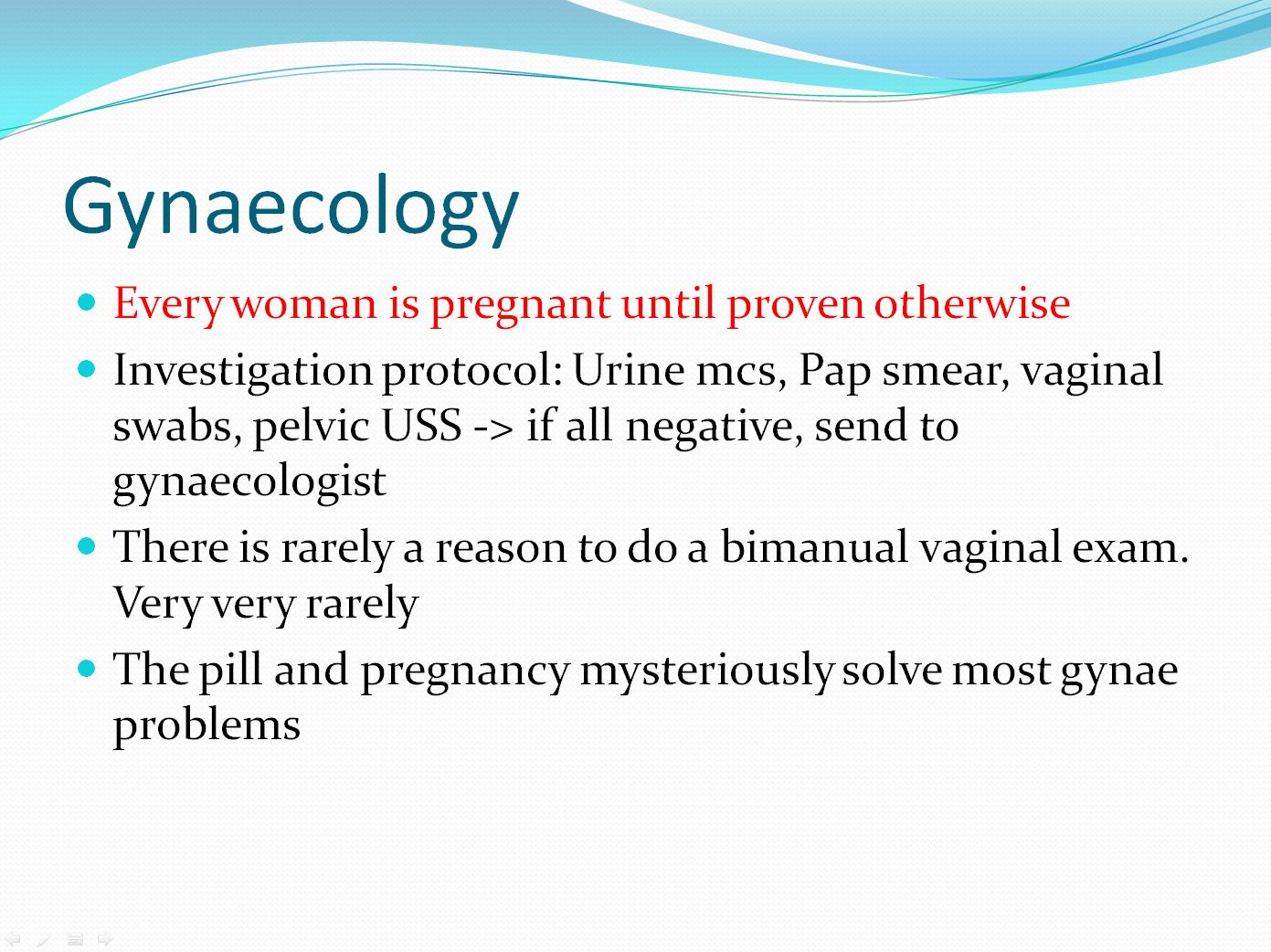
A few weeks ago I wrote a mock lecture for a friend who is a nurse to “upskill” her into becoming a doctor. It was something I wrote in jest with the intention of training her to do my job (so she could see my patients while I went home to sleep). I was going through the files on my computer today when I found that “lecture” again, and I got to thinking how actually, it’s not that hard to do my job! I will show you now why I say this, incorporating part of my lecture. Think of this as something like the general practice version of the 'The House of God' rules :P


Yes, these treatment options apply to everything.

OK, now that the basics are covered – and remembering that the safest thing you can do in general practice is to do nothing, here is a more detailed (using the term ‘detailed’ in a very loose fashion) run down on the medical aspect of illness, by organ system.


Now, if you remember just a few of those things, you have very close to the medical knowledge of an Australian-trained GP. (You don’t even really have to worry about knowing how to do a physical examination. I mean, have a look at rashes and things patients like to show you, but it’s rarely going to be essential that you lay even a hand on them!)

Sunday, November 11, 2012

On asking the clinically-relevant questions


There's a question out there in medical land that apparently asks whether you are racist or not. The question is: "Do you identify as of Aboriginal and/or Torres Strait Islander background?" Now, the response to this question  – which in Australia IS of clinical relevance – is not what matters, but the fact that some people are unwilling to ask this question in this first place for fear of "offending" a person who isn't of this background.

Fear of offending a racist person is the reason some people give as to why they feel uncomfortable asking the question. They imagine they may encounter a racist person who'll take offense at not clearly being identified as non-indigenous. More specifically, though, they fear that they'll meet a non-indigenous person who they will offend by implying the negative stereotypes associated with people of Aboriginal and/or Torres Strait Islander backgrounds. But who's given this question that connotation? The racist person who holds those prejudices – and that is the person fearing to ask the question! You don't know the strangers mind that you'll be asking, only that you imagine it may believe what you (either consciously or subconsciously) believe yourself.

And briefly before I leave this topic, let me explain why I say that it is clinically relevant to know whether a person is of Aboriginal and/or Torres Strait Islander background. In Australia, there is difference in the life expectancy, the mortality rate, and the burden from disease between indigenous and non-indigenous Australians. This difference is commonly referred to as “the gap” between indigenous and non-indigenous Australians. Clinically, a person may be more likely to suffer from one or another illness (e.g. diabetes mellitus) if he comes from an indigenous background than if he doesn’t, and his/her symptoms may be more likely to be caused by a disease that is more prevalent in those of indigenous background than those that aren’t. This is turn is relevant to both the adequate diagnosis and treatment of this person’s illness. Further to that, the government may have incentive programs aimed at “closing the gap” in the health of indigenous and non-indigenous Australians, some of which can be quite helpful in allowing indigenous persons to overcome some other indirect/social difficulties in accessing adequate health care. So, asking whether a person is of Aboriginal and/or Torres Strait Islander background needs to remain a relevant clinical history-taking question, and one devoid of prejudice from the person who has been tasked with the job of looking after the health of a community consisting of people of all types of backgrounds. And perhaps we should stop fearing to encounter a racist person if it will only make us become the racist one ourselves.

Sunday, November 4, 2012

On my religious and spiritual journey - Part 3/3

When I started re-evaluating my concept of God and what his will was, I went back to basics. I remembered a scripture in the bible of when Jesus was explaining the purpose of what Mosaic law meant. The law given to Moses had hundreds of commandments of what the Jews had to do and not to and when, etc. The purpose of it all was to ensure that the Jews worshipped God in a certain manner and also that they be protected from harm. Then Jesus implied that after his death, Mosaic law was to be abolished and he said that the whole of God's will can be summarized in only two commandments (not the hundreds given to Moses): 1) Love only God as god, and 2) Love each other as God loves you. That was it.

I concluded that God's will had nothing to do with guilt, and guilt was not a virtue to God! Sure, the bible still has those commandments about how to practice his worship and no idolatry, no fornication, etc, but also it tells me that God does not ask of me any more than I can give and that He will be the only one to judge my sins, errors, behaviors etc. I am not God; I have no place trying to judge other's sins or punishing myself for my own. God who knows what is in my heart, my intentions, why I do the things I do, why I desire the things I do, I believe is the only person fit to pass judgement on me. And that is my "new" thinking. That is how I came to stop feeling depressed about having to make religious sacrifice and how I overcame my guilt for just being human. If I had to do it all over again, I don't think I'd pick a different faith, I'd hope I just merely came to this conclusion faster.

So what is my philosophy? As I’ve discussed previously, my personal values are my family, participating in and enjoying life while I am alive, and not making a world a worse place for anyone or anything. I believe in God, but I also believe in humanity. I believe human's greatest quality is our ability to think and reason for ourselves. I sometimes meet with a religious group whose ideology I mostly share and I call myself a Christian because I do believe in the Bible being a holy book and I aim to follow the guidance provided in it by Jesus Christ. I worship God because I am grateful to him for all I believe he has been responsible in my life. I follow the things the Bible says because I believe it is wise and its mandates are for my overall good. I’m not scared of God that he will punish me in any way because the God I believe in is understanding, merciful, forgiving, and not vengeful. I believe he is far too grand to be offended or hurt by the actions, words, or thoughts of one little person as I am. I understand also that my belief in God may be mythical, as real as he feels to me. So I hold nothing back from this life that I may experience it in an afterlife that I am not 100% guaranteed will actually happen. Once upon a time perhaps my faith was stronger, but for now this is the God and the rules and the values I believe in. This is the type of God I respect, and the type of God I want to emulate.

I love God. My God. I love the type of God that lets me love him and not at the exclusion of also loving myself.


Sunday, October 28, 2012

On my religious and spiritual journey - Part 2/3

If it weren't because of the lack of contact with other believers and an ever deeper instruction in them, I would have joined a Jewish or Buddhist religious organization. I did wish that Judaism had reached out to me further rather than feeling that it was not a religion that encouraged new members from other cultures/ethnic group. So I delved further into going with what was around me, which was for a long time was only Catholicism. I asked a lot of questions and mostly I was shut down because, I was told, some things I just had to accept and believe rather than understand.

Only one religious group welcomed my questions and actively sought to reason with me using a holy book (the bible), "logical" deduction methodology, and my own knowledge of the world and science, etc. This group's philosophy and people welcomed me and I welcomed all their doctrines into my life too. The fact that I welcomed it too shaped the next few years of my life. Many of these group's ideals had been my pre-existing ideals also so that certainly helped to adopt this new religion. It interpreted the bible's New and Old Testaments largely literally - and it even tried to show with historical and scientific correlation how this text / prophecy was a true document that should inspire my belief and obedience. And I still to this day believe it is so, either in spite of or because of my academic background in science.

I came to believe that the bible was a document worthy of my respect and belief, and I believed then that I must do the things it says that I do and don't do in this life. Obeying bible advice was at times instinctive, but often contradictory to what I wanted and desired. No other aspect I think was more pronounced for me than its concept of "fornication" or sex outside of a traditional marriage. That was certainly not instinctive! Yet for very many years I bared my stake/cross and sacrificed my desire for sexual intimacy for the sake of not displeasing the God I had learnt about in the bible. I still don't feel that this sacrifice was in vain or bear resentment of it, but rather I am still proud (and amazed) that I was capable of such dedication, commitment, and self-control for all those many years.

If you asked my why I joined the religion I did (and I'm not talking about Catholicism, which I inherited and never chose), I would say it was because it was the one that to me seemed to have a concept of God and practice that I thought would most resemble a God that I could respect. This God (and this religion) encouraged my questions and helped me find the answers in a book believed to be inspired by God. He was also a God that had many good qualities, that encouraged new followers, and that gave commandments that were meant to benefit me and not merely fill me with guilt. I liked this God, and I liked what he stood for.

Over time I found myself becoming more and more unhappy, depressed, feeling guilty all the time. This was because I was finding it increasingly harder to do what God asked of me and it was really weighing me down. The more I tried to be a good Christian, the more it hurt. I became depressed. There were many reasons that culminated in my depression, but my spiritual beliefs should have been my saviour not the lead weighing me down further. Then I finally put the pieces together to my inescapable depression: one of the main characteristics of depression is undue guilt; and yet one of the tenets/virtues of Christianity is to feel guilt!

In Christianity it is believed that Adam and Eve were guilty of the the original sin (disobedience) and from them all human beings have inherited both the tendency to sin and guilt for this sin of theirs. Do you know how hard it is to overcome depression when you continue to feel guilty? I can see the futility of my thinking now, but for a long time I had no idea why so many of my other co-worshippers were suffering depression too. Guilt will eat you alive! Now, I'm certainly not saying that all cases of depression are due to undue religious guilt, but taking to this concept of Christianity as passionately as I once did does push you further down into a black hole. Luckily, I did not stop learning or thirsting for more knowledge and wisdom once I had become a full member of my new religion.

Sunday, October 21, 2012

On my religious and spiritual journey - Part 1/3

I was baptized as a baby into the Catholic Church. This was not my mum's idea and nor did it actually signify anything as to what my life would be as it was purely done out of cultural and family tradition. Growing up my mum taught my siblings and I to be respectful of others, not hurt them physically or verbally, to be respectful of the law, and basically to treat all human beings as equal and as we wanted to be treated in return. She also taught us about this spiritual being called God that we could never see or hear but that we could talk to in prayer to ask for help and guidance in our lives. She taught us about this book called the bible that had all these stories about God and things he had done for other people who were "good" and others who were "bad". As a result of that I concluded that I wanted to be "good" to please this God being and have his blessing and not upset him and have his punishment in the future, which mostly meant after I was dead. She didn't teach us religious rituals or ritualistic prayers like those practiced in the Catholic Church as she herself did not believe they served any purpose.

When I was seven or eight it was decided that it would be nice for me to get to wear a pretty dress, like other girls in our town did, and partake in Catholic communion. Like my baptism as a baby, it was more about tradition than any religious or spiritual symbolism. A few kids and I met for a few weeks with a very nice and respectable member of the church to learn from an illustrated book about Catholic rituals and a bit more about the stories in the bible about angels, Jesus, his mother Mary, and also about how the communion ceremony would proceed in a few weeks. We rehearsed the ceremony and learnt some Catholic prayers and hymns. My mum had a really pretty white dress prepared for me. I still remember some of the songs we sung and the part of the communion ceremony where I forgot everything we had rehearsed for it, specially of what I was supposed to say to the priest the first time I took the Eucharist and he said something about the "body of Christ". I was completely blank standing in front of him and wondering what I was supposed to say back to him so that he would give me that sticky wafer. I remember he kept asking me over and over again, changing the intonation of his voice to a slightly more angry one, and I couldn't think of anything to say back to him. At one point he inflected his voice to sound like it was a question "body of Christ?" and I thought I had finally figured out the answer. "Yes", I said. No, he repeated it again and then asked if I didn't know how to answer properly. I said, "Yes, please". Finally a child standing behind me in line said to me "you have to say Amen". Finally I said it and the priest gave me the Eucharist, but before I walked away he asked who my communion teacher had been. I can laugh at it now but for years I felt guilty that I had gotten Cesar, my teacher, into trouble by forgetting the word "Amen". (Guilt, mea culpa, and penance were some of the catholic "traditions" of christianity that Cesar had also taught me.) At the end of it all, everyone commented on how pretty I looked in my communion dress, and that to myself and my family is all Catholic communion meant: a chance to wear a pretty dress in front of a lot of people. My baptism had been my grandmother's idea (my mother thought it was a waste of time because I was a baby and I would have had no idea about Christianity), and my communion was town tradition mixed in with vanity.

I completed my Catholic "confirmation" when I was about 10 years old or so. This time it was one my aunt's idea for whatever reason that one my brothers, her son, and I all partake in this ceremony. Again, I had to go to catholic Sunday school for a few weeks. We learnt from another illustrated book about angels, catholic rituals, and Jesus. The book was very colorful and I liked the drawings in it. We also had to go to confession where you'd tell the priest bad stuff you've done and, as if he was some sort of authority, he told you that God would forgive you if you repeated some ritualized prayers so many times. I hated going to it as I had to think for ages on what I could possibly have to feel guilty about at 10 or 11 years old so I could feed to the priest at confession. After some weeks, the communion ceremony was held and we got given little certificates, a little badge with a dove on it, and we took heaps of photos in our nice clothes. Our school principal was at the ceremony and participated in it, which I didn't like because he was very mean to everyone at school and often hit the boys' hands (and once mine also) with a wooden ruler for misbehaving. I thought he was a hypocrite and not a good person, even though he was apparently a good Christian. I knew, though, even at an early age, based on what mum and not any of my Catholic teachers had taught me, that it was not my place to judge him.

After arriving in Australia, I attended a catholic primary school (with the principal I spoke about) and then a catholic high school. High school for me was such a massive change from what I had been in primary school. I finally got over my shyness and I started to form my own ideas about life, etc. As any other teenage kid, I started challenging my superiors and rebelling just for the sake of rebelling. At school I wanted to challenge my religion teacher's doctrine, and at home I wanted to challenge mum's. My mum had started to become involved with a Christian group that went very much against idolatry and religious rituals. I began to wear a crucifix I was given at school as a necklace to irritate her. At school, I would question my religion teacher about some of the scriptures I'd overhead mum learning about at her home bible study and other things I had learn at Catholic Church too. I asked my teacher about worshipping a cross or a manmade icon when God had strictly forbidden such behaviour to the Israelites in what is commonly called "the Ten Commandments", or why I had to call the priest "Father" when Jesus had insisted that not even he (allegedly God's son) be called this let alone any other human being, or why had to talk to the priest to ask for forgiveness and not directly to God if God allegedly loved me and was all-powerful and so should be able to hear my prayer directly, etc. etc. I admit most of the time I was just trying to stir people, my religion teachers or my mum and her friends from her new Christian group, but underneath it all, I guess I was also curious about religion and spirituality. Gradually I started to become more and more interested in theology.

By the time I was 17 I was very much into reading about different religions and theological belief systems. I found Christianity particularly fascinating in that so many hundreds of denominations exist with slightly (or very) different focuses, practices or rituals, and interpretations of what is essentially the same story in one book. The common origin of Judaism, Islam, and Christianity seemed so enthralling to me. The more human-oriented philosophy of Buddhism and Eastern traditions inspired me to wonder more about what is "humanity" in humans. And the polytheist religions both inspired disbelief (because it was so foreign to all I'd ever learnt with only one God) and curiosity as to how models of religion and spirituality are constructed by the minds of human beings. By the end of my schooling and soon after starting university, I was sure I'd one day I'd either join Judaism or Buddhism. I was a lot more preoccupied with religion in my teenage years than in what other teenagers were interested in; yet not completely. Sex interested me. It interested me in the normal way, and it interested me in the way it was so closely related to spirituality in most religions.

Sunday, October 14, 2012

On owning a house


I have always been scared of owning a house, but until the last week I haven’t really been able to explain it even to myself. Everyone has always told me that I should want to own “my own” home, that it’s the adult thing to do, that it’s the Australian dream, that it’s the successful person’s dream, that it’s the most financially savvy thing to do, etc… And yet at the same time knowing that it’s not my dream, I thought that I may be lacking something: maybe maturity, maybe the drive to think big. The thing is that I have rarely met people who “own” their houses, just a lot of people who think they own homes and really only own mortgages. In other words, in my eyes I know a lot of people who own large debts. I also, and not coincidentally, know a lot people who feel enslaved to jobs they no longer enjoy, a lot of people who feel a constant pressure that if they don’t earn they will lose a large sum of money and pride. I know a lot of people whose prisons are their jobs for the crime of loaning large sums of money to buy the illusion of owning the structure they take shelter in. Is the illusion worth it? Is a house really worth the slavery most people submit to for 20-30 years? But, people tell me, I am missing the point. See, they tell me, at the end of it you’ll own the house! And you were already going to be pay rent, so may as well use that same money you were already going to spend on the same thing (shelter and a living space) towards something you will eventually own. Yes, something I will own when I am over 50… and which serves me for what? Oh yeah, to live in. That’s it. That’s all the good I can see come of this.

But wait, you don’t have to just own one house, you can own several. You can own one and rent the other/s, or resell them at a higher price. And if you’re smart, you can earn a profit from doing this. Profit? Yes! Of course that is how people like Donald Trump have amounted massive amounts of wealth. However, I have to admit that I haven’t met many Donald Trumps. At the very least I haven’t met anyone who is made happy purely by the fact that they own many properties or have a lot of money. Is my view in this skewed? Yes, for two reasons: 1) I don’t know a lot of people who are made happy by money or property because I don’t share the same values as them and so don’t associate or attract these people as friends; and 2) it means little to me or my happiness how much money or property I own. If I am to be convinced that owning property is going to be beneficial to me, I have to be able to see how it would help fulfill me; unfortunately the properties and the money to be made from them would not make me feel more fulfilled.

What do I care about? My family, participating in and enjoying life while I am alive, and not making a world a worse place for anyone or anything. Call it Christian values or call it hedonism or my own particular philosophy, but it’s as simple as that for me. Yet wouldn't having more money allow me to spend greater time with my family, or “enjoy” life more, or participate in life to a greater extent, or increase my likelihood of what I could do to improve social justice or the environment? Probably. And don’t get me wrong, I usually support thinking “long-term”, but I have come to realise that life is actually not that long. Perhaps it’s as a result of the environment I grew up in with the life-expectancy of those around me being so unpredictable due to poverty and warfare, or perhaps it’s because of the job I do, but I think it’s not always wise to put off living. I genuinely worry that if I spend too much time engaged in earning (to provide for my family or enjoying life, etc), I may well miss out on my family or the time to enjoy life. Sure, most of us in Western society can quite safely expect to live past the time we would've finished paying our mortgage and past retirement, but should we really wait until then to start enjoying the profits of our labour? Maybe it is my yet immature thinking or the fact that I don’t yet have children that clouds my vision, but I don’t want to it put off too long.

Now, what if -worst case scenario- and I work, pay off my mortgage, and then die? Shouldn't I be proud and glad that at least I will have provided for my children a house for them to inherit? I mean, that’s good, right? Sure, that’s noble. How many of us, however, have not inherited houses and still turn out quite OK? I’d say that’s the majority of people. So I’m not convinced at this stage that that is a good reason to own a house. I think it was the billionaire businessman Warren Buffett who said that the perfect amount of money/things  to leave your offspring is "enough money so that they would feel they could do anything, but not so much that they could do nothing”. That is exactly what my mum did for my siblings and I and she never owned a house or anything of that cost; she just made sure to be supportive and educated us. I want to do exactly that for my children. The rest they will provide for themselves if I manage to teach them responsibility and self-reliance well enough.

OK, OK, now back to the financial reasons as to why buying a house would be good for me. I am told that if I continue to rent, then I am throwing away money, that it is “dead money”. Dead because I can’t profit from it, apparently. But you know what else is “dead money”? The money paid on interest on a home loan. Yes but I’m forgetting about the part where I get to keep my house after I have finished paying the bank back the loan and the interest! Yes, that’s nice, don’t get me wrong; and I do get the fact that you can do whatever you like to a house you have a mortgage on as opposed to one that you’re renting. For all the money I “throw away” by renting, I could be slowly paying off my house, wouldn't that be nice? Yes… if things in life could be guaranteed. I wish someone could guarantee that I will want to work with the same agility, strength, passion, and desire in 10, 20, or 30 years as I do now. Because if I lose my enthusiasm, that is when work becomes my jail for the crime of owing my house to a third party: the banks.  So most people have to keep working in order to avoid defaulting on their loans, working past the time that work became enjoyable, and working with the pressure and fear of keeping the bank fed. That is stressful! It kills the joy in life. How do I know this? Precisely because I meet people who are overwhelmed by these stresses every day at work.

I know there is stress also to pay the rent if you are renting, but I have noted one fundamental difference between those who are happy to rent and those who want to own a house: those of us who rent may stress about getting the money together at the end of the month also, but we don’t share the stress of potentially losing a large sum of money that people who default on loans take on. When you’re renting and you move house, that is it; you pay again for the chance to occupy a space you can live in. Renting is the same as any other consumer product. When we move house or as time goes by, rarely do those who rent sit to add up all the money we have “lost” by continuing to pay our rent. It is the same way that I don’t feel bad when I buy food that I have spent a small amount of money for something that is gone after I eat it when I could have instead put the money aside to buy a farm so that I could grow my own food, which eventually will overall turn out to be cheaper than all that food I bought over the years. Housing to me is just another consumer product. But those who have a mortgage and are unfortunately unable to keep paying it for whatever reason, end up owing a lot of money – and that scares me! Houses cost a lot of money and I don’t enjoy the pressure of having a debt that big.

I met someone a few years ago that told me that he was overwhelmed by the amount of work he had to do in order to provide for his family and maintain all the properties he owned. I asked him why he had so many houses. He said that it was because that was the Australian dream. It wasn't his dream, though. And I started wondering to myself ‘who is selling us these dreams, then?’ And then I read an internet post recently that answered this question and summarised the financial reasons of my fear of getting a home loan: “It is necessary that you be forced deeply into debt, and therefore forced into slavery, for the banks to make a profit”.